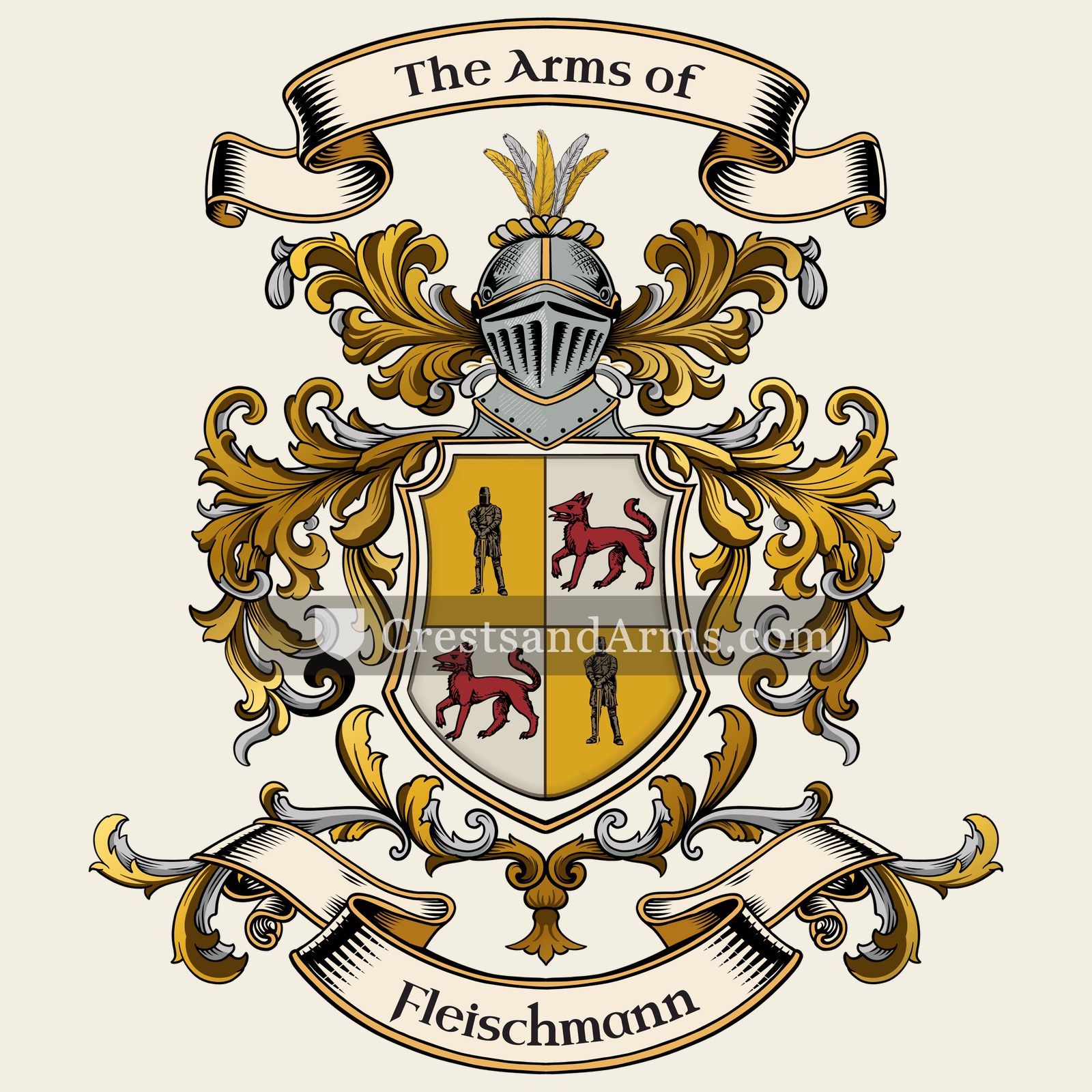
A record of documented arms, meaning and origin, researched for the Fleischmann family of Germany.
Reg. 3281 · German, D–F
Coat of Arms & Family Crest Details
Symbols on this shield
knightChivalry and service in arms
wolfReward from long service and hard work
Colours
Gold (Or)Means: Generosity
Silver (Argent)Means: Peace and sincerity
Red (Gules)Means: Military strength
Historical info
Source
J. B. Rietstap, Armorial Général, Gouda: G. B. van Goor Zonen, 1884–87
Blazon (the actual original written record)
“Ec.: aux 1 et 4 parti d'or et d'azur; à un homme iss., hab. d'un parti de l'un en l'autre, coiffé d'un bonnet aussi de l'un en l'autre, tenant de sa main dextre une hache de boucher au nat.; aux 2 et 3 d'arg. à un loup naiss. de gu., tenant de sa patte dextre un marteau de cordonnier de sa. Cq. cour. C.: le loup, iss., entre un vol, l'aile dextre d'or ch. d'une barre de gu. et l'aile sen. d'azur ch. d'une bande d'arg. L. conformes aux émaux du vol.”
GermanyPalatinat, c. 1654
Digital archive packCoat of arms PNG, gold border print PDF, vector SVG and the certificate of authenticity. Sent to your email in minutes.
Map of Germany showing where the Fleischmann arms are recorded
The Fleischmann arms were recorded in Palatinat, c. 1654.
This is where the arms were entered in the register. Families often moved to other parts of the country, so the same name can turn up in more than one region.
The body that granted and recorded arms in Germany in this period.
Ferdinand III, Holy Roman Emperor
Sovereign of the period
Ferdinand III, Holy Roman Emperor
1637–1657
Reigning in Germany when the Fleischmann arms are first recorded.
How Arms Worked in Germany
In the Holy Roman Empire, coats of arms were often granted to individuals by the Emperor or his representatives. These arms were then passed down through the generations to all legitimate descendants of the original holder. Younger branches of a family usually kept the same shield design without needing to change it, as the arms belonged to the entire lineage.
Granting authority
The Holy Roman Emperor held the sole power to grant new coats of arms throughout his vast imperial territories.
How they got arms
Families typically obtained their coats of arms through a formal imperial grant or by proving their noble status to the authorities.
Where arms were recorded
These grants were officially recorded in the Imperial Chancery registers, which began keeping formal records of such honors during the Middle Ages.
The family's standing
Recorded among the armigerous families of Germany.
Origin & History of the Fleischmann Family in Germany
The surname Fleischmann is a classic German occupational name that translates literally to meat man or butcher. During the Middle Ages, surnames were often adopted to describe a person’s trade, and this name identified individuals who worked in the meat processing or selling industry. By the year 1654, records confirm that members of the Fleischmann family were well-established in the Palatinate region of Germany. This area, known as the Pfalz, was a significant hub for families during the seventeenth century, though it was a period marked by great instability due to the aftermath of the Thirty Years' War. Families living there at the time were often resilient farmers or tradespeople who helped rebuild local communities after years of conflict. The presence of the Fleischmann name in these early church and civil records highlights a long-standing history of families who maintained their professional identity across generations in the heart of the Rhineland.
Fleischmann Meaning & Related Branches
Root word
Fleisch
German word for flesh or meat.
This name
FleischmannAn occupational surname for a butcher or someone who sold meat.
also spelled
Fleishman
Fleischman
Flashman
Related arms
Fleichmannvariant spelling
Documented Sources
J. B. Rietstap, Armorial Général, Gouda: G. B. van Goor Zonen, 1884–87
Bahlow, Hans, Deutsches Namenlexikon: Familien- und Vornamen nach Ursprung und Sinn erklärt, 1967
Bremm, Klaus, Die Pfalz: Eine Geschichte, 2012
Landesarchiv Speyer, Kirchenbücher der Pfalz (Church Records of the Palatinate), 1650–1700
Digital archive packCoat of arms PNG, gold border print PDF, vector SVG and the certificate of authenticity. Sent to your email in minutes.


 knightChivalry and service in arms
 wolfReward from long service and hard work
 knightChivalry and service in arms
 wolfReward from long service and hard work