Map of France showing where the Fleury arms are recorded
The Fleury arms were recorded in Lorraine, c. 1523.
Lorraine sat on the border between France and the German lands, and border country bred soldiers. Families here held small estates and served in arms, and a fighting man was exactly the sort who carried a shield of his own.
This is where the arms were entered in the register. Families often moved to other parts of the country, so the same name can turn up in more than one region.
The body that granted and recorded arms in France in this period.
Francis I of France
Sovereign of the period
Francis I of France
1515–1547
Reigning in France when the Fleury arms are first recorded.
How Arms Worked in France
In France, a coat of arms was a mark of honor that passed down through the male line to all legitimate descendants. Families often used the same shield without changes to show their shared heritage. If a branch wanted to stand out, they could add a small mark to their shield to show their specific place in the family tree.
Granting authority
The Juge d'armes de France acted as the official authority that regulated and verified coats of arms across the country.
How they got arms
Families typically inherited their arms from ancestors, though they could also receive them through royal grants or by proving their noble status.
Where arms were recorded
Coats of arms were officially recorded in the Armorial Général de France, which began its main collection in the year 1696.
The family's standing
Recorded among the armigerous families of Lorraine.
Origin & History of the Fleury Family in France
The surname Fleury originates from the northern regions of France, where it developed as a topographic name linked to the Latin word floretum, meaning a place where flowers grow. By the early sixteenth century, the family established a notable presence in the province of Lorraine. During this era, Lorraine served as a complex crossroads between the Holy Roman Empire and the French kingdom, which shaped the lives of those living there. Families like the Fleurys often held roles as local landowners or officials who managed the rural estates of the region. Because the name was tied to the landscape, it likely emerged independently in several different areas before becoming a fixed family identity. The movement of these early members through the towns of Lorraine suggests a family that was well-integrated into the social and agricultural life of the French borderlands during the Renaissance.
Coat of Arms & Family Crest Details
Symbols on this shield
fleur de lisPurity, light, and the sixth son
Colours
Red (Gules)Means: Military strength
Gold (Or)Means: Generosity
Historical info
Source
J. B. Rietstap, Armorial Général, Gouda: G. B. van Goor Zonen, 1884–87
Blazon (the actual original written record)
“De gu. à une fleur-de-lis d'or.”
SwitzerlandNeufchâtel, c. 1745
Digital archive packCoat of arms PNG, gold border print PDF, vector SVG and the certificate of authenticity. Sent to your email in minutes.
Map of Switzerland showing where the Fleury arms are recorded
The Fleury arms were recorded in Neufchâtel, c. 1745.
This is where the arms were entered in the register. Families often moved to other parts of the country, so the same name can turn up in more than one region.
The body that granted and recorded arms in Switzerland in this period.
How Arms Worked in Switzerland
In Switzerland, coats of arms were not restricted to the nobility and were often adopted by common citizens and families. These symbols were passed down through generations to show family identity. When branches of a family grew, they often changed small details of the design to distinguish their own line from the original group.
Granting authority
Cantonal and civic authorities managed the use of coats of arms within their specific regions and local jurisdictions.
How they got arms
Families typically assumed their own coats of arms based on local custom rather than receiving them from a central monarch.
Where arms were recorded
Arms were recorded in various cantonal and civic registers starting from the fourteenth century throughout the Swiss region.
The family's standing
Recorded among the armigerous families of Switzerland.
Origin & History of the Fleury Family in Switzerland
The surname Fleury has deep roots in the French-speaking regions of Switzerland, particularly within the canton of Neuchâtel. While the name is of French origin, meaning someone who lived near a flower or a meadow, it became well-established in Swiss communities by the mid-eighteenth century. Official records confirm that members of the Fleury family were living and working in Neuchâtel by 1745. During this era, families with this name often participated in the local trades and agricultural life that defined the Jura mountain region. As the family grew, they integrated into the social and political structures of the Swiss cantons, often serving as craftsmen or landowners. Their presence in the region reflects the broader movement of families across the border between France and Switzerland during a time of significant cultural and economic exchange.
Coat of Arms & Family Crest Details
Symbols on this shield
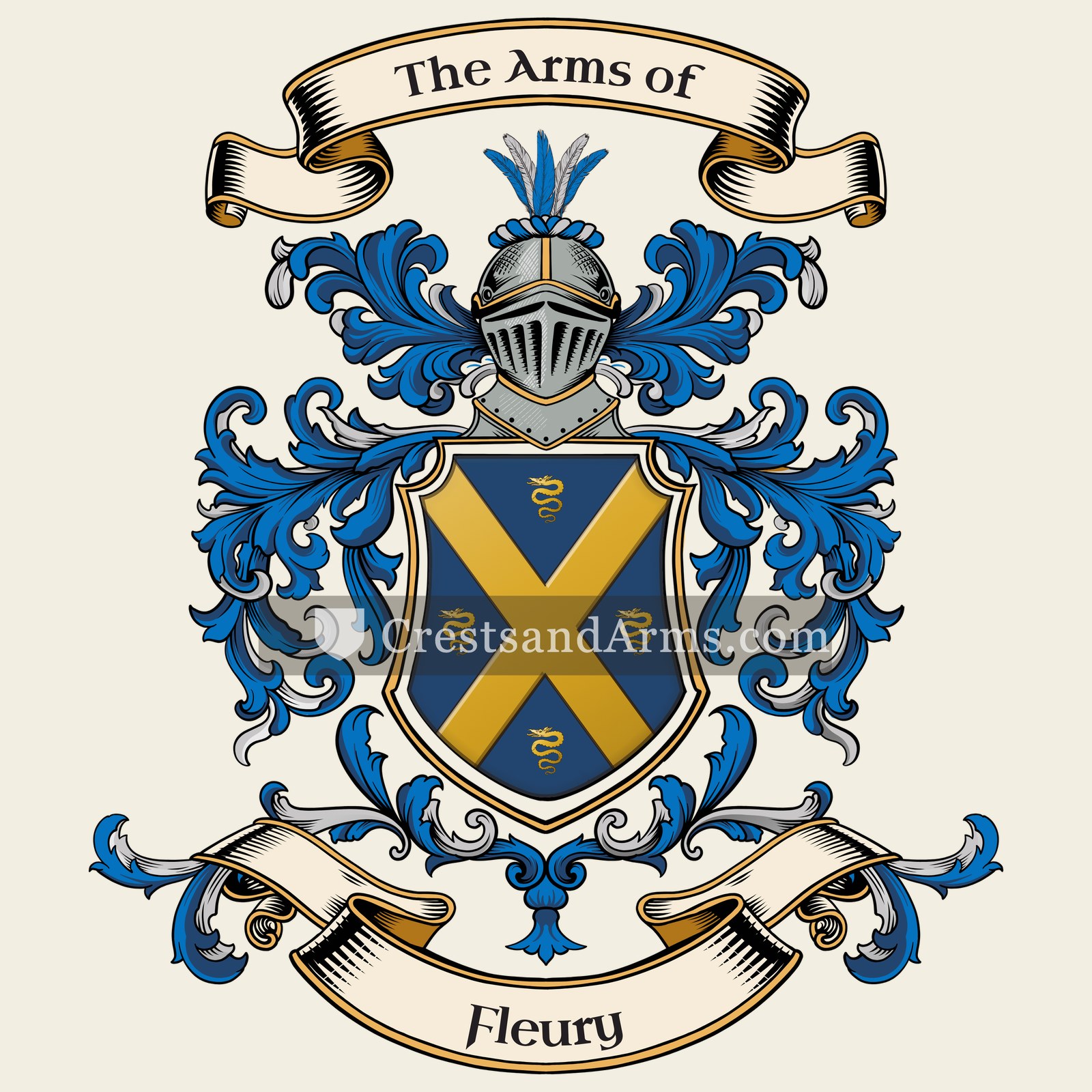
saltireResolution, and St Andrew's cross
serpentWisdom, healing and prudence
Colours
Blue (Azure)Means: Loyalty and truth
Gold (Or)Means: Generosity
Historical info
Source
Sir Bernard Burke, The General Armory of England, Scotland, Ireland and Wales, London: Harrison & Sons, 1884
Blazon (the actual original written record)
“Az. a saltire or, betw. four eels naiant wavy of the last”
Irelandc. 1645
Digital archive packCoat of arms PNG, gold border print PDF, vector SVG and the certificate of authenticity. Sent to your email in minutes.
Map of Ireland showing where the Fleury arms are recorded
The Fleury arms were recorded in Ireland, c. 1645.
Arms such as these were typically recorded in Dublin.
Dublin was the seat of government in Ireland and the place where grants were sought and recorded. Families with business at the castle or the courts settled nearby, and settling there put their arms on record.
This is where the arms were entered in the register. Families often moved to other parts of the country, so the same name can turn up in more than one region.
The body that granted and recorded arms in Ireland in this period.
Charles I of England
Sovereign of the period
Charles I of England
1625–1649
Reigning in France when the Fleury arms are first recorded.
How Arms Worked in Ireland
The Ulster King of Arms granted coats of arms to individuals who proved their social standing and good character. These symbols were typically inherited by all legitimate descendants of the original holder. If a family branch wanted a unique look, they could apply for a specific change to their design through the office to ensure their identity remained distinct.
Granting authority
The Ulster King of Arms acted as the official body that regulated and issued all coats of arms throughout Ireland.
How they got arms
Families obtained their arms through formal grants issued by the office after proving their eligibility and paying the required fees.
Where arms were recorded
All official grants were recorded in the registers held by the Ulster King of Arms starting from the year 1552.
The family's standing
Recorded among the armigerous families of Ireland.
Origin & History of the Fleury Family in Ireland
The Fleury family name has a distinct history in Ireland that traces back to the mid-seventeenth century. Records confirm that members of the family were established in Dublin by 1645, a period marked by significant social and political upheaval in the city. The name itself is of French origin, typically associated with people who lived near flowering meadows or fields. When these individuals arrived in Ireland, they often integrated into the professional and merchant classes of Dublin. Over the following generations, the family became deeply rooted in the local community, moving beyond their initial arrival to play active roles in the civic life of the capital. Their presence in Ireland reflects the broader pattern of migration that brought diverse European families to the region during the seventeenth century, where they eventually adopted Irish customs while maintaining their unique ancestral identity.
Fleury Meaning & Related Branches
Root word
flos
Latin word meaning flower or blossom.
This name
FleuryDerived from a place name meaning flowery or abounding in flowers.
also spelled
Fleurie
Fleurye
Fleuris
Flury
Fleurey
Related arms
Parisetsame arms
Bernon de Seyressimilar arms
Beruonsimilar arms
Documented Sources
J. B. Rietstap, Armorial Général, Gouda: G. B. van Goor Zonen, 1884–87
Dauzat, Albert. Dictionnaire étymologique des noms et prénoms de France. 1951
Morlet, Marie-Thérèse. Dictionnaire étymologique des noms de famille. 1991
Archives départementales de Meurthe-et-Moselle. Série B: Cours et juridictions. 1523
Digital archive packCoat of arms PNG, gold border print PDF, vector SVG and the certificate of authenticity. Sent to your email in minutes.


 lionCourage, strength and royalty
 lionCourage, strength and royalty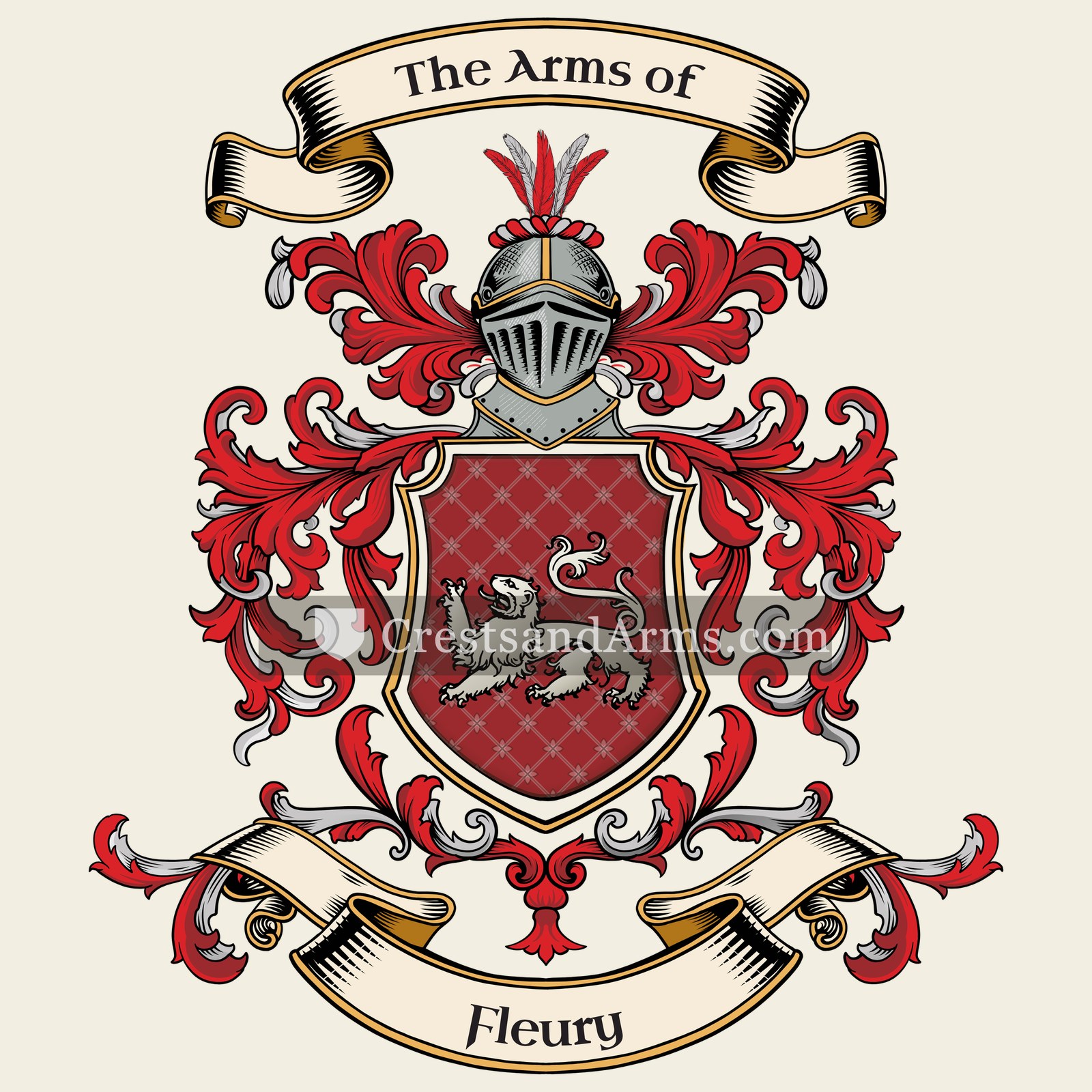


 fleur de lisPurity, light, and the sixth son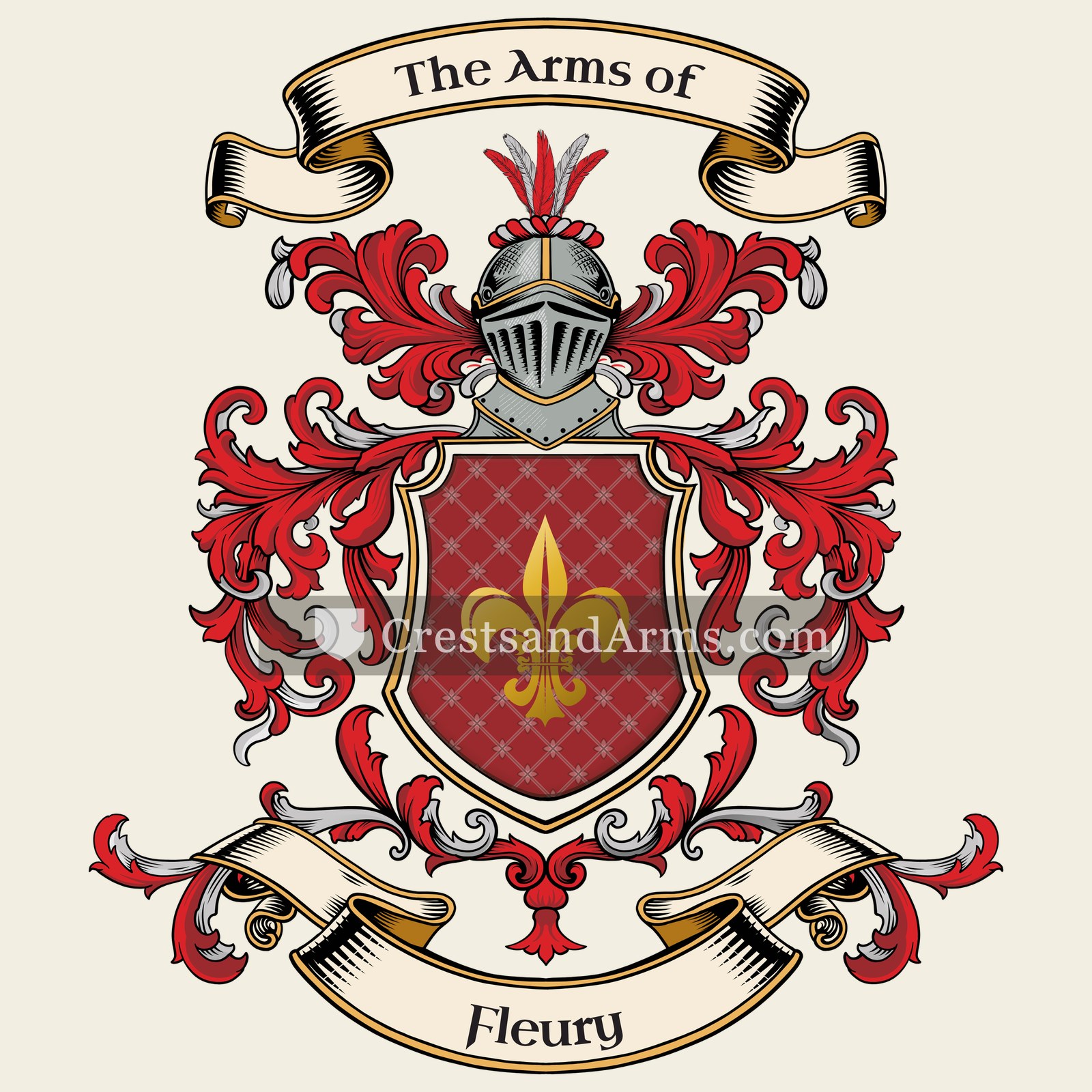

 saltireResolution, and St Andrew's cross
 serpentWisdom, healing and prudence