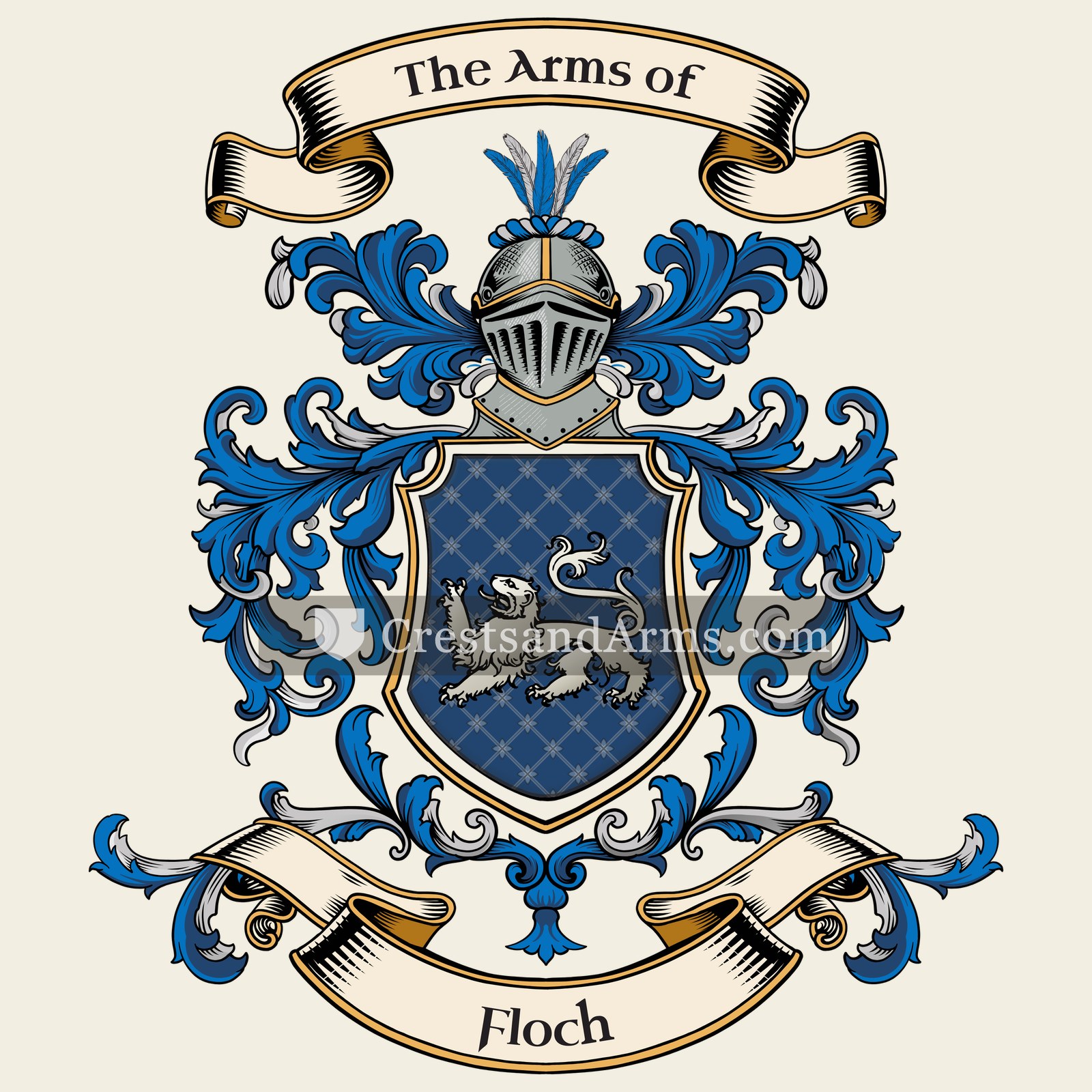
A record of documented arms, meaning and origin, researched for the Floch family of Austria.
Reg. 0791 · Austrian, D–F
Coat of Arms & Family Crest Details
Symbols on this shield
lionCourage, strength and royalty
Colours
Blue (Azure)Means: Loyalty and truth
Silver (Argent)Means: Peace and sincerity
Historical info
Source
J. B. Rietstap, Armorial Général, Gouda: G. B. van Goor Zonen, 1884–87
Blazon (the actual original written record)
“D'azur au lion d'arg., tenant de chaque patte un bâton fleurdelisé d'or. Deux cq. cour. C.: 1° le lion, iss. et cont.; 2° un vol de sa. L.: d'arg. et d'azur.”
Austriac. 1797
Where the Floch Arms Were Recorded
Tyrol
Map of Austria showing where the Floch arms are recorded
The Floch arms were recorded in Austria, c. 1797.
Arms such as these were typically recorded in Tyrol.
Tyrol was mountain country in western Austria, where the valleys were held by families who had been there a very long time. Old tenure counted for more than money, and old families carried arms.
This is where the arms were entered in the register. Families often moved to other parts of the country, so the same name can turn up in more than one region.
Region
Tyrol
First recorded
1797
Granting Authority for the Floch Arms
Imperial and Royal chancery
Sodacan · CC BY-SA 3.0
The body that granted and recorded arms in Austria in this period.
Francis II, Holy Roman Emperor
Sovereign of the period
Francis II, Holy Roman Emperor
1792–1806
Reigning in Austria when the Floch arms are first recorded.
How Arms Worked in Austria
Austrian coats of arms were often linked directly to noble titles granted by the Emperor. These symbols belonged to the entire family line rather than just one individual. When a family grew, new branches kept the original design without needing to change it. This system allowed all members of a noble house to share the same identity across many generations.
Granting authority
The Imperial and Royal chancery managed all heraldic matters and controlled the official granting of arms throughout the Austrian lands.
How they got arms
Families typically received their arms through a formal imperial decree that often accompanied the elevation of a person to noble status.
Where arms were recorded
Official records of these grants were kept in the Imperial Register of Nobility which began its formal documentation process in 1453.
The family's standing
Recorded among the armigerous families of Austria.
Origin & History of the Floch Family in Austria
The family name Floch has deep roots in the Alpine regions of Europe, with documented evidence placing the family in the Tyrol area by the year 1797. During this period, the region was a rugged landscape defined by mountain farming and strong local traditions. The name itself likely originated as a descriptive term in the local dialects, possibly referring to a person’s physical traits or their specific role within a small village community. Families in Tyrol at the end of the eighteenth century often lived in tight-knit groups, relying on agriculture and trade to survive in the high mountain valleys. As the name spread through these communities, it became a marker of identity for those living under the influence of the Holy Roman Empire and later the Austrian Empire. By settling in this mountainous terrain, the early members of the Floch family became part of a resilient culture that valued independence and deep ties to the land.
Related Branches & Arms
Root word
floccus
Latin term referring to a tuft of wool or hair.
This name
FlochA descriptive nickname for someone with curly, woolly, or unkempt hair.
also spelled
Flock
Flosh
Documented Sources
J. B. Rietstap, Armorial Général, Gouda: G. B. van Goor Zonen, 1884–87
Tiroler Landesarchiv, Tauf-, Heirats- und Sterbebücher der Pfarreien in Tirol
Tiroler Landesarchiv, Grundbuch der Steuerkatastralgemeinden


 lionCourage, strength and royalty
 lionCourage, strength and royalty