Map of Netherlands showing where the Floor arms are recorded
The Floor arms were recorded in Netherlands, c. 1815.
Arms such as these were typically recorded in Friesland.
Friesland was low, wet country on the northern coast of the Netherlands, farmed by families who had held the same land for centuries. Free landholders were unusually common there, and a free landholder could carry arms.
This is where the arms were entered in the register. Families often moved to other parts of the country, so the same name can turn up in more than one region.
Region
Friesland
First recorded
1815
Granting Authority for the Floor Arms
Hoge Raad van Adel
Photograph made by me · CC BY-SA 3.0
The body that granted and recorded arms in Netherlands in this period.
William I of the Netherlands
Sovereign of the period
William I of the Netherlands
1815–1840
Reigning in Netherlands when the Floor arms are first recorded.
How Arms Worked in Netherlands
In the Netherlands, coats of arms were often used by noble families and those who held specific public offices. These arms were passed down through the generations to legitimate descendants. Younger branches of a family usually kept the original design without needing to add special marks. This system ensured that the family identity remained clear and consistent over many years.
Granting authority
The Hoge Raad van Adel is the official body that regulates and manages noble titles and coats of arms in the Netherlands.
How they got arms
Families typically obtained their coats of arms through official royal grants or by proving their long-standing historical use of the symbols.
Where arms were recorded
Coats of arms are officially recorded in the registers held by the Hoge Raad van Adel, which began its work in 1814.
The family's standing
Recorded among the armigerous families of Netherlands.
Origin & History of the Floor Family in Netherlands
The surname Floor has deep roots in the northern provinces of the Netherlands, particularly within the region of Friesland. By the early 19th century, the name was well-established among families living in this coastal area. During this period, the Netherlands underwent significant changes in how citizens registered their identities. In 1811, under French rule, the government required all families to adopt formal, permanent surnames to improve taxation and military conscription records. Many families in Friesland chose names that reflected their local heritage or their daily occupations. The name Floor likely originated as a patronymic or a descriptive nickname that evolved into a fixed family name during this era of administrative reform. These early ancestors were often part of the hardworking rural population, contributing to the agricultural and maritime traditions that defined Frisian life in the early 1800s.
Meaning of the Floor family crest colors & symbols
Symbols on this shield
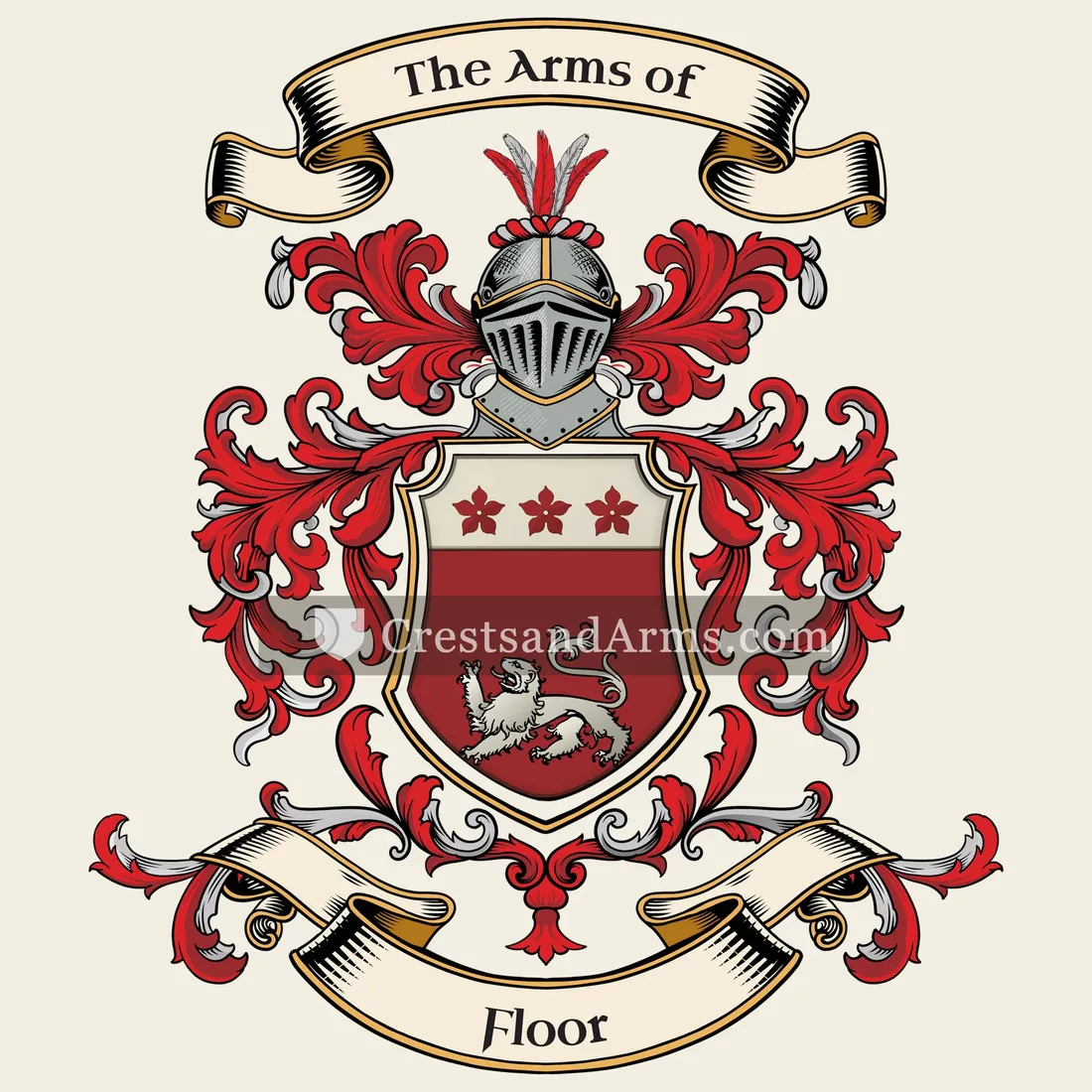
chiefAuthority, wisdom and dominion
lionCourage, strength and royalty
cinquefoilHope and joy
Colours
Red (Gules)Means: Military strength
Silver (Argent)Means: Peace and sincerity
Historical info
Source
J. B. Rietstap, Armorial Général, Gouda: G. B. van Goor Zonen, 1884–87
Blazon (the actual original written record)
“De gu. au lion d'arg.; au chef du même, ch. de trois quintefeuilles du champ.”
FranceCambr, c. 1663
Digital archive packCoat of arms PNG, gold border print PDF, vector SVG and the certificate of authenticity. Sent to your email in minutes.
Map of France showing where the Floor arms are recorded
The Floor arms were recorded in Cambr, c. 1663.
This is where the arms were entered in the register. Families often moved to other parts of the country, so the same name can turn up in more than one region.
The body that granted and recorded arms in France in this period.
Louis XIV of France
Sovereign of the period
Louis XIV of France
1643–1715
Reigning in Netherlands when the Floor arms are first recorded.
How Arms Worked in France
In France, a coat of arms was a mark of honor that passed down through the male line to all legitimate descendants. Families often used the same shield without changes to show their shared heritage. If a branch wanted to stand out, they could add a small mark to their shield to show their specific place in the family tree.
Granting authority
The Juge d'armes de France acted as the official authority that regulated and verified coats of arms across the country.
How they got arms
Families typically inherited their arms from ancestors, though they could also receive them through royal grants or by proving their noble status.
Where arms were recorded
Coats of arms were officially recorded in the Armorial Général de France, which began its main collection in the year 1696.
The family's standing
Recorded among the armigerous families of France.
Origin & History of the Floor Family in France
The family name Floor has deep roots in the northern regions of France, particularly within the historic province of Cambrésis. By the year 1663, records confirm that members of the family were well-established residents of Cambrai, a city known for its strategic importance and vibrant trade culture during the seventeenth century. The name likely originated as a descriptive term or a local occupational identifier, reflecting the way families were often categorized by their neighbors or their specific roles within the community. Living in a region frequently caught between shifting political borders, the early Floor family members would have navigated a society defined by agricultural labor and the influence of the local church. Their presence in the official municipal records of Cambrai suggests that they were recognized citizens who participated in the social and economic life of the city during a time of significant transition in French history.
Meaning of the Floor family crest colors & symbols
Symbols on this shield
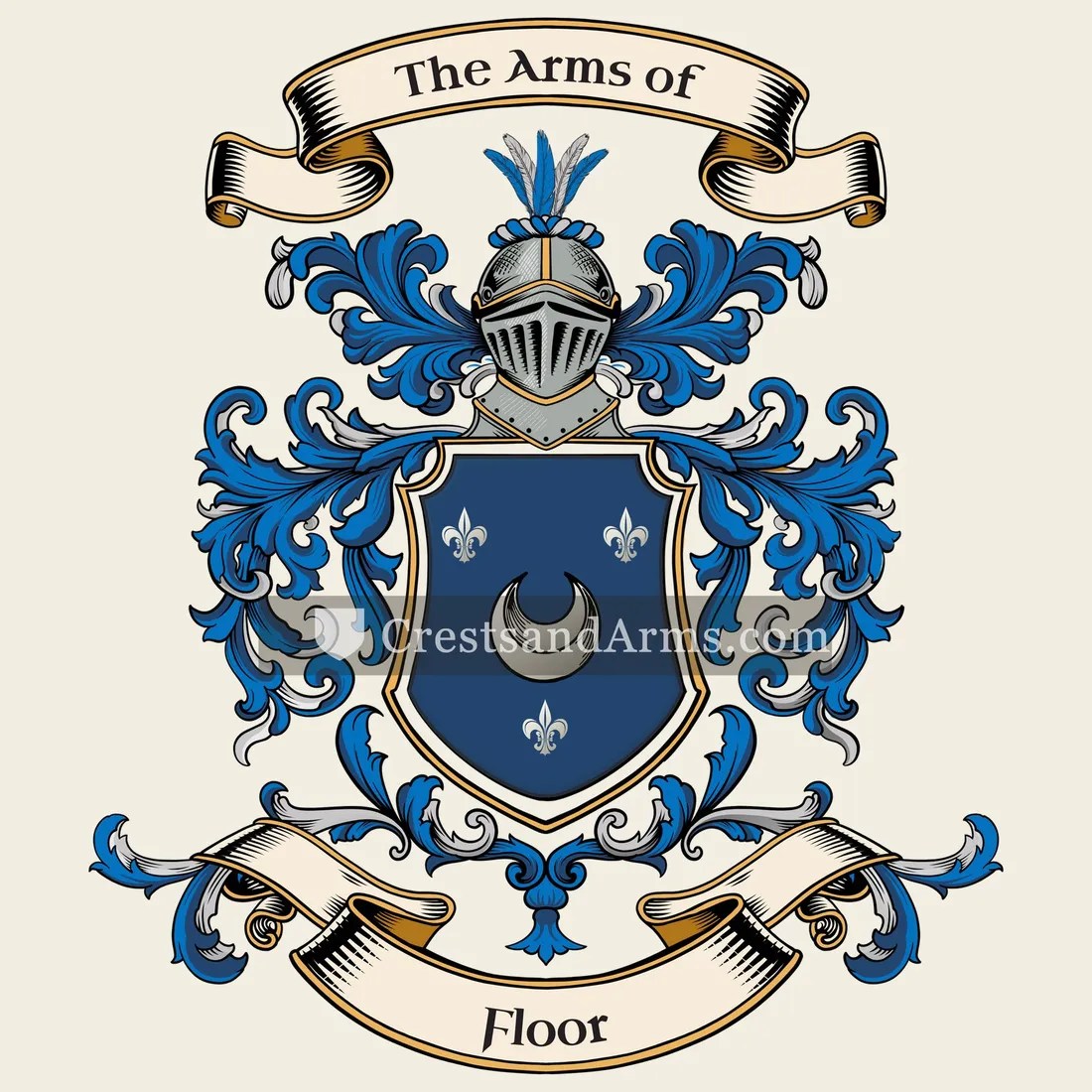
crescentHonour by the sovereign, and the second son
fleur de lisPurity, light, and the sixth son
Colours
Blue (Azure)Means: Loyalty and truth
Silver (Argent)Means: Peace and sincerity
Historical info
Source
Sir Bernard Burke, The General Armory of England, Scotland, Ireland and Wales, London: Harrison & Sons, 1884
Blazon (the actual original written record)
“Az. a crescent betw. three fleurs-de-lis ar. seeded or”
SomersetSomerset, c. 1620
Digital archive packCoat of arms PNG, gold border print PDF, vector SVG and the certificate of authenticity. Sent to your email in minutes.
Map of England showing where the Floor arms are recorded
The Floor arms were recorded in Somerset, c. 1620.
Somerset was rich farming country with a thick scattering of manor houses. Its gentry were numerous and long-settled, and a settled landed family almost always ended up with arms.
This is where the arms were entered in the register. Families often moved to other parts of the country, so the same name can turn up in more than one region.
The body that granted and recorded arms in England in this period.
James VI and I
Sovereign of the period
James VI and I
1603–1625
Reigning in Netherlands when the Floor arms are first recorded.
How Arms Worked in England
English heraldry allowed arms to be shared by all legitimate descendants of the original owner. These symbols were treated as personal property that moved through the generations to all children. While the eldest son kept the original design, other family members could use the same shield without needing to change it or register their own unique versions.
Granting authority
The College of Arms in London has regulated the use of coats of arms throughout England and Wales since 1484.
How they got arms
Families typically obtained their coats of arms through a formal grant from the Crown or by proving their ancient right to them.
Where arms were recorded
All official coats of arms are recorded in the registers kept at the College of Arms, which date back to the fifteenth century.
The family's standing
Recorded among the armigerous families of Somerset.
Origin & History of the Floor Family in England
The surname Floor has deep roots in the English county of Somerset, where records confirm the family was well-established by the year 1620. The name likely originated as a topographic descriptor, used to identify individuals who lived near a specific piece of land or a prominent flat area of ground. During the early seventeenth century, the people of Somerset were primarily engaged in agricultural work, and surnames often served as a way to distinguish neighbors in small, rural parishes. As the family grew, they became part of the local social fabric, contributing to the development of the region through trade and land management. By settling in the West Country, the early members of the Floor family helped shape the local community, leaving behind a legacy that is still tied to the geography and history of Somerset today.
Floor Meaning & Related Branches
Root word
Floris
Derived from the Latin word flos meaning flower or blooming.
This name
FloorA patronymic or shortened form referring to someone associated with the name Floris or flowering.
also spelled
Flori
Florie
Florya
Documented Sources
J. B. Rietstap, Armorial Général, Gouda: G. B. van Goor Zonen, 1884–87
Meertens, P.J., De betekenis van de Nederlandse familienamen, 1970
Van der Schaar, J., Woordenboek van voornamen, 1964
Tresoar (Fries Historisch en Letterkundig Centrum), Burgerlijke Stand van Friesland
Nationaal Archief, Registers van de Burgerlijke Stand (1811-1900)
Digital archive packCoat of arms PNG, gold border print PDF, vector SVG and the certificate of authenticity. Sent to your email in minutes.


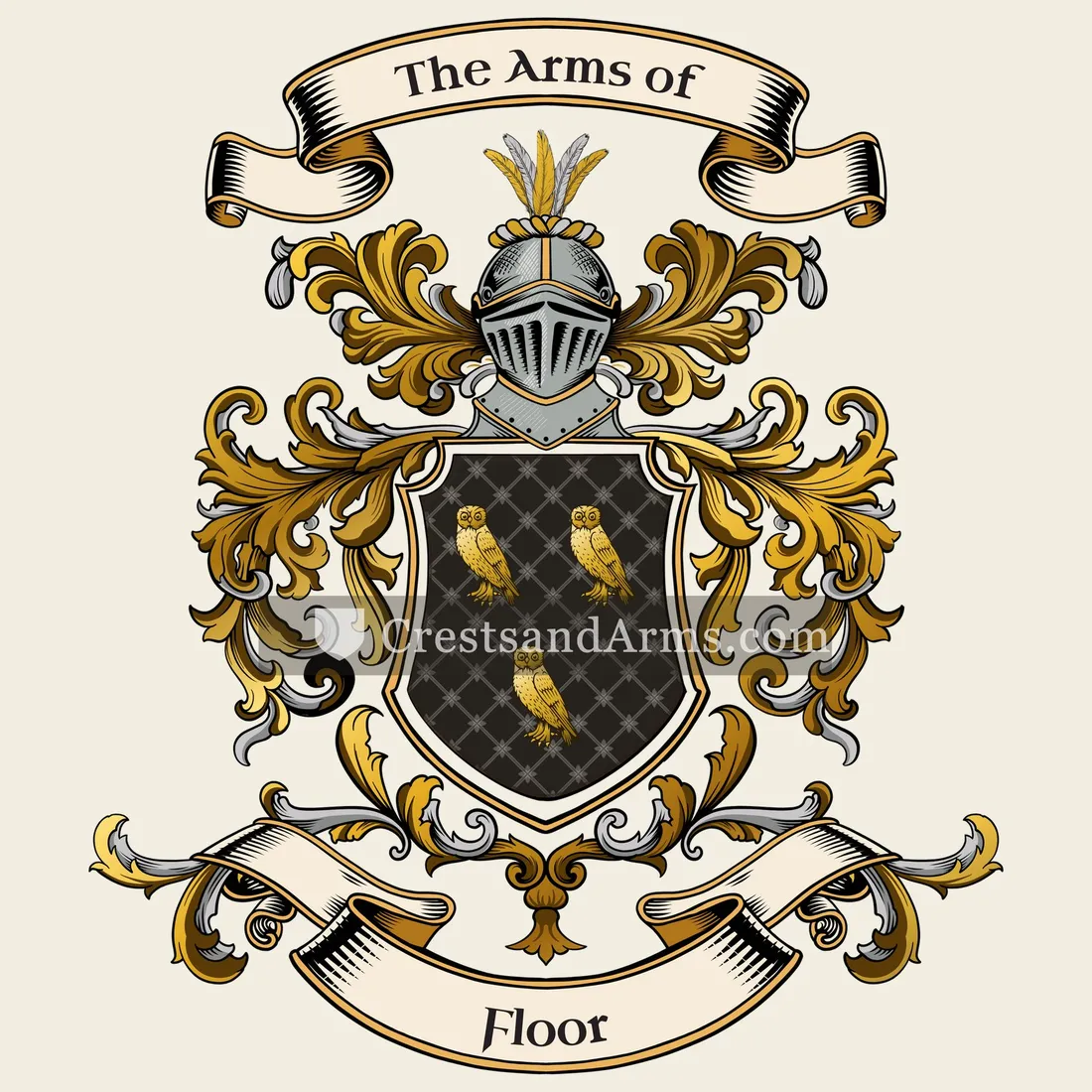
 owlWisdom and vigilance by night
 owlWisdom and vigilance by night


 chiefAuthority, wisdom and dominion
 lionCourage, strength and royalty
 cinquefoilHope and joy


 crescentHonour by the sovereign, and the second son
 fleur de lisPurity, light, and the sixth son