Map of France showing where the Flore arms are recorded
The Flore arms were recorded in Northamptonshire, c. 1642.
This is where the arms were entered in the register. Families often moved to other parts of the country, so the same name can turn up in more than one region.
The body that granted and recorded arms in France in this period.
Louis XIII of France
Sovereign of the period
Louis XIII of France
1617–1643
Reigning in France when the Flore arms are first recorded.
How Arms Worked in France
In France, a coat of arms was a mark of honor that passed down through the male line to all legitimate descendants. Families often used the same shield without changes to show their shared heritage. If a branch wanted to stand out, they could add a small mark to their shield to show their specific place in the family tree.
Granting authority
The Juge d'armes de France acted as the official authority that regulated and verified coats of arms across the country.
How they got arms
Families typically inherited their arms from ancestors, though they could also receive them through royal grants or by proving their noble status.
Where arms were recorded
Coats of arms were officially recorded in the Armorial Général de France, which began its main collection in the year 1696.
The family's standing
Recorded among the armigerous families of Northamptonshire.
Origin & History of the Flore Family in France
The surname Flore has deep roots in the English landscape, with early records placing members of the family in the county of Northamptonshire by the year 1642. The name itself is likely topographic or locative in origin, often derived from the Old French word for flower or linked to specific geographic locations where the family first settled. During the seventeenth century, families in Northamptonshire were often tied to the land through agriculture or local trade, living in small rural parishes that had remained largely unchanged for generations. As the family established itself in this region, they became part of the local social fabric during a time of significant national upheaval. By documenting their presence in parish registers and local tax rolls, these early ancestors helped preserve the history of the name as it transitioned from a simple identifier into a lasting family legacy.
Flore Meaning & Related Branches
Root word
flos
Latin term referring to a flower or blossom.
This name
FloreDerived from a medieval given name signifying a blooming flower or someone flourishing.
also spelled
Enyon
Flore
Enyon-Flore
Enyon de Flor
Documented Sources
J. B. Rietstap, Armorial Général, Gouda: G. B. van Goor Zonen, 1884–87


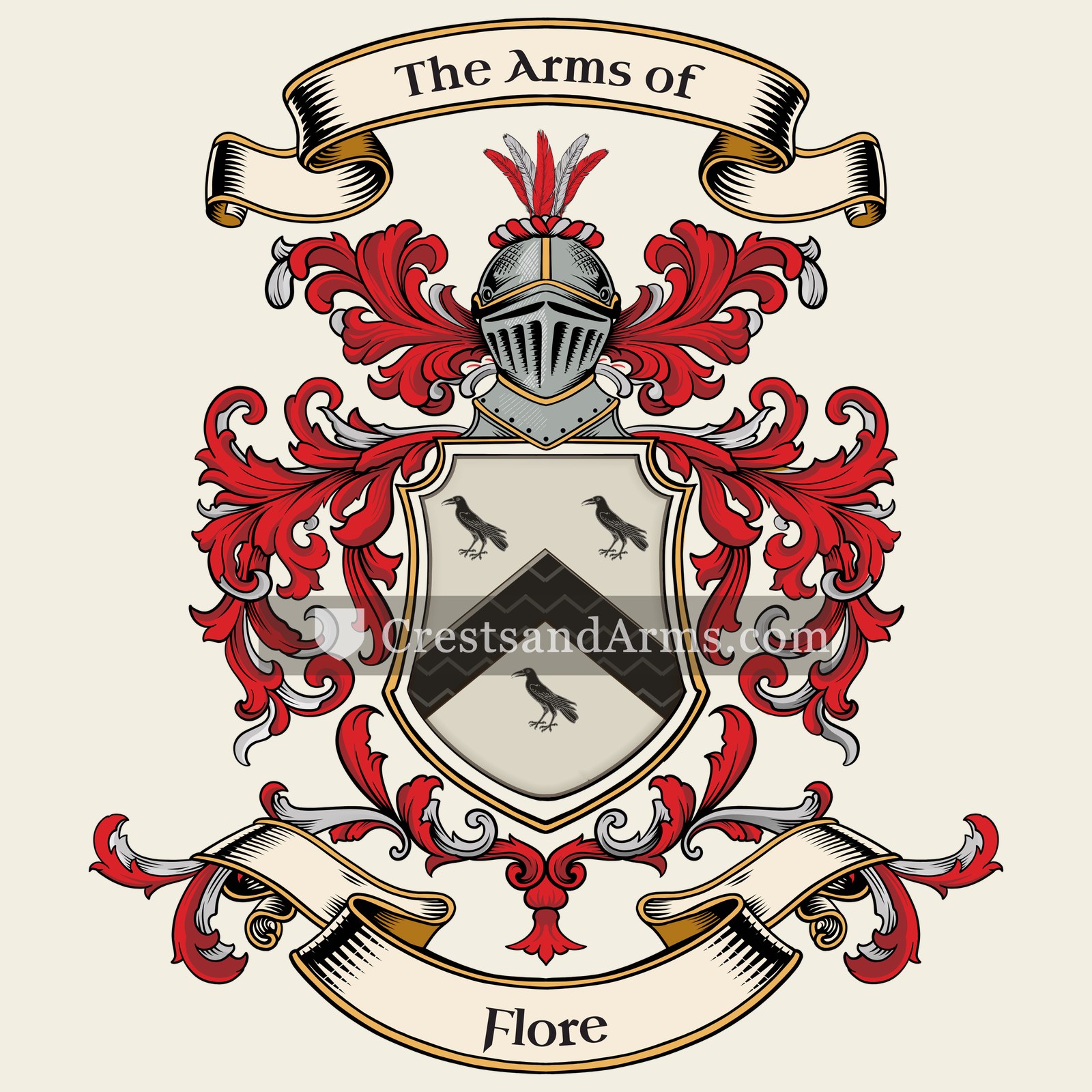
 chevronProtection, and faithful service completed
 ravenConstancy and divine providence
 chevronProtection, and faithful service completed
 ravenConstancy and divine providence