A record of documented arms, meaning and origin, researched for the Florio family lines. Documented in 2 countries.
Reg. 2488 · Italian, D–F
Coat of Arms & Family Crest Details
Symbols on this shield
cross symbolChristian faith and service
fleur de lisPurity, light, and the sixth son
Colours
Red (Gules)Means: Military strength
Blue (Azure)Means: Loyalty and truth
Silver (Argent)Means: Peace and sincerity
Gold (Or)Means: Generosity
Historical info
Source
J. B. Rietstap, Armorial Général, Gouda: G. B. van Goor Zonen, 1884–87
Blazon (the actual original written record)
“Ec. de gu. et d'azur; à la croix d'arg., br. sur l'écartelé, cant. de quatre fleurs-de-lis d'or. Deux cq. cour. C.: 1º un vol cont., l'aile de derrière d'arg. plein, l'aile de devant de gu., ch. d'une ancre d'or; l. d'arg. et de gu.; 2º un senestrochère, arm. au nat., tenant une épée; entre un vol à l'antique, l'aile de devant d'azur et l'aile de derrière d'or; l. d'or et d'azur.”
DalmatiaDalmatia, c. 1775
Digital archive packCoat of arms PNG, gold border print PDF, vector SVG and the certificate of authenticity. Sent to your email in minutes.
Map of Italy showing where the Florio arms are recorded
The Florio arms were recorded in Dalmatia, c. 1775.
Dalmatia was a string of walled towns along the Adriatic coast, each with its own leading families. Sea trade made them wealthy, and the towns kept lists of the houses entitled to arms.
This is where the arms were entered in the register. Families often moved to other parts of the country, so the same name can turn up in more than one region.
The body that granted and recorded arms in Italy in this period.
Alvise Giovanni Mocenigo
Sovereign of the period
Alvise Giovanni Mocenigo
1763–1778
Reigning in Italy when the Florio arms are first recorded.
How Arms Worked in Italy
In the Italian states, coats of arms were often used by noble families to show their status and history. These symbols were passed down through the generations to all legitimate male descendants. Younger branches of a family usually kept the original design but sometimes added small changes to distinguish their specific line from the main branch.
Granting authority
Various local rulers and city governments controlled the use of coats of arms across the different Italian states.
How they got arms
Families often assumed their own arms or received them as official grants from local lords, popes, or city councils.
Where arms were recorded
Arms were recorded in local city archives or private family books rather than in one single national register.
The family's standing
Recorded among the armigerous families of Dalmatia.
Origin & History of the Florio Family in Italy
The name Florio finds its roots in the Latin word *florus*, which means blooming or flowering. In Italy, the name gained prominence as a surname during the Middle Ages, often serving as a way to identify families who lived near gardens or worked as florists. By the late 18th century, the family had established a significant presence in the coastal regions of the Adriatic Sea. Records from 1775 confirm that members of the Florio family were active in Dalmatia, a region that was then a vital hub for maritime trade and cultural exchange between Italy and the Balkan Peninsula. During this era, the family was deeply involved in the merchant class, using their connections across the Adriatic to build influence. This period of migration and commerce helped the name spread from its Italian origins into the broader Mediterranean world, where the family became known for their business ventures and their ability to adapt to new political landscapes.
Coat of Arms & Family Crest Details
Symbols on this shield
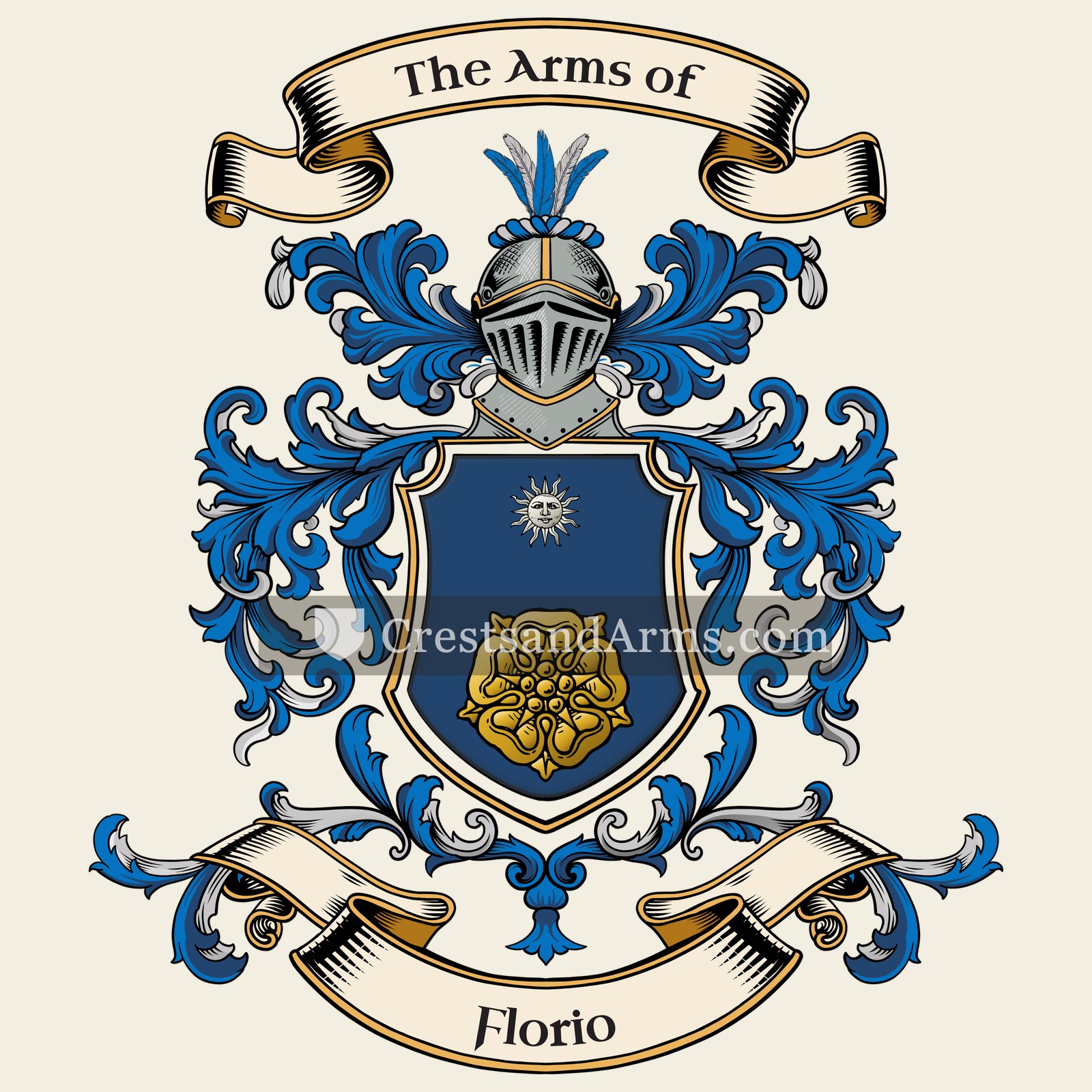
roseThe seventh son, and beauty with grace
sunGlory, splendour and the source of life
Colours
Blue (Azure)Means: Loyalty and truth
Gold (Or)Means: Generosity
Historical info
Source
Sir Bernard Burke, The General Armory of England, Scotland, Ireland and Wales, London: Harrison & Sons, 1884
Blazon (the actual original written record)
“Az. a heliotropo (or sunflower) or, issuing from the stalk, sprouting out of two leaves vert, in chief the sun in splendour ppr”
SpainSpain, c. 1614
Digital archive packCoat of arms PNG, gold border print PDF, vector SVG and the certificate of authenticity. Sent to your email in minutes.
Map of Spain showing where the Florio arms are recorded
The Florio arms were recorded in Spain, c. 1614.
Arms such as these were typically recorded in Castile.
Castile was the heart of Spain and the source of most of its noble families. Land won in the long wars against the Moors was granted out to fighting men, and a man granted land was granted arms along with it.
This is where the arms were entered in the register. Families often moved to other parts of the country, so the same name can turn up in more than one region.
The body that granted and recorded arms in Spain in this period.
Philip III of Spain
Sovereign of the period
Philip III of Spain
1598–1621
Reigning in Italy when the Florio arms are first recorded.
How Arms Worked in Spain
In Spain, a coat of arms was considered a form of property that belonged to the entire family line. These arms were passed down from a father to all his children equally. Younger branches of the family usually kept the original design without needing to add any special marks to distinguish their specific line.
Granting authority
The Cronista Rey de Armas was the official body that regulated and granted coats of arms throughout Spain.
How they got arms
Families often obtained their arms through royal grants or by proving their noble status to the official heraldic authority.
Where arms were recorded
Coats of arms were officially recorded in the registers of the Cronista Rey de Armas starting in 1496.
The family's standing
Recorded among the armigerous families of Spain.
Origin & History of the Florio Family in Spain
The family name Florio carries a deep history that traces back to the vibrant landscapes of Spain. By the year 1614, records confirm that members of the Florio family were well-established residents of the Castile region. During this period, Castile served as the political and cultural heart of the Spanish Empire. Families living there often played active roles in the local administration and the agricultural development of the central plateau. The name itself is linked to the Latin word for flower, which suggests that early ancestors may have been associated with gardening, herbal medicine, or the fertile lands of the Mediterranean. As these individuals moved through the towns of Castile, they helped shape the social fabric of their communities during a time of significant change in Spanish history. Their presence in 17th-century records highlights a legacy of stability and long-standing roots in the Iberian Peninsula.
Florio Meaning & Related Branches
Root word
flos
Latin word meaning flower or blossom.
This name
FlorioDerived from a medieval personal name signifying one who is blooming or flourishing.
also spelled
Flori
Florios
Floriow
Floryo
Related arms
Florivariant spelling
Ayalarecorded with Florio, same area
Gambowrecorded with Florio, same area
Lousadarecorded with Florio, same area
Documented Sources
J. B. Rietstap, Armorial Général, Gouda: G. B. van Goor Zonen, 1884–87
De Felice, Emidio. Dizionario dei cognomi italiani. 1978
State Archives of Zadar (Državni arhiv u Zadru). Zbirka matičnih knjiga (Collection of Parish Registers). 1775
Digital archive packCoat of arms PNG, gold border print PDF, vector SVG and the certificate of authenticity. Sent to your email in minutes.


 cross symbolChristian faith and service
 fleur de lisPurity, light, and the sixth son
 cross symbolChristian faith and service
 fleur de lisPurity, light, and the sixth son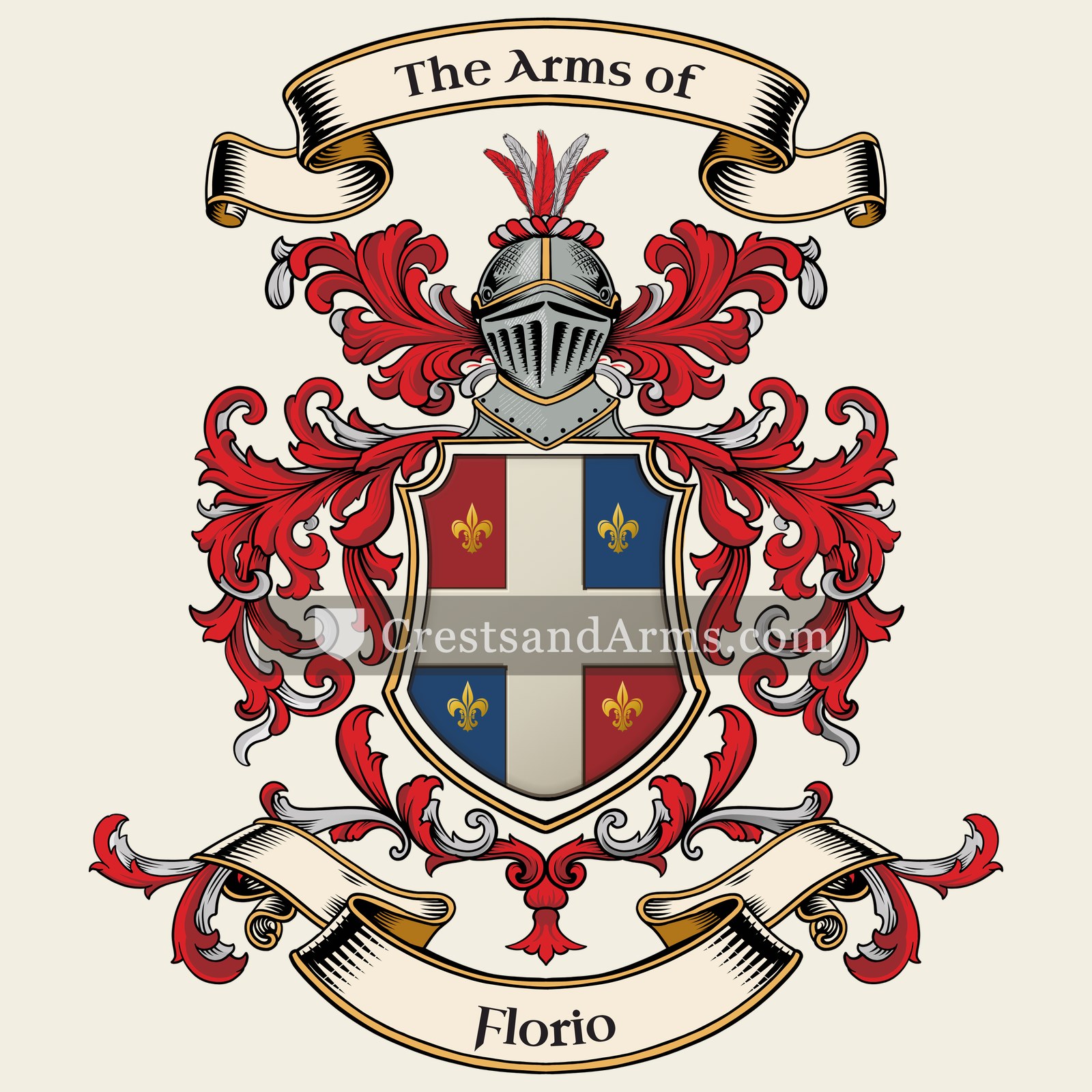


 roseThe seventh son, and beauty with grace
 sunGlory, splendour and the source of life