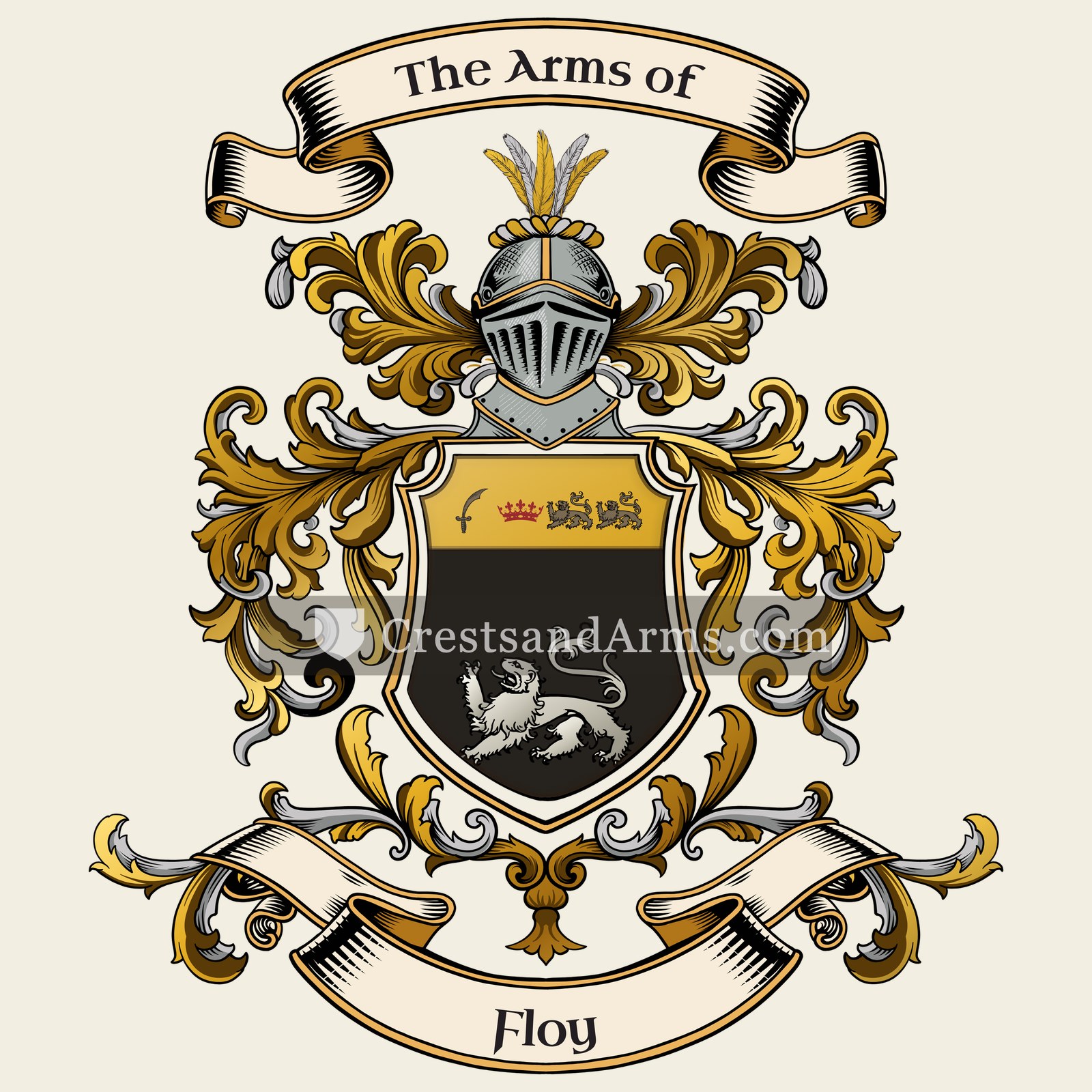
A record of documented arms, meaning and origin, researched for the Floy family of Britain.
Reg. 9000 · Britain, D–F
Coat of Arms & Family Crest Details
Symbols on this shield
chiefAuthority, wisdom and dominion
lionCourage, strength and royalty
swordJustice, and military honour
crownSovereignty, authority and just reward
Colours
Black (Sable)Means: Constancy
Gold (Or)Means: Generosity
Silver (Argent)Means: Peace and sincerity
Red (Gules)Means: Military strength
Historical info
Source
J. B. Rietstap, Armorial Général, Gouda: G. B. van Goor Zonen, 1884–87
Blazon (the actual original written record)
“De sa. au lion ramp. et reg. d'arg.; au chef bastillé d'or, ch. d'une épée au nat. enfilant une couronne à l'antique de gu., entre deux rencontres de tigre au nat. C.: le lion de l'écu, sommé d'une couronne murale de gu. et tenant de ses pattes l'étendard de Tippoo Saïb. D.: PATIENS PULVERIS ATQUE SOLIS.”
DevonshireDevonshire, c. 1816
Digital archive packCoat of arms PNG, gold border print PDF, vector SVG and the certificate of authenticity. Sent to your email in minutes.
Map of Britain showing where the Floy arms are recorded
The Floy arms were recorded in Devonshire, c. 1816.
This is where the arms were entered in the register. Families often moved to other parts of the country, so the same name can turn up in more than one region.
The body that granted and recorded arms in Britain in this period.
George III of Great Britain
Sovereign of the period
George III of Great Britain
1801–1820
Reigning in Britain when the Floy arms are first recorded.
How Arms Worked in Britain
English heraldry allowed arms to be shared by all legitimate descendants of the original owner. These symbols were treated as personal property that moved through the generations to all children. While the eldest son kept the original design, other family members could use the same shield without needing to change it or register their own unique versions.
Granting authority
The College of Arms in London has regulated the use of coats of arms throughout England and Wales since 1484.
How they got arms
Families typically obtained their coats of arms through a formal grant from the Crown or by proving their ancient right to them.
Where arms were recorded
All official coats of arms are recorded in the registers kept at the College of Arms, which date back to the fifteenth century.
The family's standing
Recorded among the armigerous families of Devonshire.
Origin & History of the Floy Family in Britain
The surname Floy is a rare and distinct name with deep roots in the southwestern region of England. Historical records confirm that members of the family were well-established in the county of Devonshire by the early nineteenth century. During this period, Devonshire was a landscape defined by its rolling hills and a strong reliance on agriculture and local trade. Families like the Floys often lived in small rural parishes where they contributed to the local economy as farmers, craftsmen, or laborers. Because the name is not widely distributed, it suggests that the family likely originated from a specific village or community within the county. Over time, the family name remained tied to the unique culture and geography of the West Country, preserving a quiet but steady presence in the region for generations.
Floy Meaning & Related Branches
Root word
Floyd
Derived from the Welsh word llwyd meaning grey or hoary.
This name
FloyA locational or descriptive surname referring to someone with grey hair or a grey complexion.
also spelled
Floyde
Floydd
Floy
Floydde
Documented Sources
J. B. Rietstap, Armorial Général, Gouda: G. B. van Goor Zonen, 1884–87
Devon Archives and Local Studies Service, Parish registers for the Diocese of Exeter, 1816
Reaney, P.H., A Dictionary of British Surnames, 1958
Digital archive packCoat of arms PNG, gold border print PDF, vector SVG and the certificate of authenticity. Sent to your email in minutes.


 chiefAuthority, wisdom and dominion
 lionCourage, strength and royalty
 swordJustice, and military honour
 crownSovereignty, authority and just reward
 chiefAuthority, wisdom and dominion
 lionCourage, strength and royalty
 swordJustice, and military honour
 crownSovereignty, authority and just reward