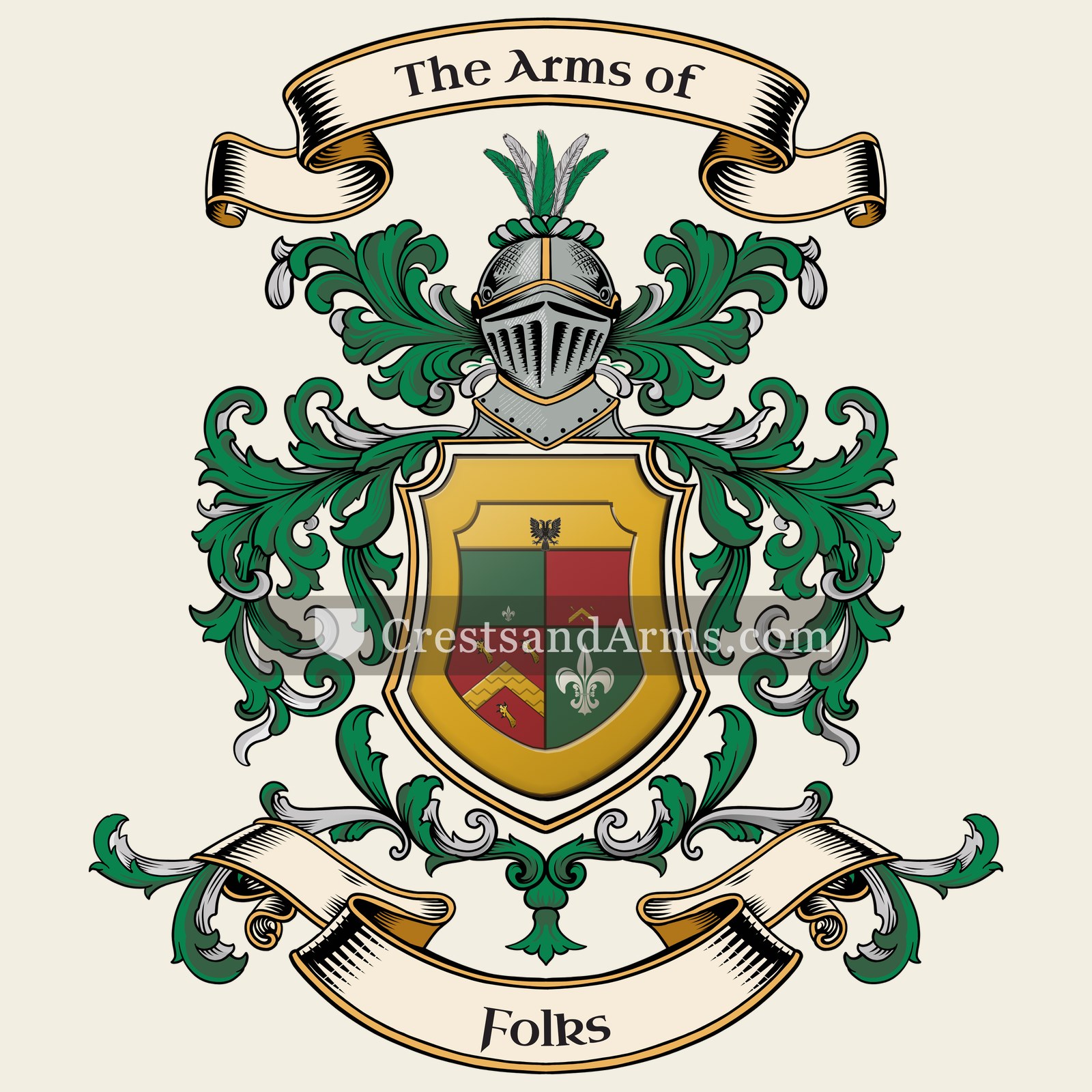
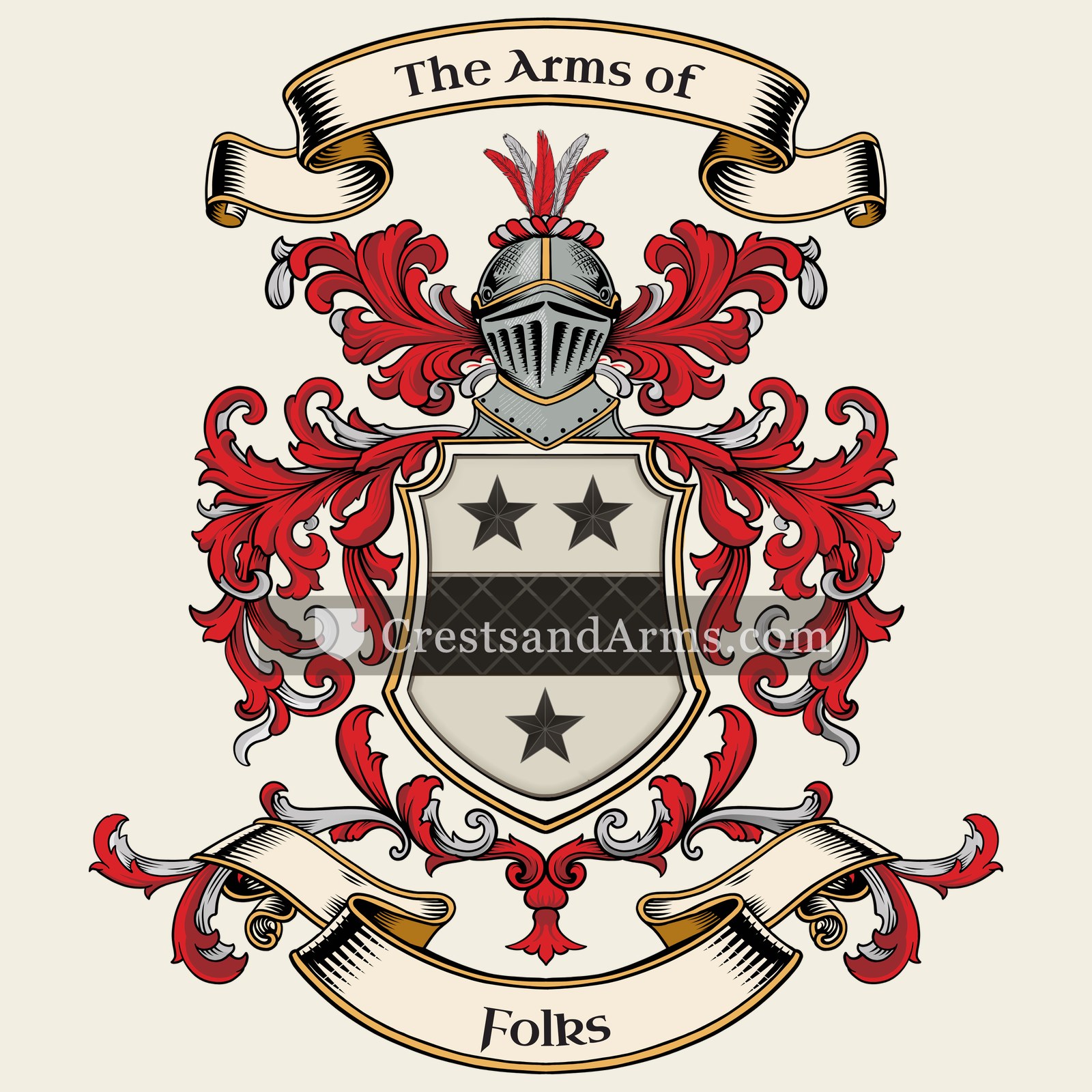
A record of documented arms, meaning and origin, researched for the Folks family lines. Documented in 2 countries.
Reg. 1866 · Britain, D–F
Coat of Arms & Family Crest Details
Symbols on this shield
chevronProtection, and faithful service completed
paleMilitary strength, and a fortified defence
chiefAuthority, wisdom and dominion
eagleNobility, strength and a keen mind
fleur de lisPurity, light, and the sixth son
pawStrength held ready, the beast's power in a single limb
Colours
Green (Vert)Means: Hope
Red (Gules)Means: Military strength
Gold (Or)Means: Generosity
Black (Sable)Means: Constancy
Silver (Argent)Means: Peace and sincerity
Historical info
Source
J. B. Rietstap, Armorial Général, Gouda: G. B. van Goor Zonen, 1884–87
Blazon (the actual original written record)
“Ec.: aux 1 et 4 parti de sin. et de gu.; à une fleur-de-lis d'arg., br. sur le parti; aux 2 et 3 de gu. au chev. d'or, acc. de trois pattes de lion du même en pals; au chef d'or, ch. d'une aigle de sa.; le quartier entouré d'une bord. d'or. C.: un avant-bras, en pal, paré d'un parti de sin. et de gu., rebr. d'herm., la main de carn. empoignant une pique en barre, la pointe en bas. D.: 1° QUI SERA SERA; 2° PRINCIPIIS OBSTA [Comp. Fowke de Lowesby.]”
NorfolkNorfolk, c. 1774
Where the Folks Arms Were Recorded
Norfolk
Map of Britain showing where the Folks arms are recorded
The Folks arms were recorded in Norfolk, c. 1774.
Norfolk grew rich on wool and grain, and its wealth was spread among many middling families rather than a few great ones. Households of that kind bought land and took arms, and the county holds a large share of English names.
This is where the arms were entered in the register. Families often moved to other parts of the country, so the same name can turn up in more than one region.
The body that granted and recorded arms in Britain in this period.
George III of Great Britain
Sovereign of the period
George III of Great Britain
1760–1801
Reigning in Britain when the Folks arms are first recorded.
How Arms Worked in Britain
English heraldry allowed arms to be shared by all legitimate descendants of the original owner. These symbols were treated as personal property that moved through the generations to all children. While the eldest son kept the original design, other family members could use the same shield without needing to change it or register their own unique versions.
Granting authority
The College of Arms in London has regulated the use of coats of arms throughout England and Wales since 1484.
How they got arms
Families typically obtained their coats of arms through a formal grant from the Crown or by proving their ancient right to them.
Where arms were recorded
All official coats of arms are recorded in the registers kept at the College of Arms, which date back to the fifteenth century.
The family's standing
Recorded among the armigerous families of Norfolk.
Origin & History of the Folks Family in Britain
The surname Folks is a patronymic name, which means it originated as a way to identify a person as the son or descendant of someone named Fulk. The name Fulk itself comes from ancient Germanic roots and translates to mean people or folk. By the time the name became established in England, it was commonly used to describe individuals who were part of a specific community or group. Records show that by 1774, the family was well-settled in Norfolk, a region known for its strong agricultural traditions and long history of rural craftsmanship. Families in this area often lived in small villages where their name helped neighbors distinguish them from other local clans. Over many generations, the spelling evolved from early variations like Fulkes or Folkes into the modern version used today. This transition reflects the way names were written down by local clerks who often spelled them based on how they sounded in the local Norfolk dialect.
Coat of Arms & Family Crest Details
Symbols on this shield
fessThe military belt, and readiness to serve
mulletThe third son, and a divine quality from above
Colours
Silver (Argent)Means: Peace and sincerity
Black (Sable)Means: Constancy
Historical info
Source
Sir Bernard Burke, The General Armory of England, Scotland, Ireland and Wales, London: Harrison & Sons, 1884
Blazon (the actual original written record)
“Ar. a fesse betw. three mullets sa”
StaffordStafford, c. 1620
Where the Folks Arms Were Recorded
Stafford
Map of England showing where the Folks arms are recorded
The Folks arms were recorded in Stafford, c. 1620.
Staffordshire was mixed country of moorland, farmland and early ironworking. Its landed families were spread widely rather than concentrated, and each holding brought its own claim to arms.
This is where the arms were entered in the register. Families often moved to other parts of the country, so the same name can turn up in more than one region.
The body that granted and recorded arms in England in this period.
James VI and I
Sovereign of the period
James VI and I
1603–1625
Reigning in Britain when the Folks arms are first recorded.
How Arms Worked in England
English heraldry allowed arms to be shared by all legitimate descendants of the original owner. These symbols were treated as personal property that moved through the generations to all children. While the eldest son kept the original design, other family members could use the same shield without needing to change it or register their own unique versions.
Granting authority
The College of Arms in London has regulated the use of coats of arms throughout England and Wales since 1484.
How they got arms
Families typically obtained their coats of arms through a formal grant from the Crown or by proving their ancient right to them.
Where arms were recorded
All official coats of arms are recorded in the registers kept at the College of Arms, which date back to the fifteenth century.
The family's standing
Recorded among the armigerous families of Stafford.
Origin & History of the Folks Family in England
The family name Folks has deep roots in the English landscape, emerging as a descriptive surname during the Middle Ages. Names like this often began as nicknames to identify a person based on their character or their role within a local community. By the year 1620, historical records confirm that members of the Folks family were well established in the town of Stafford. At that time, Stafford was a bustling market center where families often worked as tradespeople or farmers. Living in such a central location suggests that early ancestors were active participants in the social and economic life of the English Midlands. Over the centuries, the name evolved through various spellings as it was passed down through generations, eventually becoming the version used today. This history reflects the quiet persistence of a family that helped build the foundations of local life in Staffordshire long before the modern era.
Related Branches & Arms
Root word
Folc
An Old English term referring to the common people or tribe.
This name
FolksA patronymic surname denoting a descendant of someone belonging to the people.
also spelled
Folkes
Ffolkes
Folks
Folksdehillington
Documented Sources
J. B. Rietstap, Armorial Général, Gouda: G. B. van Goor Zonen, 1884–87
Reaney, P.H., A Dictionary of English Surnames, 1991
Cottle, Basil, The Penguin Dictionary of Surnames, 1967
Norfolk Record Office, Parish Register Transcripts for Norfolk, 1774
Digital archive packCoat of arms PNG, gold border print PDF, vector SVG and the certificate of authenticity. Sent to your email in minutes.


 chevronProtection, and faithful service completed
 paleMilitary strength, and a fortified defence
 chiefAuthority, wisdom and dominion
 eagleNobility, strength and a keen mind
 fleur de lisPurity, light, and the sixth son
 pawStrength held ready, the beast's power in a single limb
 chevronProtection, and faithful service completed
 paleMilitary strength, and a fortified defence
 chiefAuthority, wisdom and dominion
 eagleNobility, strength and a keen mind
 fleur de lisPurity, light, and the sixth son
 pawStrength held ready, the beast's power in a single limb

 fessThe military belt, and readiness to serve
 mulletThe third son, and a divine quality from above