A record of documented arms, meaning and origin, researched for the Fontana family lines. Documented in 3 countries.
Reg. 4243 · Italian, D–F
Coat of Arms & Family Crest Details
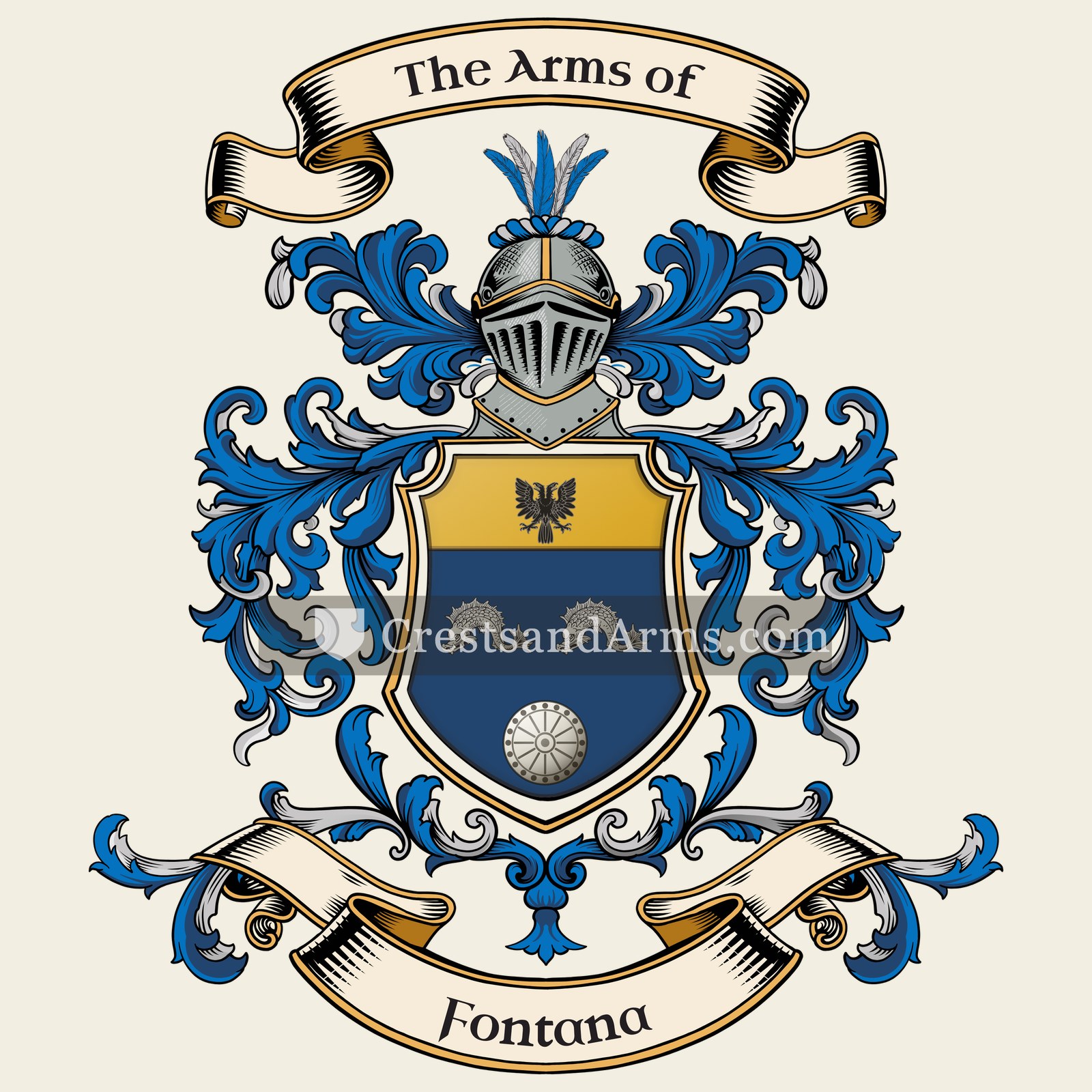
Symbols on this shield
chiefAuthority, wisdom and dominion
roundelA coin, and one who has been to the crusades
dolphinSwiftness, charity and love
eagleNobility, strength and a keen mind
Colours
Blue (Azure)Means: Loyalty and truth
Gold (Or)Means: Generosity
Silver (Argent)Means: Peace and sincerity
Black (Sable)Means: Constancy
Historical info
Source
J. B. Rietstap, Armorial Général, Gouda: G. B. van Goor Zonen, 1884–87
Blazon (the actual original written record)
“D'azur à une fontaine jaillissante de quatre traits, le bassin soutenu de deux dauphins, le tout d'arg.; au chef d'or, ch. d'une aigle de sa., cour. d'or. Cq. cour. C.: l'aigle. D.: SIC VIRTUS PER ARDUA TRANSIT.”
ItalyMilan, c. 1775
Where the Fontana Arms Were Recorded
Milan
Map of Italy showing where the Fontana arms are recorded
The Fontana arms were recorded in Milan, c. 1775.
This is where the arms were entered in the register. Families often moved to other parts of the country, so the same name can turn up in more than one region.
The body that granted and recorded arms in Italy in this period.
Alvise Giovanni Mocenigo
Sovereign of the period
Alvise Giovanni Mocenigo
1763–1778
Reigning in Italy when the Fontana arms are first recorded.
How Arms Worked in Italy
In the Italian states, coats of arms were often used by noble families to show their status and history. These symbols were passed down through the generations to all legitimate male descendants. Younger branches of a family usually kept the original design but sometimes added small changes to distinguish their specific line from the main branch.
Granting authority
Various local rulers and city governments controlled the use of coats of arms across the different Italian states.
How they got arms
Families often assumed their own arms or received them as official grants from local lords, popes, or city councils.
Where arms were recorded
Arms were recorded in local city archives or private family books rather than in one single national register.
The family's standing
Recorded among the armigerous families of Italy.
Origin & History of the Fontana Family in Italy
The surname Fontana is a classic Italian topographic name, which means it was originally given to families who lived near a prominent fountain, spring, or water source. In the Italian language, the word *fontana* translates directly to fountain, and it often identified people who resided in areas where water was a central part of community life. By the time the family was documented in Milan in 1775, the name had already been established for centuries across various regions of Italy. During this period, Milan was a bustling center of trade and culture under the influence of the Habsburg monarchy. Families with this name were often integrated into the local urban fabric as skilled laborers, merchants, or artisans who relied on the city's sophisticated water systems. Because the name was tied to a common geographical feature, it emerged independently in many different towns, meaning that those who carried it in the 18th century were often part of a long-standing tradition of local residency and civic participation.
Coat of Arms & Family Crest Details
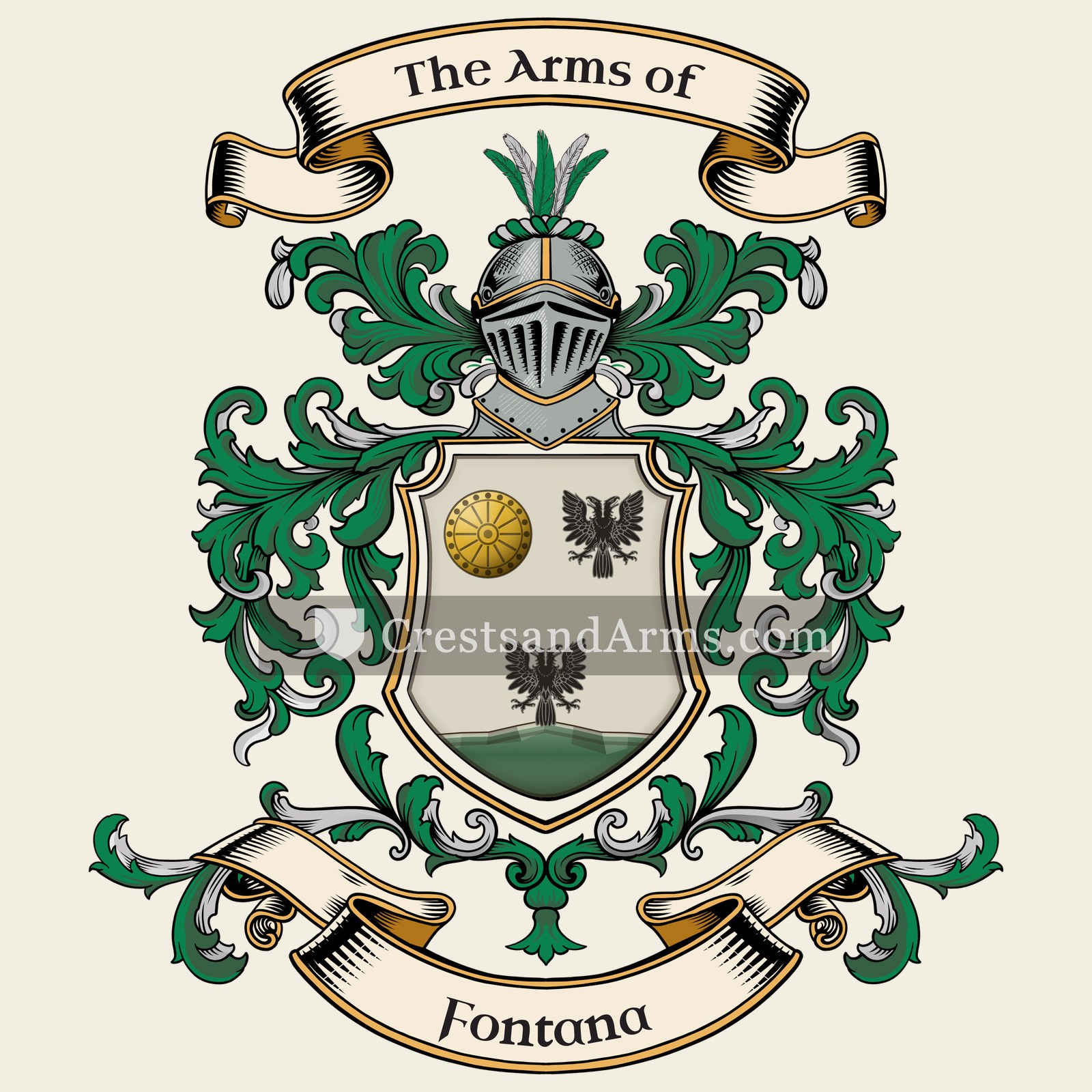
Symbols on this shield
mountThe ground held, and steadfastness upon it
roundelA coin, and one who has been to the crusades
eagleNobility, strength and a keen mind
Colours
Silver (Argent)Means: Peace and sincerity
Green (Vert)Means: Hope
Gold (Or)Means: Generosity
Black (Sable)Means: Constancy
Historical info
Source
J. B. Rietstap, Armorial Général, Gouda: G. B. van Goor Zonen, 1884–87
Blazon (the actual original written record)
“D'arg. à une fontaine d'or, jaillissante de deux traits d'arg., accostée de deux aigles de profil affr. de sa., les ailes levées, perchées sur le bord du bassin, buvant dans ledit bassin; la fontaine posée sur une terrasse isolée de sin.”
SpainMurcie, c. 1722
Where the Fontana Arms Were Recorded
Murcie
Map of Spain showing where the Fontana arms are recorded
The Fontana arms were recorded in Murcie, c. 1722.
This is where the arms were entered in the register. Families often moved to other parts of the country, so the same name can turn up in more than one region.
The body that granted and recorded arms in Spain in this period.
Philip V of Spain
Sovereign of the period
Philip V of Spain
1714–1724
Reigning in Italy when the Fontana arms are first recorded.
How Arms Worked in Spain
In Spain, a coat of arms was considered a form of property that belonged to the entire family line. These arms were passed down from a father to all his children equally. Younger branches of the family usually kept the original design without needing to add any special marks to distinguish their specific line.
Granting authority
The Cronista Rey de Armas was the official body that regulated and granted coats of arms throughout Spain.
How they got arms
Families often obtained their arms through royal grants or by proving their noble status to the official heraldic authority.
Where arms were recorded
Coats of arms were officially recorded in the registers of the Cronista Rey de Armas starting in 1496.
The family's standing
Recorded among the armigerous families of Spain.
Origin & History of the Fontana Family in Spain
The surname Fontana carries a rich history that reflects the movement of people across the Mediterranean. While the name is often associated with Italian roots, it established a firm presence in Spain as early as the eighteenth century. By 1722, records confirm that members of the Fontana family were living in the region of Murcia. During this era, Murcia was a vital agricultural hub, and families with this name likely integrated into the local community through trade or land management. The name itself is derived from the Latin word for fountain or spring, which suggests that the family’s earliest ancestors may have lived near a prominent water source. As they settled in Spain, these individuals contributed to the social and economic life of the region, helping to weave the name into the fabric of Spanish history long before modern migration patterns shifted the population.
Coat of Arms & Family Crest Details
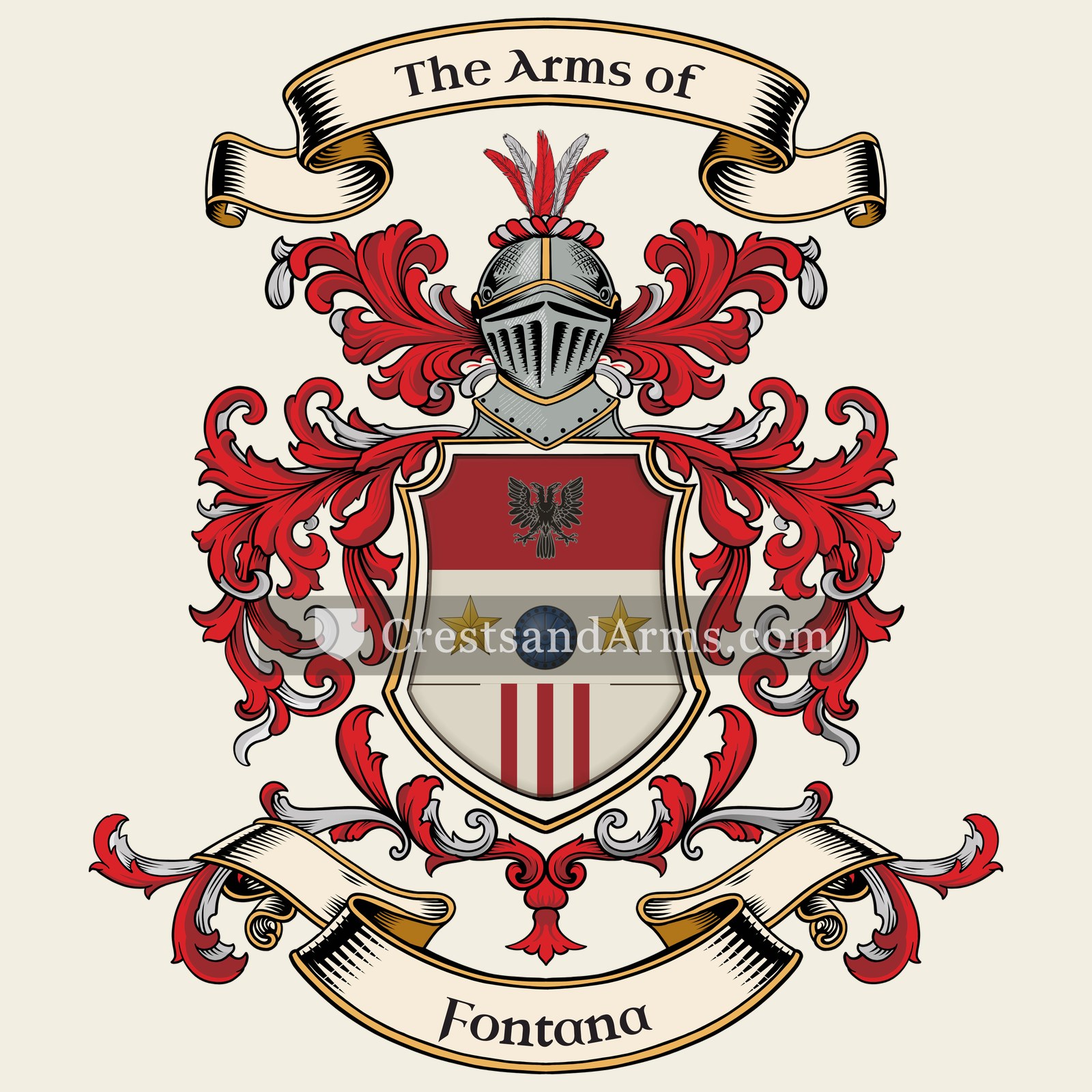
Symbols on this shield
paleMilitary strength, and a fortified defence
eagleNobility, strength and a keen mind
roundelA coin, and one who has been to the crusades
mulletThe third son, and a divine quality from above
Colours
Red (Gules)Means: Military strength
Silver (Argent)Means: Peace and sincerity
Black (Sable)Means: Constancy
Blue (Azure)Means: Loyalty and truth
Gold (Or)Means: Generosity
Historical info
Source
J. B. Rietstap, Armorial Général, Gouda: G. B. van Goor Zonen, 1884–87
Blazon (the actual original written record)
“Tiercé en fasce: au 1 de gu. à l'aigle ép. de sa.; au 2 d'arg. à une fontaine d'azur jaillissante du même, accostée de deux étoiles d'or; au 3 d'arg. à trois pals de gu. Cq. cour. C.: cinq pl. d'aut. d'arg.”
Polandc. 1772
Where the Fontana Arms Were Recorded
Mazovia
Map of Poland showing where the Fontana arms are recorded
The Fontana arms were recorded in Poland, c. 1772.
Arms such as these were typically recorded in Mazovia.
Mazovia held Warsaw, the Polish court and the assemblies where the szlachta met. Poland's nobles were unusually numerous and every one of them bore arms, and Warsaw is where those arms were argued over and recorded.
This is where the arms were entered in the register. Families often moved to other parts of the country, so the same name can turn up in more than one region.
Region
Mazovia
First recorded
1772
Granting Authority for the Fontana Arms
Ennoblement by the Sejm
Author: Olek Remesz · CC BY-SA 3.0
The body that granted and recorded arms in Poland in this period.
Stanisław August Poniatowski
Sovereign of the period
Stanisław August Poniatowski
1764–1795
Reigning in Italy when the Fontana arms are first recorded.
How Arms Worked in Poland
Polish noble families shared a single coat of arms across many different surnames, creating large clans rather than individual designs. These symbols were held collectively by all members of the clan regardless of their specific family name. When a new family joined the nobility, they were adopted into an existing clan and began using that group's established shield.
Granting authority
The Sejm, which was the Polish parliament, held the power to grant noble status and the right to bear arms.
How they got arms
Families typically received their coat of arms through a formal act of ennoblement granted by the Sejm for distinguished service.
Where arms were recorded
These grants were officially recorded in the Crown Metrica, which served as the central archive for state documents starting in the sixteenth century.
The family's standing
Recorded among the armigerous families of Poland.
Origin & History of the Fontana Family in Poland
The Fontana family name has deep roots in the history of Mazovia, a region in east-central Poland where members of the family were documented as early as 1772. While the name is of Italian origin and translates to fountain, the family became well established within the Polish social and professional landscape over several generations. Many individuals carrying this name worked as skilled architects, builders, and craftsmen who helped shape the physical appearance of Polish cities during the eighteenth century. By settling in Mazovia, the family integrated into the local community and contributed to the regional development of the area. Their presence in historical records from this time suggests that they were active participants in the economic and cultural life of the Polish lands long before the modern era.
Related Branches & Arms
Root word
fons
A Latin term referring to a spring, source, or fountain.
This name
FontanaDerived from a topographic name for someone who lived near a spring or fountain.
also spelled
Fontanae
Fontanna
Fontane
Fontan
Documented Sources
J. B. Rietstap, Armorial Général, Gouda: G. B. van Goor Zonen, 1884–87
De Felice, Emidio. Dizionario dei cognomi italiani. 1978
Fucile, Roberto. I cognomi d'Italia: Dizionario storico ed etimologico. 1987
Archivio di Stato di Milano, Anagrafe civica di Milano
Digital archive packCoat of arms PNG, gold border print PDF, vector SVG and the certificate of authenticity. Sent to your email in minutes.


 chiefAuthority, wisdom and dominion
 roundelA coin, and one who has been to the crusades
 dolphinSwiftness, charity and love
 eagleNobility, strength and a keen mind
 chiefAuthority, wisdom and dominion
 roundelA coin, and one who has been to the crusades
 dolphinSwiftness, charity and love
 eagleNobility, strength and a keen mind

 mountThe ground held, and steadfastness upon it

 paleMilitary strength, and a fortified defence
 mulletThe third son, and a divine quality from above