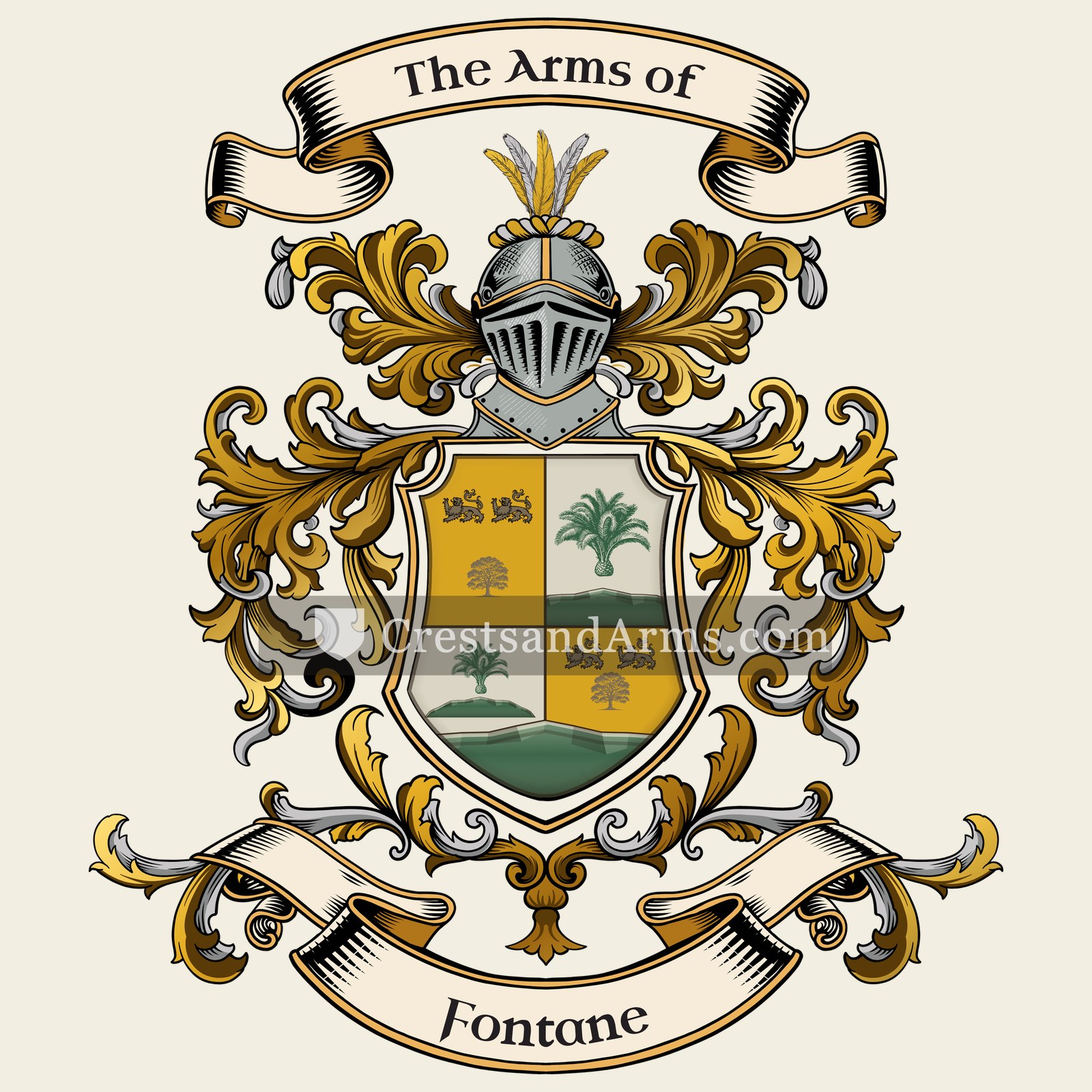
A record of documented arms, meaning and origin, researched for the Fontane family of Italy.
Reg. 7688 · Italian, D–F
Coat of Arms & Family Crest Details
Symbols on this shield
mountThe ground held, and steadfastness upon it
treeLife, endurance and deep roots
lionCourage, strength and royalty
palm treeVictory, and righteousness that flourishes
Colours
Gold (Or)Means: Generosity
Silver (Argent)Means: Peace and sincerity
Green (Vert)Means: Hope
Historical info
Source
J. B. Rietstap, Armorial Général, Gouda: G. B. van Goor Zonen, 1884–87
Blazon (the actual original written record)
“Ec.: aux 1 et 4 d'or à un cyprès au nat., accosté de deux lions affr. au nat., cour. de gu., celui à dextre supp. de sa patte sen. une couronne d'or et celui à sen. tenant un sceptre d'or; le tout soutenu d'une terrasse de sin.; aux 2 et 3 d'arg. au palmier de sin., terrassé du même.”
ItalyIstrie, c. 1825
Digital archive packCoat of arms PNG, gold border print PDF, vector SVG and the certificate of authenticity. Sent to your email in minutes.
Map of Italy showing where the Fontane arms are recorded
The Fontane arms were recorded in Istrie, c. 1825.
This is where the arms were entered in the register. Families often moved to other parts of the country, so the same name can turn up in more than one region.
The body that granted and recorded arms in Italy in this period.
How Arms Worked in Italy
In the Italian states, coats of arms were often used by noble families to show their status and history. These symbols were passed down through the generations to all legitimate male descendants. Younger branches of a family usually kept the original design but sometimes added small changes to distinguish their specific line from the main branch.
Granting authority
Various local rulers and city governments controlled the use of coats of arms across the different Italian states.
How they got arms
Families often assumed their own arms or received them as official grants from local lords, popes, or city councils.
Where arms were recorded
Arms were recorded in local city archives or private family books rather than in one single national register.
The family's standing
Recorded among the armigerous families of Italy.
Origin & History of the Fontane Family in Italy
The surname Fontane traces its roots to the Latin word for a spring or fountain, which suggests that the earliest families likely lived near a prominent water source. By the early 19th century, records confirm that members of the family were established in the Istrian peninsula, a region known for its complex history of shifting borders between Italian, Slavic, and Austrian influences. During this period, the family lived in a landscape defined by coastal trade and inland agriculture. As the name spread across these diverse territories, it became associated with families who navigated the unique cultural crossroads of the Adriatic. These early ancestors were part of a society that valued local craftsmanship and maritime connection, helping to anchor the name within the historic records of the region by 1825.
Fontane Meaning & Related Branches
Root word
fons
Latin term referring to a spring, fountain, or source of water.
This name
FontaneDerived from a topographic name for someone who lived near a spring or fountain.
also spelled
Borisifontane
Boreesee dee Fontanay
Borisi
Fontane
Documented Sources
J. B. Rietstap, Armorial Général, Gouda: G. B. van Goor Zonen, 1884–87


 mountThe ground held, and steadfastness upon it
 treeLife, endurance and deep roots
 lionCourage, strength and royalty
 palm treeVictory, and righteousness that flourishes
 mountThe ground held, and steadfastness upon it
 treeLife, endurance and deep roots
 lionCourage, strength and royalty
 palm treeVictory, and righteousness that flourishes