Map of England showing where the Foote arms are recorded
The Foote arms were recorded in Cornwall, c. 1620.
Cornwall was a county apart, with its own language and its own tight-knit gentry. Tin and the sea made money there, and families who made it bought land, which is what brought arms with it.
This is where the arms were entered in the register. Families often moved to other parts of the country, so the same name can turn up in more than one region.
The body that granted and recorded arms in England in this period.
James VI and I
Sovereign of the period
James VI and I
1603–1625
Reigning in England when the Foote arms are first recorded.
How Arms Worked in England
English heraldry allowed arms to be shared by all legitimate descendants of the original owner. These symbols were treated as personal property that moved through the generations to all children. While the eldest son kept the original design, other family members could use the same shield without needing to change it or register their own unique versions.
Granting authority
The College of Arms in London has regulated the use of coats of arms throughout England and Wales since 1484.
How they got arms
Families typically obtained their coats of arms through a formal grant from the Crown or by proving their ancient right to them.
Where arms were recorded
All official coats of arms are recorded in the registers kept at the College of Arms, which date back to the fifteenth century.
The family's standing
Recorded among the armigerous families of Cornwall.
Origin & History of the Foote Family in England
The surname Foote is an ancient English name that likely began as a descriptive nickname for a person who was known for being a swift runner or for someone who traveled primarily on foot. By the early 17th century, the family had established a notable presence in the rugged coastal region of Cornwall. Records from 1620 confirm that members of the Foote family were living in this area, where they were deeply integrated into the local community life. During this period, many families in Cornwall were involved in agriculture, mining, or maritime trades, which shaped the daily experiences of those bearing the name. As the family grew, they became part of the social fabric of the English West Country, eventually contributing to the migration patterns that would later see the name spread far beyond its original regional roots.
Foote Meaning & Related Branches
Root word
fot
Old English word for the lower extremity of the human leg.
This name
FooteA topographical name for someone who lived at the base of a hill or mountain.
also spelled
Foott
Related arms
Barnerecorded with Foote, same area
Burridgerecorded with Foote, same area
Diamondrecorded with Foote, same area
Dunsfordrecorded with Foote, same area
Documented Sources
Sir Bernard Burke, The General Armory of England, Scotland, Ireland and Wales, London: Harrison & Sons, 1884
Bardsley, Charles Wareing, A Dictionary of English and Welsh Surnames, 1901


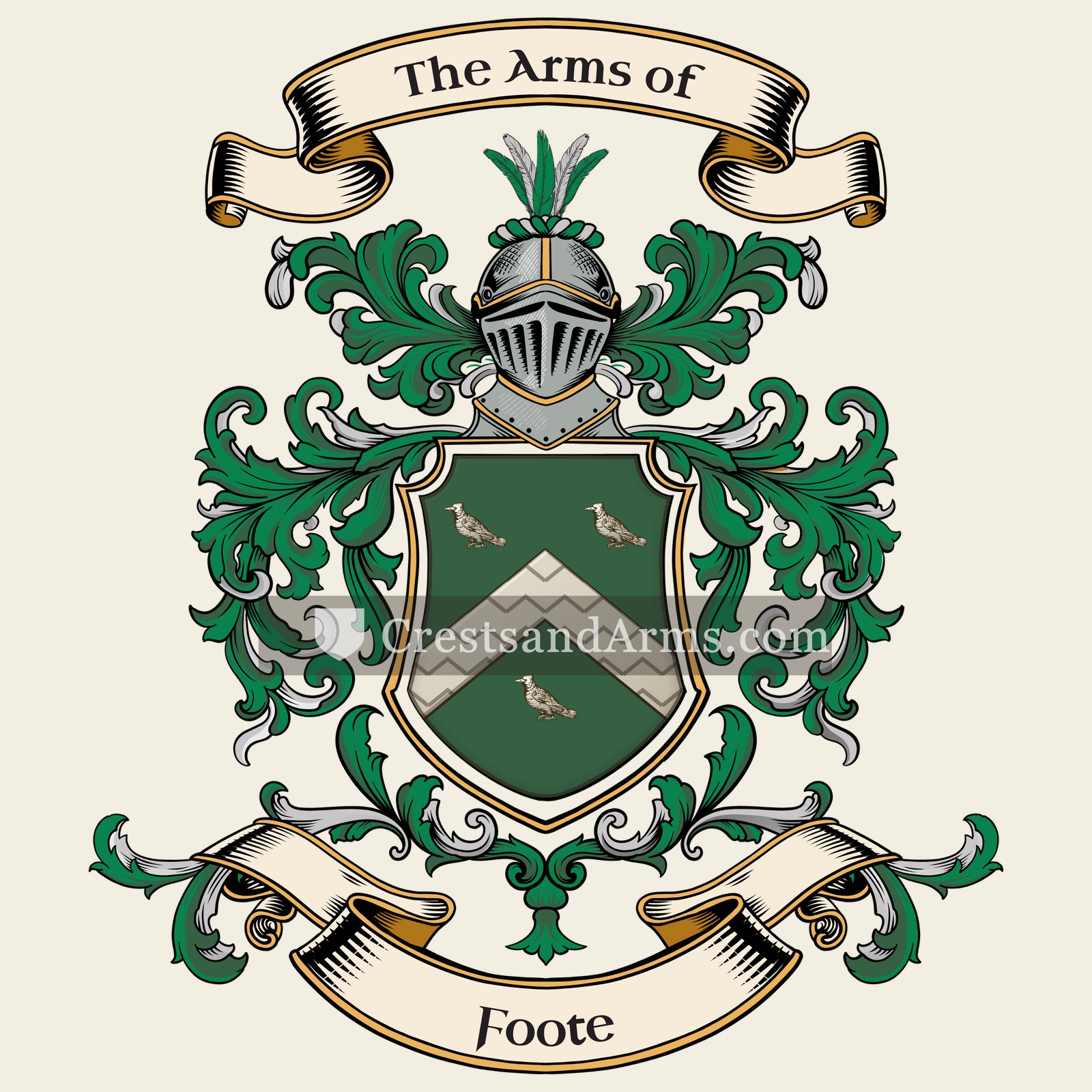
 chevronProtection, and faithful service completed
 dovePeace, love and the Holy Spirit
 chevronProtection, and faithful service completed
 dovePeace, love and the Holy Spirit