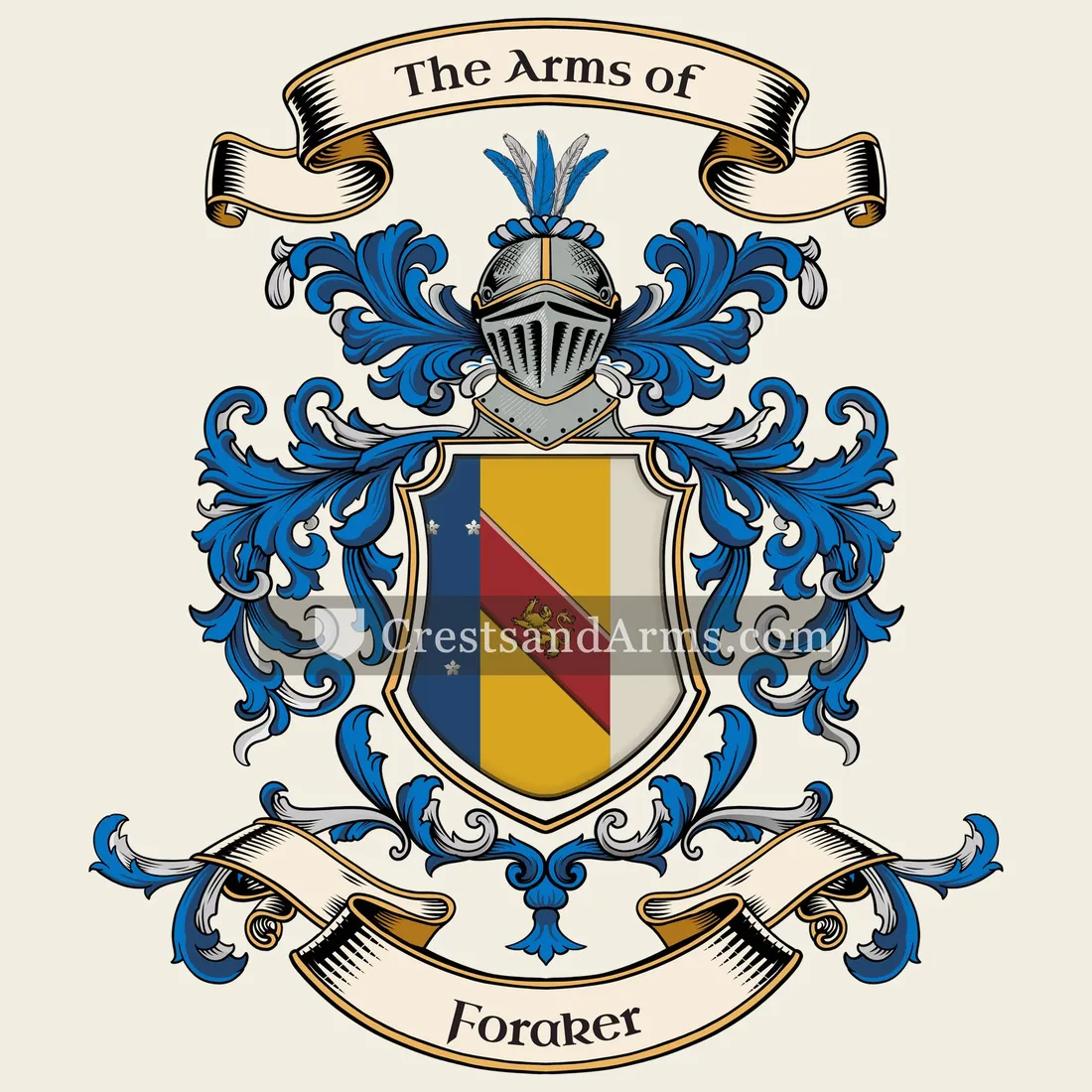
A record of documented arms, meaning and origin, researched for the Foraker family lines. Documented in 3 countries.
Reg. 2766 · Finnish, D–F
Meaning of the Foraker family crest colors & symbols
Symbols on this shield
cinquefoilHope and joy
lionCourage, strength and royalty
Colours
Blue (Azure)Means: Loyalty and truth
Gold (Or)Means: Generosity
Silver (Argent)Means: Peace and sincerity
Red (Gules)Means: Military strength
Historical info
Source
J. B. Rietstap, Armorial Général, Gouda: G. B. van Goor Zonen, 1884–87
Blazon (the actual original written record)
“d'azur à trois quintefeuilles d'arg. (Fraser); au 2 d'or au lion de gu.: à la cotice de sa., br. sur le lion (Abernethy); au 3 d'arg. à trois piles de gu. (Wishart). C.: une autruche, tenant en son bec un fer-à-cheval, le tout au nat. T.: deux anges, hab. de dalmatiques d'or. D.: IN GOD IS ALL.”
Finlandc. 1445
Digital archive packCoat of arms PNG, gold border print PDF, vector SVG and the certificate of authenticity. Sent to your email in minutes.
Map of Finland showing where the Foraker arms are recorded
The Foraker arms were recorded in Finland, c. 1445.
Arms such as these were typically recorded in Uusimaa.
Uusimaa was the Finnish coast facing Sweden, and the part of the country most closely tied to Stockholm. Its landowners and officers served the Swedish crown, and that service is what put their arms on record.
This is where the arms were entered in the register. Families often moved to other parts of the country, so the same name can turn up in more than one region.
The body that granted and recorded arms in Finland in this period.
How Arms Worked in Finland
Nobility in Finland held the exclusive right to register their coats of arms with the House of Nobility. These symbols were tied to the family name and were inherited by all members of the noble house. If a family branch moved or changed status, they kept their original design to maintain their identity within the official records.
Granting authority
The Finnish House of Nobility served as the official body that managed and protected all noble coats of arms.
How they got arms
Families received their arms through formal letters of nobility or by having their existing ancestral symbols confirmed by the House.
Where arms were recorded
All approved coats of arms were officially recorded in the Finnish House of Nobility Armorial starting in 1818.
The family's standing
Recorded among the armigerous families of Finland.
Origin & History of the Foraker Family in Finland
The history of the Foraker family in Finland begins in the southern coastal region of Uusimaa, where early records confirm their presence as far back as 1445. During this period, the family lived within a landscape defined by shifting borders and the influence of the Hanseatic League, which connected Finnish coastal communities to trade networks across Northern Europe. Because Uusimaa served as a vital gateway for maritime commerce and cultural exchange, the family likely navigated a society that blended local traditions with international customs. Life in the fifteenth century required the family to adapt to the rigorous demands of the Baltic climate and the complex social structures of the time. By establishing themselves in this specific region, the early Foraker ancestors became part of a resilient population that helped shape the development of the Finnish coast during the late Middle Ages.
Meaning of the Foraker family crest colors & symbols
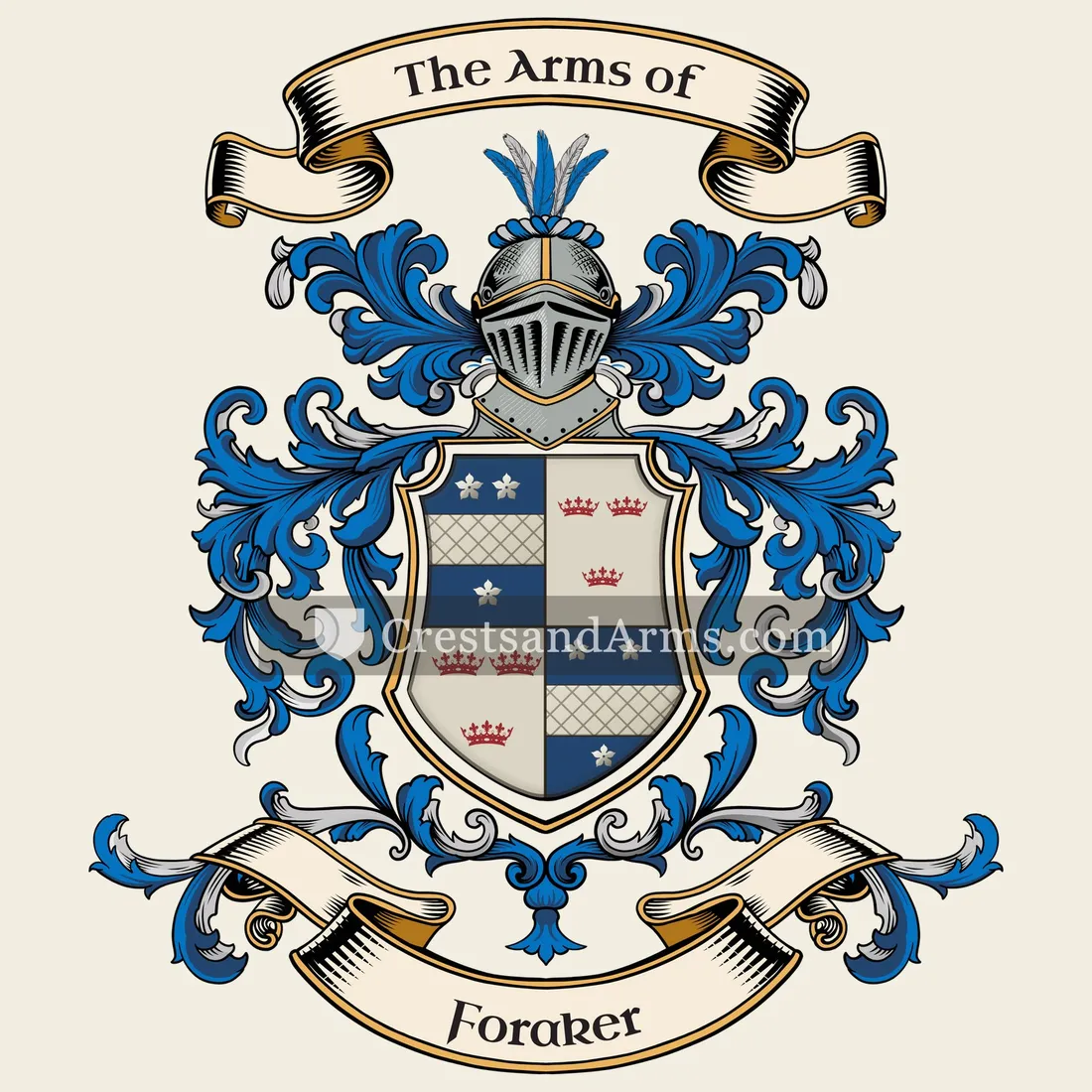
Symbols on this shield
fessThe military belt, and readiness to serve
cinquefoilHope and joy
crownSovereignty, authority and just reward
Colours
Blue (Azure)Means: Loyalty and truth
Silver (Argent)Means: Peace and sincerity
Red (Gules)Means: Military strength
Historical info
Source
Sir Bernard Burke, The General Armory of England, Scotland, Ireland and Wales, London: Harrison & Sons, 1884
Blazon (the actual original written record)
“Quarterly, 1st and 4th, az. a fess betw. three frases ar.; 2nd and 3rd, ar. three antique crowns gu”
InvernessPhilip Fraser · Inverness, c. 1692
Digital archive packCoat of arms PNG, gold border print PDF, vector SVG and the certificate of authenticity. Sent to your email in minutes.
Map of Scotland showing where the Foraker arms are recorded
The Foraker arms were recorded in Inverness, c. 1692.
Inverness was the largest Highland county, clan country of glens and long sea lochs. Chiefs recorded arms to mark the head of a family, and cadet branches recorded their own to show their place.
This is where the arms were entered in the register. Families often moved to other parts of the country, so the same name can turn up in more than one region.
The body that granted and recorded arms in Scotland in this period.
Mary II of England
Sovereign of the period
Mary II of England
1689–1694
Reigning in Finland when the Foraker arms are first recorded.
How Arms Worked in Scotland
Scottish heraldry is unique because it treats a coat of arms as a piece of personal property protected by law. Only one person can own a specific design at any given time. When a family grows, the head keeps the original shield while other relatives must apply for their own distinct version with slight changes to prove their specific identity.
Granting authority
The Court of the Lord Lyon acts as the official body that regulates and controls all heraldic matters throughout Scotland.
How they got arms
Individuals obtain a legal right to their arms through a formal petition process that confirms their identity and family connection.
Where arms were recorded
All valid coats of arms are officially entered into the Public Register of All Arms and Bearings starting from 1672.
The family's standing
Recorded among the armigerous families of Inverness.
Origin & History of the Foraker Family in Scotland
The history of the Foraker name in Scotland is deeply tied to the rugged landscape of the Highlands, specifically around the city of Inverness. By 1692, records confirm that families bearing this name were established in the region during a time of significant political and social transition. Life in Inverness during the late seventeenth century required great resilience, as the area served as a central hub for trade and military activity in the north. Families living there likely navigated the complex clan structures and shifting loyalties that defined Highland life after the Glorious Revolution. Because the name appears in local records during this era, it suggests that these early ancestors were integrated into the local community, perhaps working as craftsmen, farmers, or merchants who helped sustain the growing town. Their presence in the historical record provides a rare glimpse into the lives of ordinary people who helped shape the identity of the Inverness region before the major cultural changes of the eighteenth century.
Meaning of the Foraker family crest colors & symbols
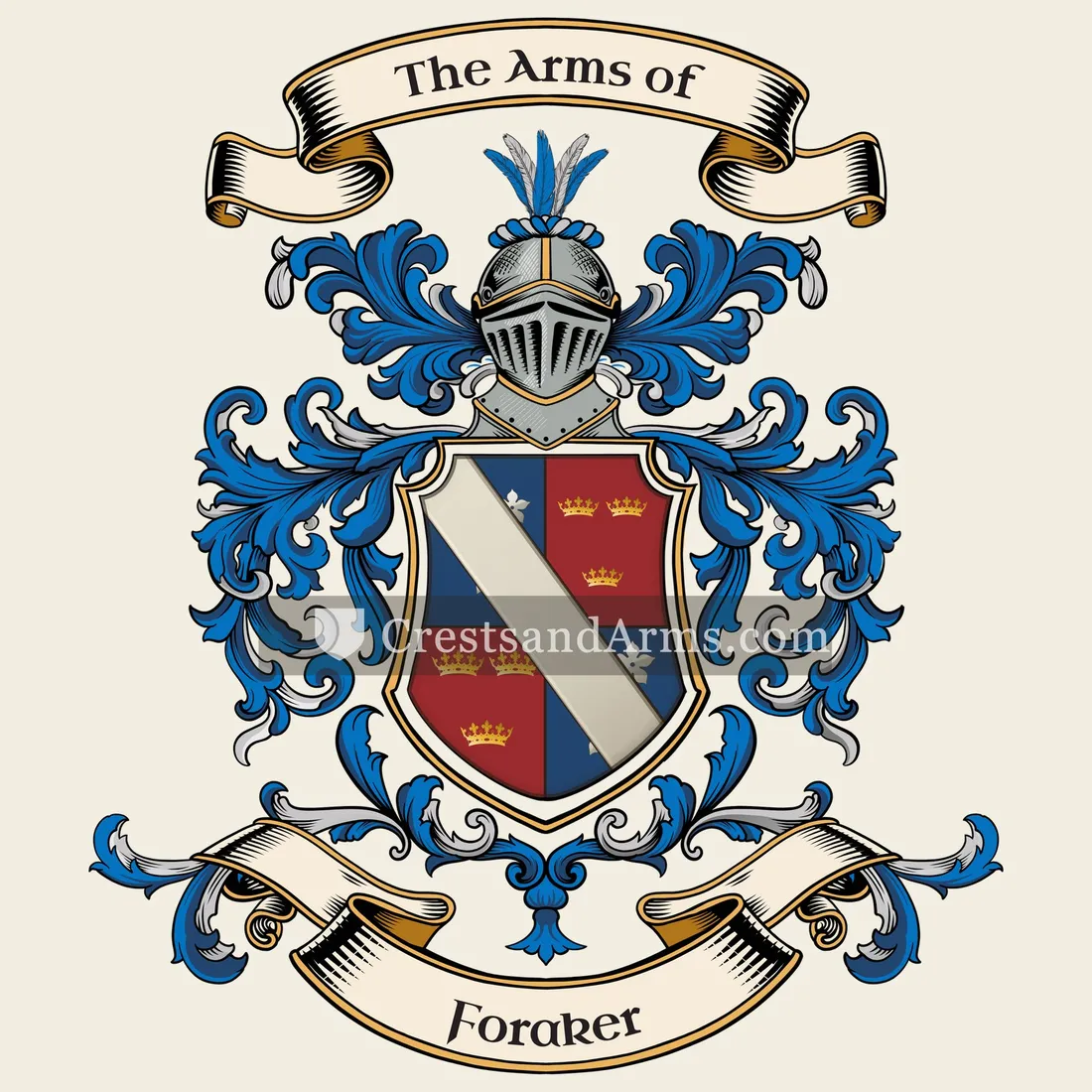
Symbols on this shield
bendDefence, and the scarf of a commander
cinquefoilHope and joy
crownSovereignty, authority and just reward
Colours
Blue (Azure)Means: Loyalty and truth
Red (Gules)Means: Military strength
Silver (Argent)Means: Peace and sincerity
Gold (Or)Means: Generosity
Historical info
Source
Sir Bernard Burke, The General Armory of England, Scotland, Ireland and Wales, London: Harrison & Sons, 1884
Blazon (the actual original written record)
“Quarterly, 1st and 4th, az. a bend engr. betw. three frases ar.; 2nd and 3rd, gu. three antique crowns or”
Englandc. 1798
Digital archive packCoat of arms PNG, gold border print PDF, vector SVG and the certificate of authenticity. Sent to your email in minutes.
Map of England showing where the Foraker arms are recorded
The Foraker arms were recorded in England, c. 1798.
Arms such as these were typically recorded in York.
Yorkshire is the largest of the English counties, and it held more gentry families than any other. Land there was split among a great many households rather than a few, so a great many of them carried arms.
This is where the arms were entered in the register. Families often moved to other parts of the country, so the same name can turn up in more than one region.
The body that granted and recorded arms in England in this period.
George III of Great Britain
Sovereign of the period
George III of Great Britain
1760–1801
Reigning in Finland when the Foraker arms are first recorded.
How Arms Worked in England
English heraldry allowed arms to be shared by all legitimate descendants of the original owner. These symbols were treated as personal property that moved through the generations to all children. While the eldest son kept the original design, other family members could use the same shield without needing to change it or register their own unique versions.
Granting authority
The College of Arms in London has regulated the use of coats of arms throughout England and Wales since 1484.
How they got arms
Families typically obtained their coats of arms through a formal grant from the Crown or by proving their ancient right to them.
Where arms were recorded
All official coats of arms are recorded in the registers kept at the College of Arms, which date back to the fifteenth century.
The family's standing
Recorded among the armigerous families of England.
Origin & History of the Foraker Family in England
The surname Foraker is rooted in the northern regions of England, specifically within the historic city of York. By the late 18th century, records confirm that families bearing this name were well-established in the area, living and working amidst the city’s ancient stone walls and bustling market streets. The name likely evolved from local descriptions of the landscape or the specific occupations held by early ancestors in the Yorkshire countryside. As the Industrial Revolution began to reshape England, families like the Forakers were part of the steady population that defined the social fabric of York. Their presence in the 1798 records suggests they were settled members of the community long before the modern era. This history reflects the quiet, persistent lives of ordinary people who helped build the identity of northern England through generations of labor and local connection.
Foraker Meaning & Related Branches
Root word
Foraker
Derived from the Old English word for a furrow or trench.
This name
ForakerRefers to a person who lived near a plowed field or furrow.
also spelled
Frasier
Frazer
Frayser
Fraysier
Documented Sources
J. B. Rietstap, Armorial Général, Gouda: G. B. van Goor Zonen, 1884–87


 cinquefoilHope and joy
 lionCourage, strength and royalty
 cinquefoilHope and joy
 lionCourage, strength and royalty

 fessThe military belt, and readiness to serve
 crownSovereignty, authority and just reward


 bendDefence, and the scarf of a commander