Map of Sweden showing where the Forbis arms are recorded
The Forbis arms were recorded in Sweden, c. 1700.
Arms such as these were typically recorded in Stockholm.
Stockholm held the Swedish court and the House of Nobility, where every noble family's arms were entered and kept. Families ennobled for service registered there, which is why so many are recorded around the city.
This is where the arms were entered in the register. Families often moved to other parts of the country, so the same name can turn up in more than one region.
The body that granted and recorded arms in Sweden in this period.
Carl XII of Sweden
Sovereign of the period
Carl XII of Sweden
1697–1718
Reigning in Sweden when the Forbis arms are first recorded.
How Arms Worked in Sweden
In Sweden, a coat of arms belonged to a noble family as a whole rather than just one individual. These arms were passed down through the generations to all legitimate descendants. Younger branches of the family used the same shield without needing to change it. This system ensured that the entire lineage shared the same identity and status under the law.
Granting authority
The Riddarhuset, or House of Nobility, regulated all noble coats of arms in Sweden under royal authority.
How they got arms
Families received their coats of arms through royal grants of nobility which were then officially registered with the House.
Where arms were recorded
Coats of arms were officially recorded in the Swedish House of Nobility register starting in the year 1626.
The family's standing
Recorded among the armigerous families of Sweden.
Origin & History of the Forbis Family in Sweden
The history of the Forbis name in Sweden begins in the bustling urban environment of Stockholm during the early 18th century. While the name likely originated from roots outside of Scandinavia, the family established a notable presence in the Swedish capital by the year 1700. During this period, Stockholm was a major hub for trade and craftsmanship, attracting skilled individuals from across Europe who sought to build new lives in a growing city. Members of the Forbis family integrated into this society by participating in the local economy and adapting to the social structures of the time. Their presence in the city records suggests they were part of the expanding middle class that helped shape the administrative and commercial life of Sweden during the transition into the modern era. By settling in such a central location, the family became part of the diverse cultural fabric that defined Stockholm at the turn of the century.
Coat of Arms & Family Crest Details
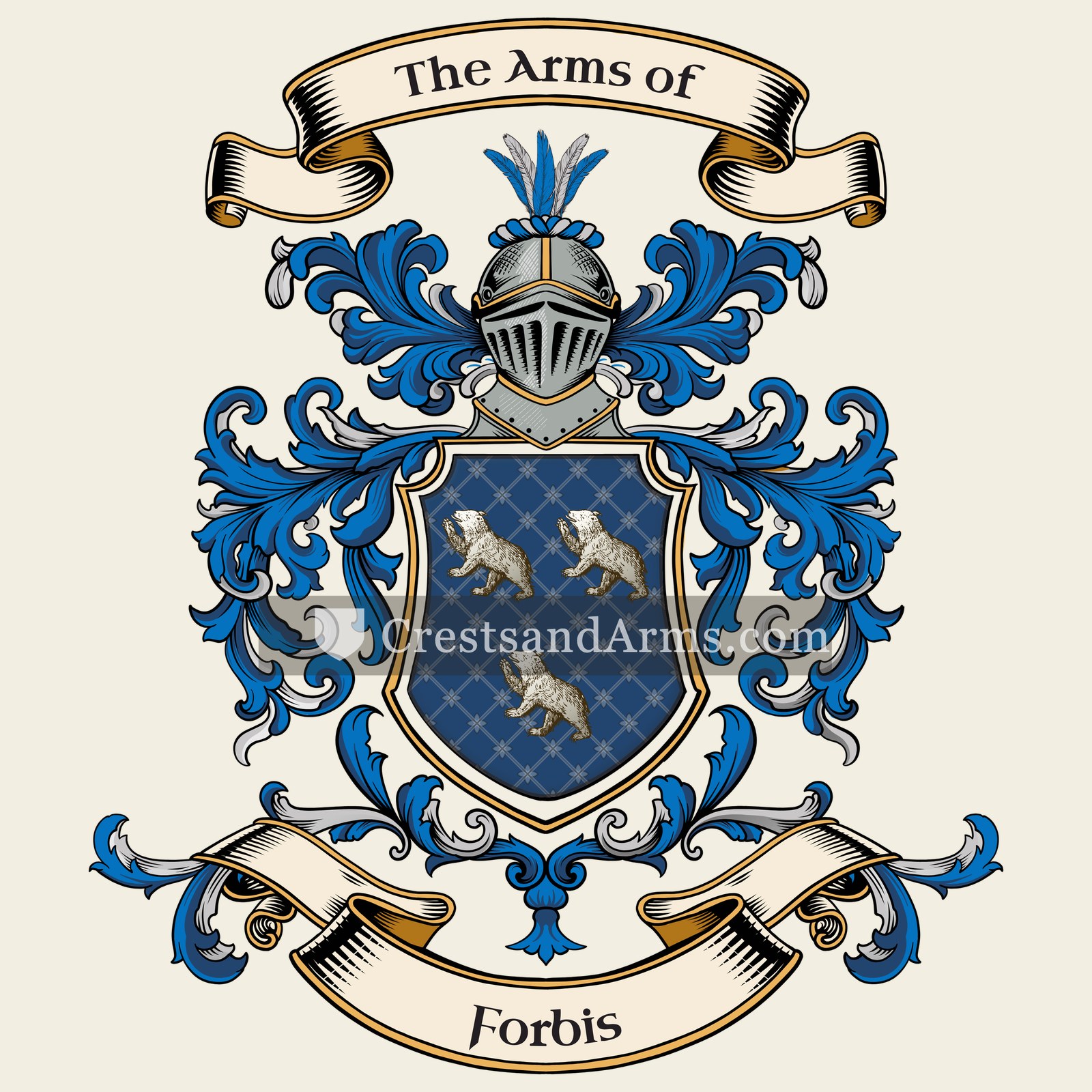
Symbols on this shield
bearStrength, cunning and protection of kin
Colours
Blue (Azure)Means: Loyalty and truth
Silver (Argent)Means: Peace and sincerity
Historical info
Source
J. B. Rietstap, Armorial Général, Gouda: G. B. van Goor Zonen, 1884–87
Blazon (the actual original written record)
“D'azur à trois têtes d'ours coupées d'arg., emmuselées de gu. C.: une tête et col de cerf au nat. S.: deux lévriers d'arg., coll. de gu. D.: GRACE ME GUIDE.”
Britainc. 1436
Digital archive packCoat of arms PNG, gold border print PDF, vector SVG and the certificate of authenticity. Sent to your email in minutes.
Map of Britain showing where the Forbis arms are recorded
The Forbis arms were recorded in Britain, c. 1436.
Arms such as these were typically recorded in Kent.
Kent sits between London and the short crossing to Europe, and the trade passing through made it wealthy. Merchant families bought land with that money, and it was landowners who took coats of arms.
This is where the arms were entered in the register. Families often moved to other parts of the country, so the same name can turn up in more than one region.
The body that granted and recorded arms in Britain in this period.
Henry VI of England
Sovereign of the period
Henry VI of England
1422–1461
Reigning in Sweden when the Forbis arms are first recorded.
How Arms Worked in Britain
English heraldry allowed arms to be shared by all legitimate descendants of the original owner. These symbols were treated as personal property that moved through the generations to all children. While the eldest son kept the original design, other family members could use the same shield without needing to change it or register their own unique versions.
Granting authority
The College of Arms in London has regulated the use of coats of arms throughout England and Wales since 1484.
How they got arms
Families typically obtained their coats of arms through a formal grant from the Crown or by proving their ancient right to them.
Where arms were recorded
All official coats of arms are recorded in the registers kept at the College of Arms, which date back to the fifteenth century.
The family's standing
Recorded among the armigerous families of Britain.
Origin & History of the Forbis Family in Britain
The surname Forbis is a variation of the Scottish name Forbes, which originated from the lands of Forbes in Aberdeenshire. While the name is deeply rooted in Scottish history, members of the family began moving south into England during the Middle Ages. By 1436, records confirm that individuals bearing this name were established in the county of Kent. At that time, Kent was a vital center for trade and agriculture, making it a common destination for families seeking new opportunities outside of their ancestral homes. The presence of the Forbis family in this region suggests they were part of a broader movement of people who traveled from the north to the south for work or service. Over time, the spelling of the name shifted as it adapted to local dialects and record-keeping practices in southern England, eventually becoming distinct from its northern origins.
Forbis Meaning & Related Branches
Root word
Forbes
Derived from the Gaelic word for a field or district.
This name
ForbisA locational surname originating from a place in Aberdeenshire, Scotland, meaning field.
also spelled
Forbis
Forbs
Forbus
Forbose
Documented Sources
J. B. Rietstap, Armorial Général, Gouda: G. B. van Goor Zonen, 1884–87
Stockholm City Archives (Stockholms stadsarkiv), Mantalslängder för Stockholms stad (1700)
Swedish National Archives (Riksarkivet), Kyrkoarkiv, Födelse- och dopböcker (1700–1750)
Digital archive packCoat of arms PNG, gold border print PDF, vector SVG and the certificate of authenticity. Sent to your email in minutes.


 crescentHonour by the sovereign, and the second son
 bearStrength, cunning and protection of kin
 crescentHonour by the sovereign, and the second son
 bearStrength, cunning and protection of kin