A record of documented arms, meaning and origin, researched for the Forde family lines. Documented in 2 countries.
Reg. 2128 · Irish, D–F
Meaning of the Forde family crest colors & symbols
Symbols on this shield
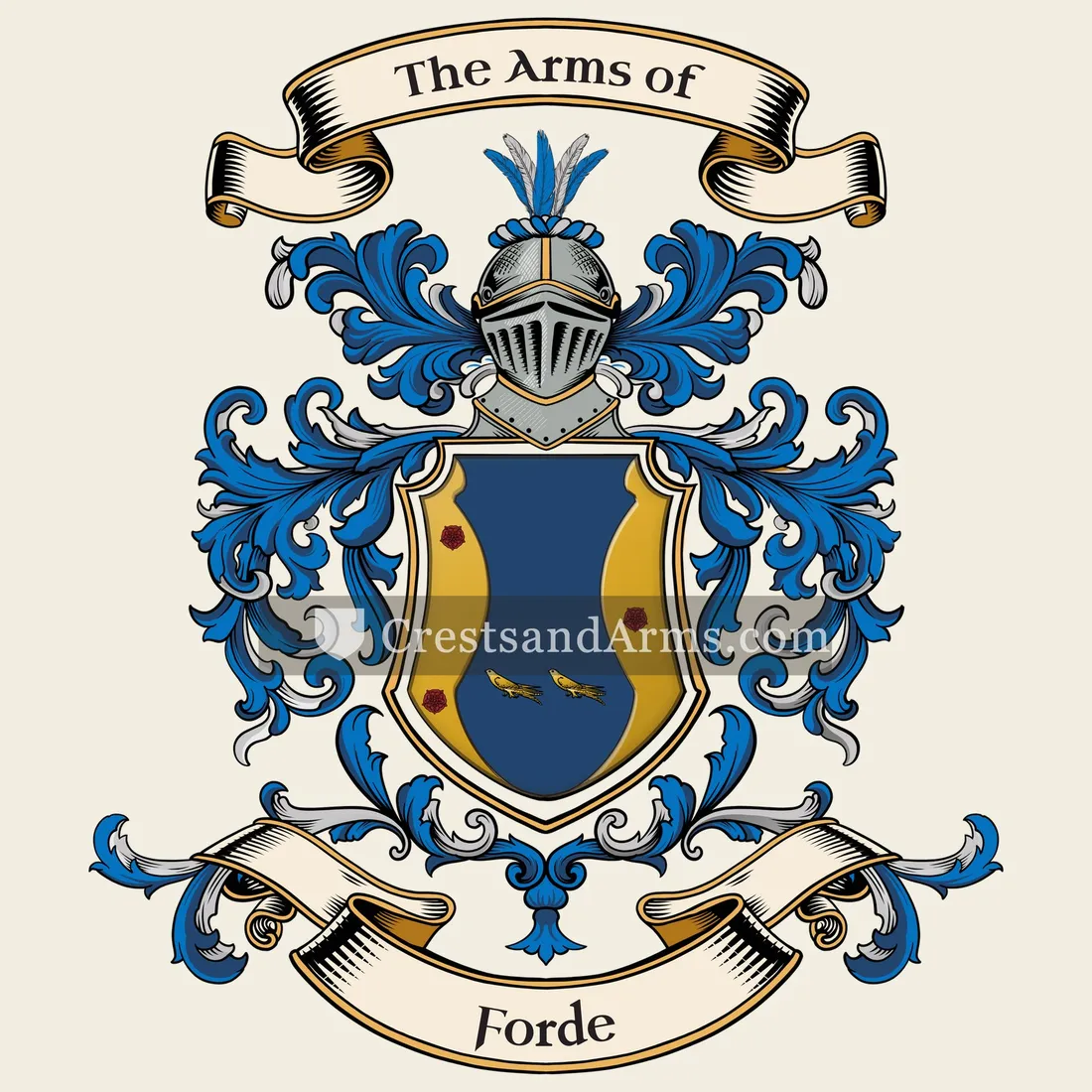
flaunchesA reward for virtue and learning
roseThe seventh son, and beauty with grace
martletA younger son, who must win his own land
Colours
Blue (Azure)Means: Loyalty and truth
Gold (Or)Means: Generosity
Red (Gules)Means: Military strength
Historical info
Source
Sir Bernard Burke, The General Armory of England, Scotland, Ireland and Wales, London: Harrison & Sons, 1884
Blazon (the actual original written record)
“Az. two flaunches or, charged with three roses in fesse, the centre rose gold, the two exterior (on the flaunches) gu. betw. two martlets of the second”
Irelandc. 1604
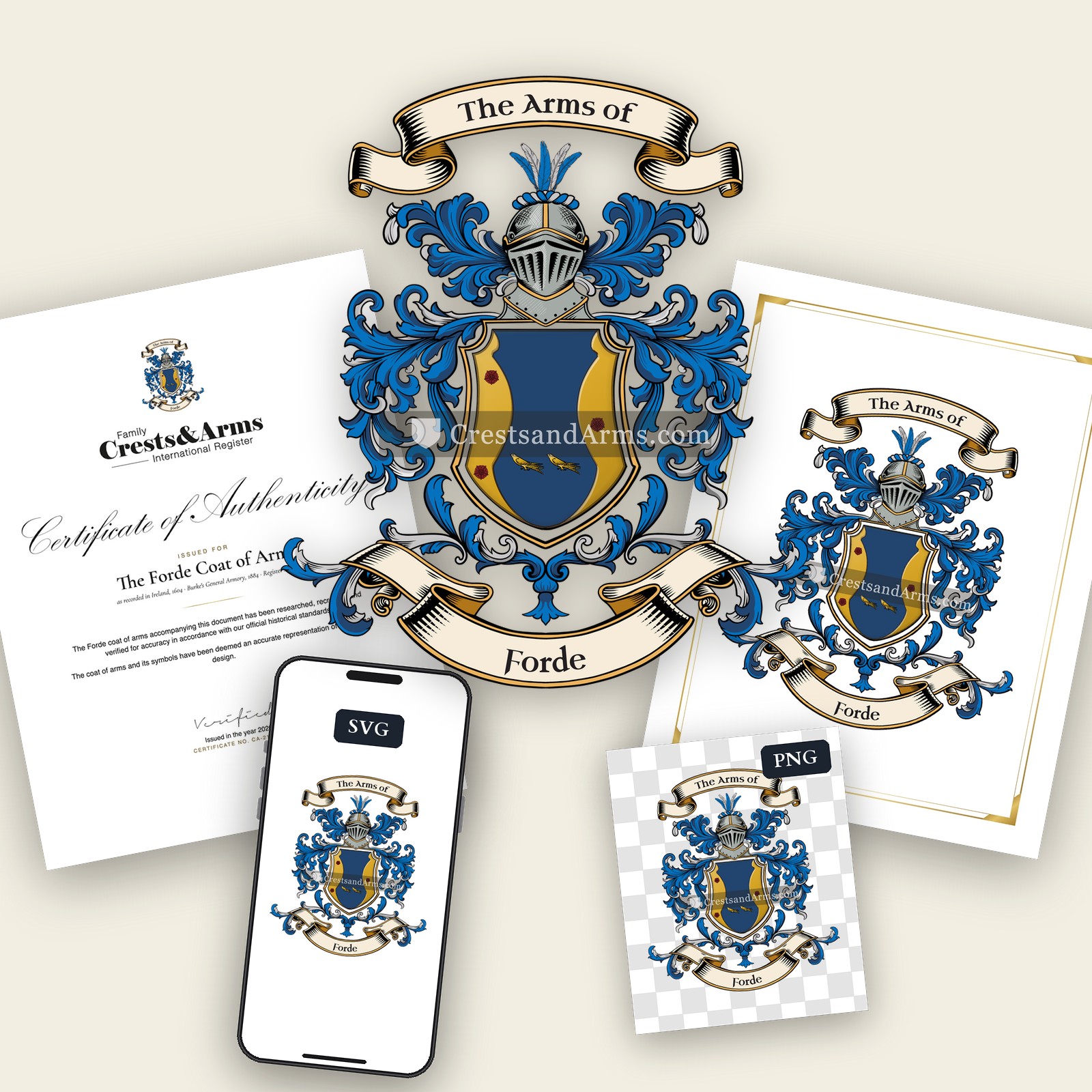
Digital archive packCoat of arms PNG, gold border print PDF, vector SVG and the certificate of authenticity. Sent to your email in minutes.
Map of Ireland showing where the Forde arms are recorded
The Forde arms were recorded in Ireland, c. 1604.
Arms such as these were typically recorded in Dublin.
Dublin was the seat of government in Ireland and the place where grants were sought and recorded. Families with business at the castle or the courts settled nearby, and settling there put their arms on record.
This is where the arms were entered in the register. Families often moved to other parts of the country, so the same name can turn up in more than one region.
The body that granted and recorded arms in Ireland in this period.
James VI and I
Sovereign of the period
James VI and I
1603–1625
Reigning in Ireland when the Forde arms are first recorded.
How Arms Worked in Ireland
The Ulster King of Arms granted coats of arms to individuals who proved their social standing and good character. These symbols were typically inherited by all legitimate descendants of the original holder. If a family branch wanted a unique look, they could apply for a specific change to their design through the office to ensure their identity remained distinct.
Granting authority
The Ulster King of Arms acted as the official body that regulated and issued all coats of arms throughout Ireland.
How they got arms
Families obtained their arms through formal grants issued by the office after proving their eligibility and paying the required fees.
Where arms were recorded
All official grants were recorded in the registers held by the Ulster King of Arms starting from the year 1552.
The family's standing
Recorded among the armigerous families of Ireland.
Origin & History of the Forde Family in Ireland
The surname Forde has deep roots in Ireland, where it functioned as a topographical name for families living near a river crossing or a ford. While the name exists in various parts of the country, historical records confirm that members of the Forde family were established in Dublin as early as 1604. During this period, the family was part of the growing urban population in the capital, often engaging in trade or local administration as the city expanded under English rule. Over the following centuries, the name became associated with several prominent landowning families, particularly in County Down and County Galway, where they integrated into the local social and political landscape. The name remains a testament to the family's long-standing presence in Ireland, reflecting both the geographical features of the landscape and the shifting history of the Irish people.
Meaning of the Forde family crest colors & symbols
Symbols on this shield
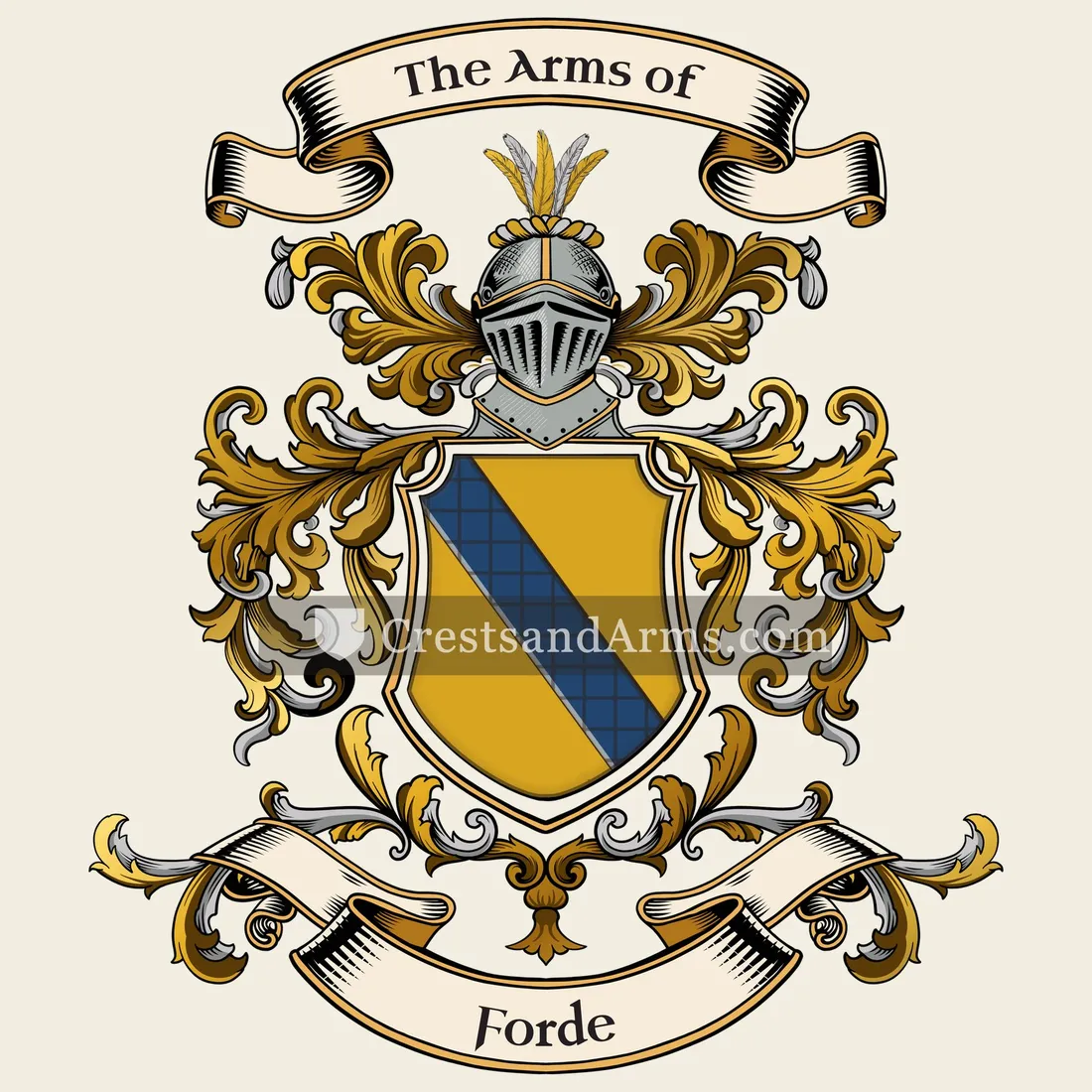
bendDefence, and the scarf of a commander
Colours
Gold (Or)Means: Generosity
Blue (Azure)Means: Loyalty and truth
Historical info
Source
Sir Bernard Burke, The General Armory of England, Scotland, Ireland and Wales, London: Harrison & Sons, 1884
Blazon (the actual original written record)
“Or, four bends az”
SuffolkHadley · Suffolk, c. 1620
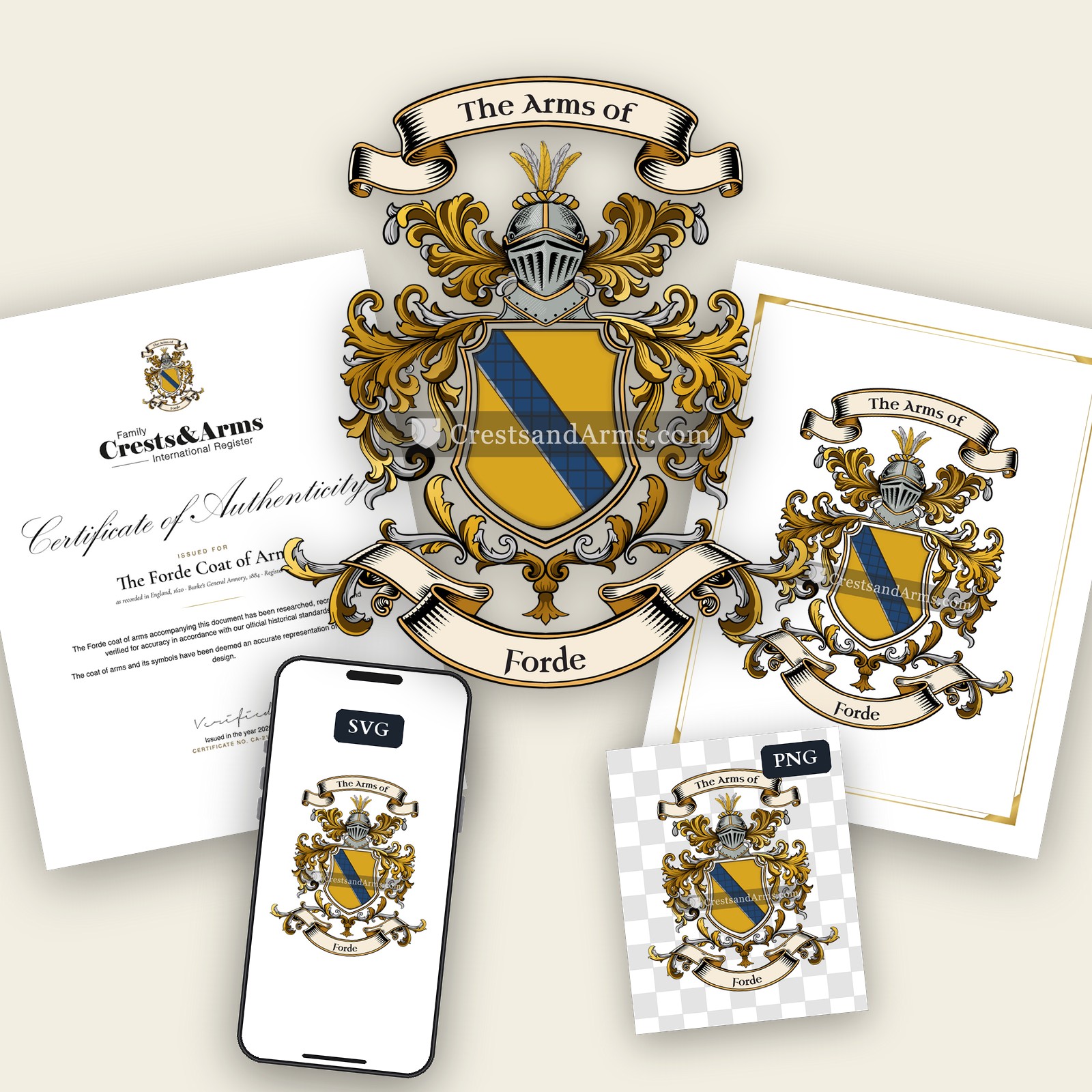
Digital archive packCoat of arms PNG, gold border print PDF, vector SVG and the certificate of authenticity. Sent to your email in minutes.
Map of England showing where the Forde arms are recorded
The Forde arms were recorded in Suffolk, c. 1620.
Suffolk was wool country, and its cloth towns were among the wealthiest in England. Clothier families bought manors with their profits, and holding a manor was the ordinary route to a coat of arms.
This is where the arms were entered in the register. Families often moved to other parts of the country, so the same name can turn up in more than one region.
The body that granted and recorded arms in England in this period.
James VI and I
Sovereign of the period
James VI and I
1603–1625
Reigning in Ireland when the Forde arms are first recorded.
How Arms Worked in England
English heraldry allowed arms to be shared by all legitimate descendants of the original owner. These symbols were treated as personal property that moved through the generations to all children. While the eldest son kept the original design, other family members could use the same shield without needing to change it or register their own unique versions.
Granting authority
The College of Arms in London has regulated the use of coats of arms throughout England and Wales since 1484.
How they got arms
Families typically obtained their coats of arms through a formal grant from the Crown or by proving their ancient right to them.
Where arms were recorded
All official coats of arms are recorded in the registers kept at the College of Arms, which date back to the fifteenth century.
The family's standing
Recorded among the armigerous families of Suffolk.
Origin & History of the Forde Family in England
The surname Forde is a classic example of a locative name, which means it was originally given to people based on where they lived. In medieval England, a ford was a shallow place in a river or stream that allowed people and animals to cross safely on foot or by cart. Families who settled near these natural crossings often became known as "at the Ford" or simply "Forde." By the time records show the family established in Suffolk in 1620, the name had already been in use for several centuries across various English counties. Because rivers were essential for trade and travel, these families were often situated in active, bustling areas of the countryside. Over time, the spelling shifted from simple descriptions of geography into a permanent family identity that was passed down through generations of farmers, tradespeople, and local landowners.
Forde Meaning & Related Branches
Root word
Fjord
Old Norse term for a narrow inlet of the sea.
This name
FordeRefers to someone who lived near a river crossing or a narrow inlet.
also spelled
Foord
Related arms
Foordvariant spelling
Fourdevariant spelling
Fourdesvariant spelling
Cardinallrecorded with Forde, same area
Documented Sources
Sir Bernard Burke, The General Armory of England, Scotland, Ireland and Wales, London: Harrison & Sons, 1884
MacLysaght, Edward. The Surnames of Ireland. 1985
Woulfe, Patrick. Sloinnte Gaedheal is Gall. 1923
Digital archive packCoat of arms PNG, gold border print PDF, vector SVG and the certificate of authenticity. Sent to your email in minutes.


 flaunchesA reward for virtue and learning
 roseThe seventh son, and beauty with grace
 martletA younger son, who must win his own land
 flaunchesA reward for virtue and learning
 roseThe seventh son, and beauty with grace
 martletA younger son, who must win his own land


 bendDefence, and the scarf of a commander