Map of Switzerland showing where the Forero arms are recorded
The Forero arms were recorded in Berne, c. 1745.
This is where the arms were entered in the register. Families often moved to other parts of the country, so the same name can turn up in more than one region.
The body that granted and recorded arms in Switzerland in this period.
How Arms Worked in Switzerland
In Switzerland, coats of arms were not restricted to the nobility and were often adopted by common citizens and families. These symbols were passed down through generations to show family identity. When branches of a family grew, they often changed small details of the design to distinguish their own line from the original group.
Granting authority
Cantonal and civic authorities managed the use of coats of arms within their specific regions and local jurisdictions.
How they got arms
Families typically assumed their own coats of arms based on local custom rather than receiving them from a central monarch.
Where arms were recorded
Arms were recorded in various cantonal and civic registers starting from the fourteenth century throughout the Swiss region.
The family's standing
Recorded among the armigerous families of Switzerland.
Origin & History of the Forero Family in Switzerland
The surname Forero is deeply rooted in the history of the Spanish-speaking world, though its presence in European regions like Switzerland by the mid-eighteenth century highlights the mobility of families during that era. While the name is most commonly associated with the Iberian Peninsula and later colonial Colombia, records confirm that members of the Forero family were established in Berne, Switzerland, as early as 1745. This suggests that the family was part of a broader network of merchants, soldiers, or skilled laborers who moved across borders for economic or political reasons. During this period, families often maintained their identity through their surname even as they integrated into new linguistic and cultural environments. The presence of the Forero name in Swiss municipal records provides a rare glimpse into the migration patterns of the eighteenth century and shows how a family name could travel far from its traditional geographic origins.
Related Branches & Arms
Root word
Forare
Latin verb meaning to pierce, bore, or drill through.
This name
ForeroRefers to a person who lived near a mountain pass or a narrow opening.
also spelled
Forrer
Vorer
Documented Sources
J. B. Rietstap, Armorial Général, Gouda: G. B. van Goor Zonen, 1884–87
Staatsarchiv des Kantons Bern (State Archives of the Canton of Bern), Kirchenrodel (Church Registers), 1745
Flórez de Ocáriz, Juan, Genealogías del Nuevo Reino de Granada, 1674
Digital archive packCoat of arms PNG, gold border print PDF, vector SVG and the certificate of authenticity. Sent to your email in minutes.


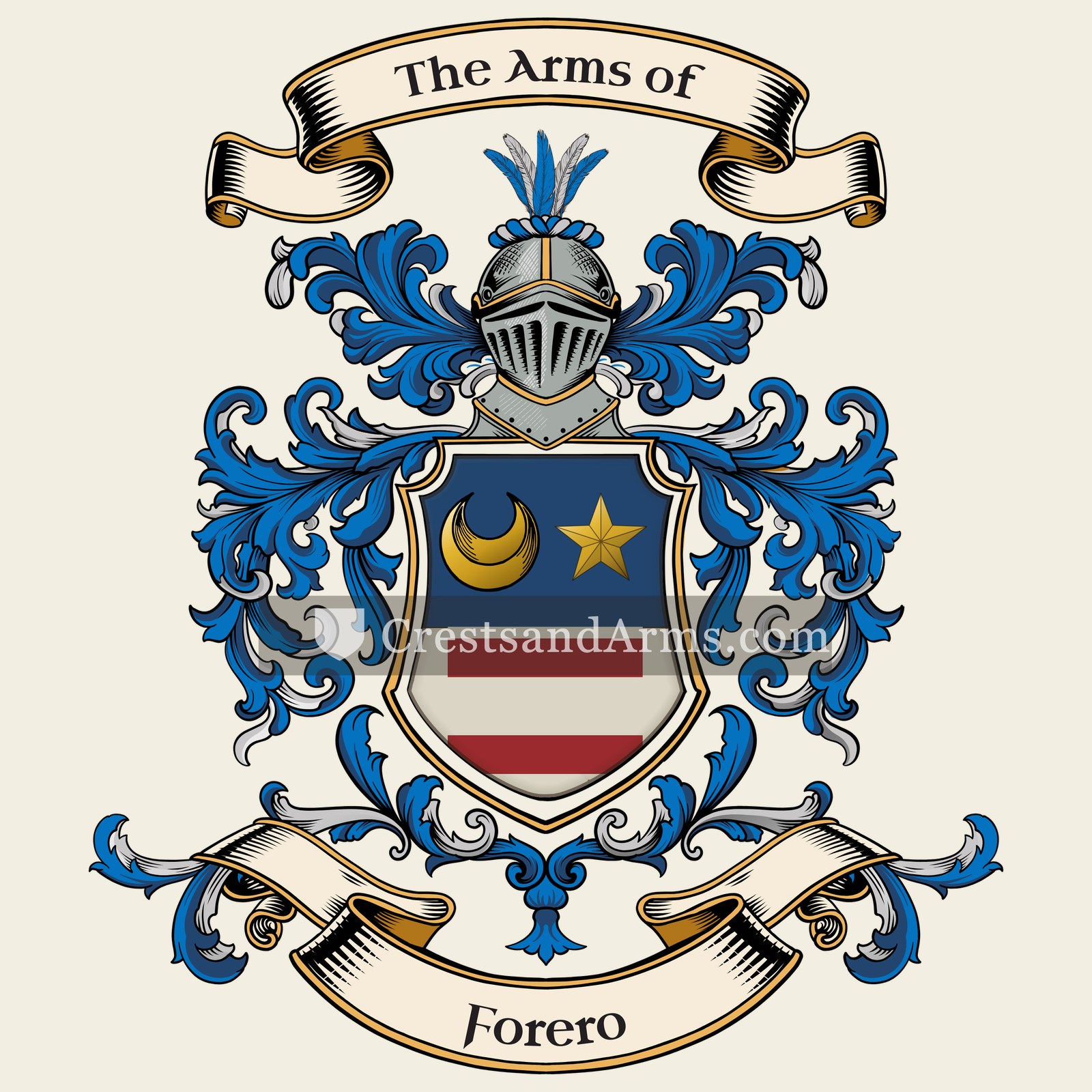
 crescentHonour by the sovereign, and the second son
 mulletThe third son, and a divine quality from above
 crescentHonour by the sovereign, and the second son
 mulletThe third son, and a divine quality from above