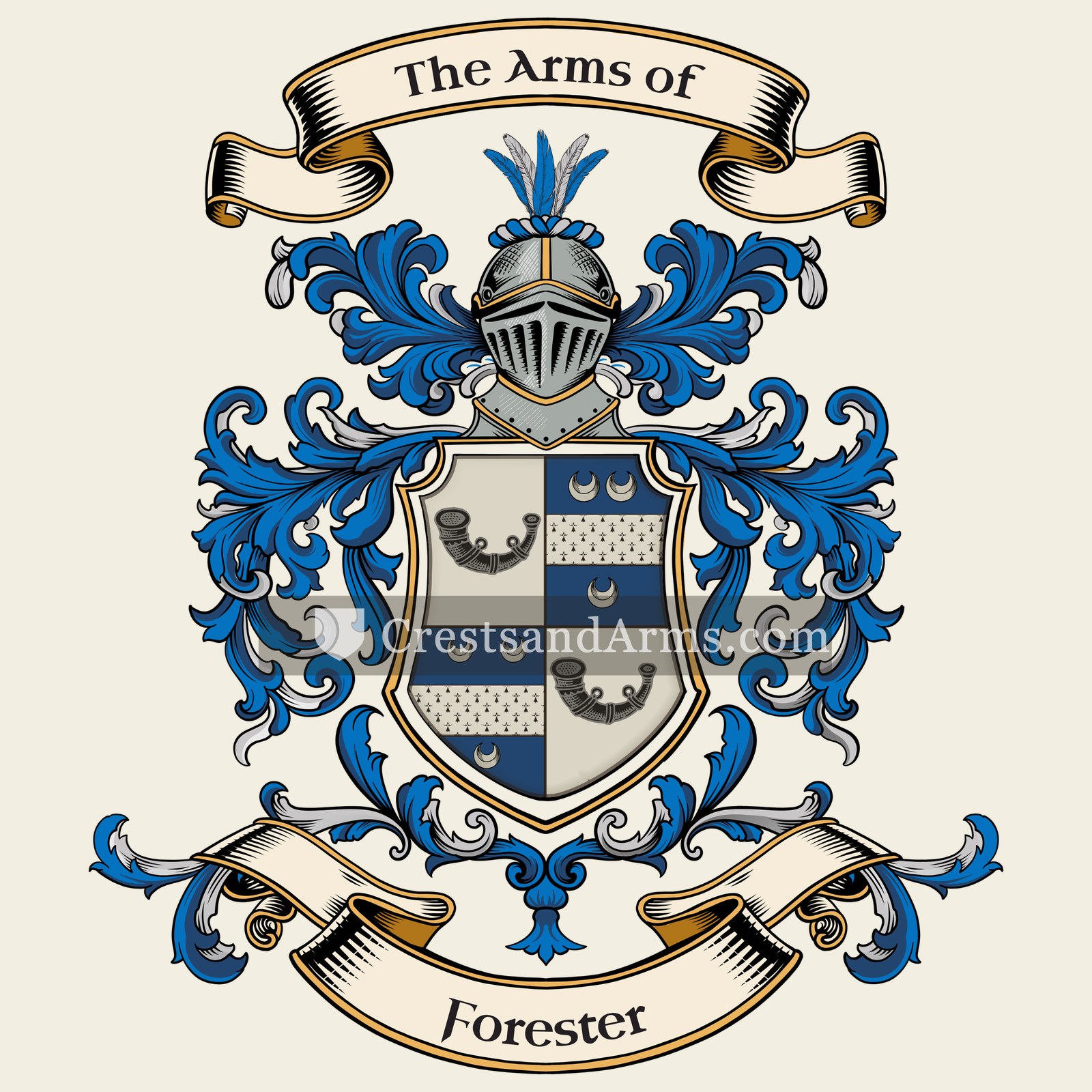
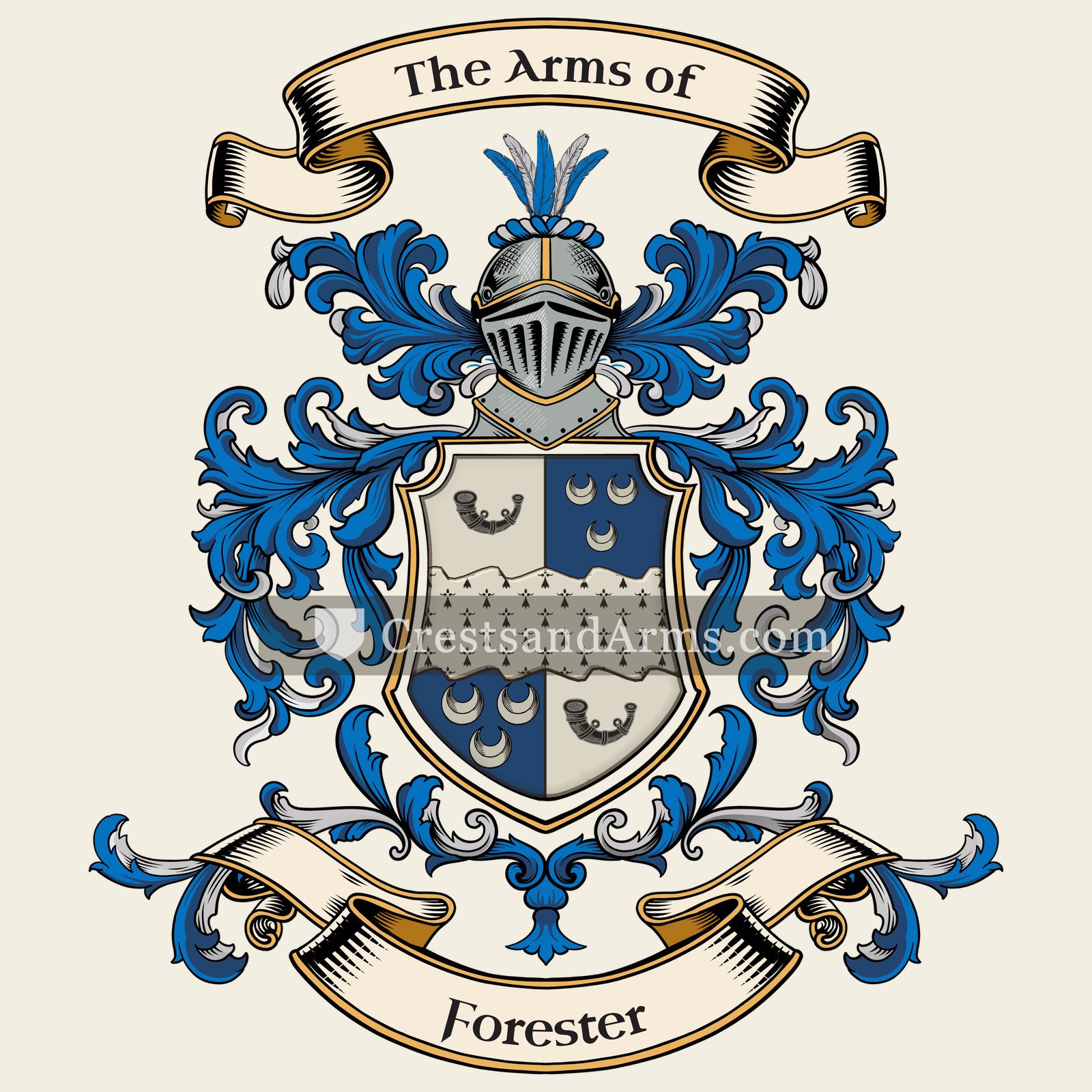
A record of documented arms, meaning and origin, researched for the Forester family lines. Documented in 2 countries.
Reg. 9190 · French, D–F
Coat of Arms & Family Crest Details
Symbols on this shield
fessThe military belt, and readiness to serve
hunting horn stringedOne who delights in the chase
crescentHonour by the sovereign, and the second son
Colours
Silver (Argent)Means: Peace and sincerity
Blue (Azure)Means: Loyalty and truth
ErmineMeans: Dignity
Black (Sable)Means: Constancy
Historical info
Source
J. B. Rietstap, Armorial Général, Gouda: G. B. van Goor Zonen, 1884–87
Blazon (the actual original written record)
“Ec.: aux I et IV. c.-éc. d'arg. et de sa., la ligne du coupé denchée; chaque quartier d'arg. ch. d'un cor-de-chasse de sa., lié d'or (Forester); aux II et III. d'azur à la fasce brét. et c.-brét. d'herm., acc. de trois croiss du même (Weld). C.: 1° un dogue pass. d'arg., coll. de sa., enchainé d'or (Forester); 2° un dragon aile de sa., semé de larmes d'or, coll. du même, enchainé aussi d'or (Weld). S.: deux dogues d'arg., ornés d'un collier de sa., auquel est suspendu un cor-de-chasse du même, lié d'or. D.: SEMPER EADEM.”
Francec. 1821
Digital archive packCoat of arms PNG, gold border print PDF, vector SVG and the certificate of authenticity. Sent to your email in minutes.
Map of France showing where the Forester arms are recorded
The Forester arms were recorded in France, c. 1821.
Arms such as these were typically recorded in Bretagne.
More families held coats of arms in Bretagne than anywhere else in France. The land was divided into many small estates rather than a few large ones, so far more households counted as gentry, and each needed a shield of its own to be told apart.
This is where the arms were entered in the register. Families often moved to other parts of the country, so the same name can turn up in more than one region.
The body that granted and recorded arms in France in this period.
How Arms Worked in France
In France, a coat of arms was a mark of honor that passed down through the male line to all legitimate descendants. Families often used the same shield without changes to show their shared heritage. If a branch wanted to stand out, they could add a small mark to their shield to show their specific place in the family tree.
Granting authority
The Juge d'armes de France acted as the official authority that regulated and verified coats of arms across the country.
How they got arms
Families typically inherited their arms from ancestors, though they could also receive them through royal grants or by proving their noble status.
Where arms were recorded
Coats of arms were officially recorded in the Armorial Général de France, which began its main collection in the year 1696.
The family's standing
Recorded among the armigerous families of France.
Origin & History of the Forester Family in France
The surname Forester traces its roots to the professional duties of those who managed and protected the vast woodlands of medieval Europe. In France, the name evolved from the Old French term *forestier*, which identified an official responsible for enforcing forest laws and maintaining the health of royal or noble timberlands. By the early nineteenth century, the family had established a documented presence in the region of Bretagne. Records from 1821 confirm that members of the family were living in this northwestern coastal area, where they likely integrated into the local agricultural or administrative life of the province. During this period, the name served as a link to a long tradition of land stewardship, reflecting a history tied to the management of the French countryside and the practical needs of rural communities.
Coat of Arms & Family Crest Details
Symbols on this shield
fessThe military belt, and readiness to serve
hunting horn stringedOne who delights in the chase
crescentHonour by the sovereign, and the second son
Colours
Silver (Argent)Means: Peace and sincerity
Blue (Azure)Means: Loyalty and truth
ErmineMeans: Dignity
Black (Sable)Means: Constancy
Historical info
Source
Sir Bernard Burke, The General Armory of England, Scotland, Ireland and Wales, London: Harrison & Sons, 1884
Blazon (the actual original written record)
“Quarterly, 1st and 4th, quarterly, per fesse indented ar. and sa. in the 1st and 4th quarters a buglehorn of the last, garnished or, for FORESTER; 2nd and 3rd, az. a fesse nebuly betw. three crescents, two and one, erm., for WELD”
Englandc. 1620
Digital archive packCoat of arms PNG, gold border print PDF, vector SVG and the certificate of authenticity. Sent to your email in minutes.
Map of England showing where the Forester arms are recorded
The Forester arms were recorded in England, c. 1620.
Arms such as these were typically recorded in York.
Yorkshire is the largest of the English counties, and it held more gentry families than any other. Land there was split among a great many households rather than a few, so a great many of them carried arms.
This is where the arms were entered in the register. Families often moved to other parts of the country, so the same name can turn up in more than one region.
The body that granted and recorded arms in England in this period.
James VI and I
Sovereign of the period
James VI and I
1603–1625
Reigning in France when the Forester arms are first recorded.
How Arms Worked in England
English heraldry allowed arms to be shared by all legitimate descendants of the original owner. These symbols were treated as personal property that moved through the generations to all children. While the eldest son kept the original design, other family members could use the same shield without needing to change it or register their own unique versions.
Granting authority
The College of Arms in London has regulated the use of coats of arms throughout England and Wales since 1484.
How they got arms
Families typically obtained their coats of arms through a formal grant from the Crown or by proving their ancient right to them.
Where arms were recorded
All official coats of arms are recorded in the registers kept at the College of Arms, which date back to the fifteenth century.
The family's standing
Recorded among the armigerous families of England.
Origin & History of the Forester Family in England
The surname Forester originated as an occupational name for a person who worked as a forest warden or a gamekeeper in medieval England. During this period, the royal forests were strictly managed areas where the king held exclusive rights to the land and the wildlife. Men with this title were responsible for enforcing forest laws, protecting timber, and managing the deer populations for the nobility. By the time members of the family were documented in York in 1620, the name had transitioned from a specific job title into a hereditary family name. These early settlers in Yorkshire were likely part of a growing urban middle class that relied on trade and local administration rather than the rural forestry work that defined their ancestors. As the family established roots in northern England, they became part of the social fabric of a city known for its deep historical ties to both Roman and Viking heritage.
Forester Meaning & Related Branches
Root word
foris
Latin term meaning outside or out of doors.
This name
ForesterAn occupational surname for someone who worked as a guardian of the forest.
also spelled
Forrester
Forster
Forrestier
Related arms
Forstersimilar arms
Forrestervariant spelling
Fosterrecorded with Forester, same area
David ap Griffithrecorded with Forester, same area
Documented Sources
J. B. Rietstap, Armorial Général, Gouda: G. B. van Goor Zonen, 1884–87
Archives Départementales du Morbihan, État civil de la commune de Vannes, 1821
Dauzat, Albert, Dictionnaire étymologique des noms et prénoms de France, 1951
Morlet, Marie-Thérèse, Dictionnaire étymologique des noms de famille, 1991
Digital archive packCoat of arms PNG, gold border print PDF, vector SVG and the certificate of authenticity. Sent to your email in minutes.


 fessThe military belt, and readiness to serve
 hunting horn stringedOne who delights in the chase
 crescentHonour by the sovereign, and the second son
 fessThe military belt, and readiness to serve
 hunting horn stringedOne who delights in the chase
 crescentHonour by the sovereign, and the second son