Map of France showing where the Forestier arms are recorded
The Forestier arms were recorded in Flandre, c. 1663.
Flandre grew rich on cloth, and its towns were among the busiest in Europe. Merchant families bought land with their profits and took arms to go with it, so trade put as many names in the registers here as land did.
This is where the arms were entered in the register. Families often moved to other parts of the country, so the same name can turn up in more than one region.
The body that granted and recorded arms in France in this period.
Louis XIV of France
Sovereign of the period
Louis XIV of France
1643–1715
Reigning in France when the Forestier arms are first recorded.
How Arms Worked in France
In France, a coat of arms was a mark of honor that passed down through the male line to all legitimate descendants. Families often used the same shield without changes to show their shared heritage. If a branch wanted to stand out, they could add a small mark to their shield to show their specific place in the family tree.
Granting authority
The Juge d'armes de France acted as the official authority that regulated and verified coats of arms across the country.
How they got arms
Families typically inherited their arms from ancestors, though they could also receive them through royal grants or by proving their noble status.
Where arms were recorded
Coats of arms were officially recorded in the Armorial Général de France, which began its main collection in the year 1696.
The family's standing
Recorded among the armigerous families of Flandre.
Origin & History of the Forestier Family in France
The surname Forestier is a classic occupational name that originated in medieval France to identify individuals who worked as forest wardens or keepers of the woods. During the feudal era, these men were responsible for managing royal forests, protecting timber, and enforcing hunting laws on behalf of local lords. By the mid-seventeenth century, the name had spread across various regions, including the northern territories of Flandre. Records confirm that members of the Forestier family were established in this region by 1663, likely serving in roles that required them to oversee the dense woodlands that defined the landscape of the time. As the family moved through different provinces, they maintained their connection to the land and the administrative duties associated with their historic title. This transition from a professional designation to a permanent family name reflects the way many French families adopted their trade as a way to distinguish themselves within their local communities.
Coat of Arms & Family Crest Details
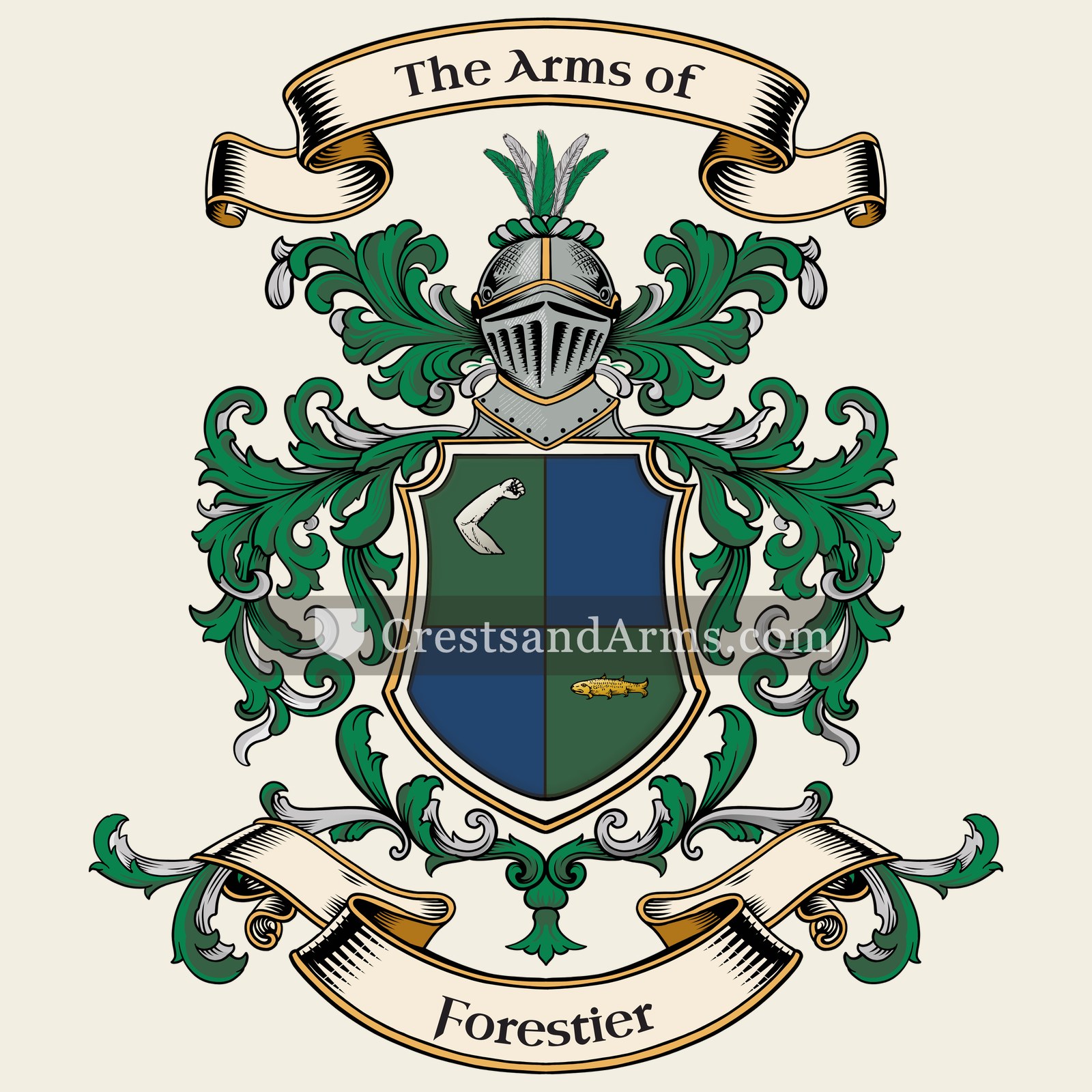
Symbols on this shield
armA person of action, industrious and laborious
fishA true and generous mind, and Christian faith
Colours
Green (Vert)Means: Hope
Blue (Azure)Means: Loyalty and truth
Silver (Argent)Means: Peace and sincerity
Gold (Or)Means: Generosity
Historical info
Source
J. B. Rietstap, Armorial Général, Gouda: G. B. van Goor Zonen, 1884–87
Blazon (the actual original written record)
“Ec. de sin., d'azur, de gu. et de sin.; à un bras d'arg., mouv. du canton sen. du chef, br. en barre sur l'écartelé et tenant une pique d'or, en bande sur ledit écartelé.”
SwitzerlandFribourg, c. 1745
Digital archive packCoat of arms PNG, gold border print PDF, vector SVG and the certificate of authenticity. Sent to your email in minutes.
Map of Switzerland showing where the Forestier arms are recorded
The Forestier arms were recorded in Fribourg, c. 1745.
This is where the arms were entered in the register. Families often moved to other parts of the country, so the same name can turn up in more than one region.
The body that granted and recorded arms in Switzerland in this period.
How Arms Worked in Switzerland
In Switzerland, coats of arms were not restricted to the nobility and were often adopted by common citizens and families. These symbols were passed down through generations to show family identity. When branches of a family grew, they often changed small details of the design to distinguish their own line from the original group.
Granting authority
Cantonal and civic authorities managed the use of coats of arms within their specific regions and local jurisdictions.
How they got arms
Families typically assumed their own coats of arms based on local custom rather than receiving them from a central monarch.
Where arms were recorded
Arms were recorded in various cantonal and civic registers starting from the fourteenth century throughout the Swiss region.
The family's standing
Recorded among the armigerous families of Switzerland.
Origin & History of the Forestier Family in Switzerland
The surname Forestier originates from the Old French word for a forest warden or a keeper of the woods. In the context of Switzerland, the name reflects the vital role that forestry played in the survival and economy of mountain communities. By the year 1745, members of the Forestier family were well established in the canton of Fribourg. During this period, families in the region were often tied to specific trades or land management duties assigned by local authorities. Because the Fribourg region was heavily forested, those bearing the name likely served as essential administrators who managed timber resources and protected woodland boundaries. This professional connection to the land helped the family integrate into the social fabric of the area, allowing them to maintain a consistent presence in local records for generations.
Forestier Meaning & Related Branches
Root word
forestis
Late Latin term referring to open woods or hunting grounds.
This name
ForestierAn occupational surname for a person who worked as a forest warden or gamekeeper.
also spelled
Forestyer
Forestie
Forestyay
Forester
Related arms
Forestriesame arms
Gouesimilar arms
Gross de Waldsimilar arms
Scheumannsimilar arms
Documented Sources
J. B. Rietstap, Armorial Général, Gouda: G. B. van Goor Zonen, 1884–87
Dauzat, Albert. Dictionnaire étymologique des noms de famille et prénoms de France. 1951
Morlet, Marie-Thérèse. Dictionnaire étymologique des noms de famille. 1991
Archives départementales du Nord, Série B: Cours et juridictions
Digital archive packCoat of arms PNG, gold border print PDF, vector SVG and the certificate of authenticity. Sent to your email in minutes.


 chevronProtection, and faithful service completed
 acornAntiquity and strength from small beginnings
 chevronProtection, and faithful service completed
 acornAntiquity and strength from small beginnings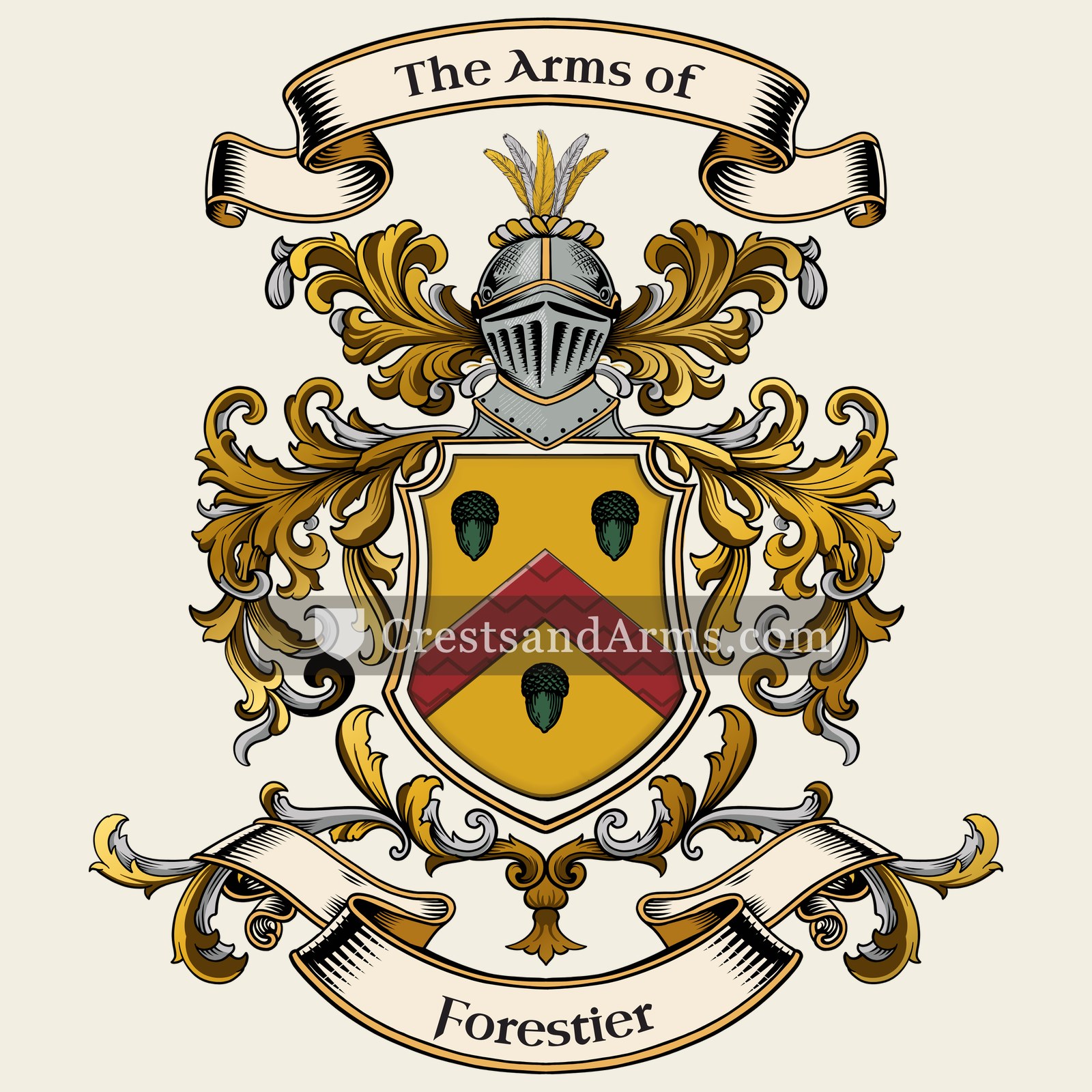


 armA person of action, industrious and laborious
 fishA true and generous mind, and Christian faith