Map of Germany showing where the Forno arms are recorded
The Forno arms were recorded in Silesia, c. 1765.
Silesia was farming country in the east of the German lands, held in large estates by families who stayed put for generations. Owning land was what entitled a family to arms, so the region fills a good deal of the register.
This is where the arms were entered in the register. Families often moved to other parts of the country, so the same name can turn up in more than one region.
The body that granted and recorded arms in Germany in this period.
Francis I, Holy Roman Emperor
Sovereign of the period
Francis I, Holy Roman Emperor
1745–1765
Reigning in Germany when the Forno arms are first recorded.
How Arms Worked in Germany
In the Holy Roman Empire, coats of arms were often granted to individuals by the Emperor or his representatives. These arms were then passed down through the generations to all legitimate descendants of the original holder. Younger branches of a family usually kept the same shield design without needing to change it, as the arms belonged to the entire lineage.
Granting authority
The Holy Roman Emperor held the sole power to grant new coats of arms throughout his vast imperial territories.
How they got arms
Families typically obtained their coats of arms through a formal imperial grant or by proving their noble status to the authorities.
Where arms were recorded
These grants were officially recorded in the Imperial Chancery registers, which began keeping formal records of such honors during the Middle Ages.
The family's standing
Recorded among the armigerous families of Silesia.
Origin & History of the Forno Family in Germany
The family name Forno carries a history deeply rooted in the cultural landscape of Central Europe, with documented evidence placing members of the family in the region of Silesia as early as 1765. During this period, Silesia was a vibrant territory caught between shifting borders and changing political powers, which often influenced how families settled and identified themselves. The name itself likely originated from occupational or geographical roots, as the term relates to the concept of a hearth or an oven in various European languages. Families living in Silesia during the mid-eighteenth century were often part of a complex social structure that included farmers, craftsmen, and small-scale merchants. By establishing their presence in this area, the Forno family became part of a long tradition of migration and settlement that defined the German-speaking lands of the era. Their survival and growth in the region reflect the broader patterns of daily life, trade, and community building that characterized the Silesian population before the industrial changes of the following century.
Coat of Arms & Family Crest Details
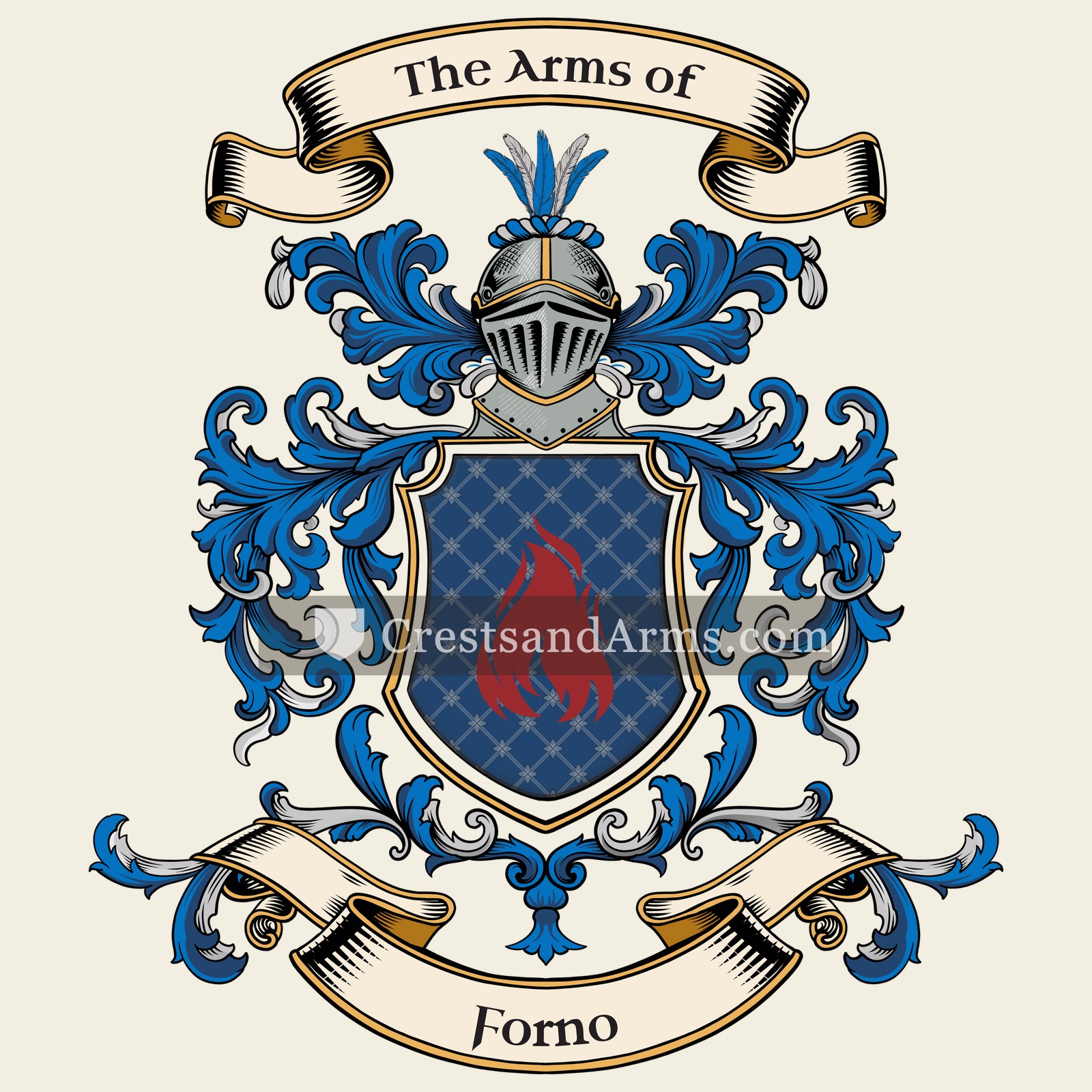
Symbols on this shield
fireZeal and purification
Colours
Blue (Azure)Means: Loyalty and truth
Red (Gules)Means: Military strength
Historical info
Source
J. B. Rietstap, Armorial Général, Gouda: G. B. van Goor Zonen, 1884–87
Blazon (the actual original written record)
“D'azur à un portique d'arg., essoré de gu., et un feu de gu., brûlant sur le seuil. Cq. cour. C.: une aigle de profil de sa., le vol levé. L.: d'arg. et d'azur.”
Italyc. 1775
Digital archive packCoat of arms PNG, gold border print PDF, vector SVG and the certificate of authenticity. Sent to your email in minutes.
Map of Italy showing where the Forno arms are recorded
The Forno arms were recorded in Italy, c. 1775.
Arms such as these were typically recorded in Venice.
Venice ran on trade, and its great families were merchants before they were anything else. The city kept a formal list of its noble houses, and a name on that list carried arms as a matter of record.
This is where the arms were entered in the register. Families often moved to other parts of the country, so the same name can turn up in more than one region.
The body that granted and recorded arms in Italy in this period.
Alvise Giovanni Mocenigo
Sovereign of the period
Alvise Giovanni Mocenigo
1763–1778
Reigning in Germany when the Forno arms are first recorded.
How Arms Worked in Italy
In the Italian states, coats of arms were often used by noble families to show their status and history. These symbols were passed down through the generations to all legitimate male descendants. Younger branches of a family usually kept the original design but sometimes added small changes to distinguish their specific line from the main branch.
Granting authority
Various local rulers and city governments controlled the use of coats of arms across the different Italian states.
How they got arms
Families often assumed their own arms or received them as official grants from local lords, popes, or city councils.
Where arms were recorded
Arms were recorded in local city archives or private family books rather than in one single national register.
The family's standing
Recorded among the armigerous families of Italy.
Origin & History of the Forno Family in Italy
The surname Forno originates from the Italian word for oven, which suggests that the earliest members of the family likely worked as bakers or managed communal ovens in their local villages. During the medieval and early modern periods in Italy, names were often derived from a person’s trade, and the Forno family would have held a vital role in providing daily bread to their neighbors. By the late 18th century, records confirm that the family had established a notable presence in Venice. Living in a major maritime republic like Venice allowed the family to participate in a bustling urban economy where trade and craftsmanship were highly valued. While the exact origins of the family remain tied to these professional roots, their documented history in 1775 shows them as part of the vibrant social fabric of one of Italy’s most influential historical cities.
Forno Meaning & Related Branches
Root word
Furnus
Latin term for an oven or a kiln used for baking.
This name
FornoAn occupational surname for a baker or someone who operated a communal oven.
Documented Sources
J. B. Rietstap, Armorial Général, Gouda: G. B. van Goor Zonen, 1884–87
Knie, Johann Georg. Alphabetisch-statistisch-topographische Uebersicht der Dörfer, Flecken, Städte und anderen Orte der königlichen preußischen Provinz Schlesien. 1845
Digital archive packCoat of arms PNG, gold border print PDF, vector SVG and the certificate of authenticity. Sent to your email in minutes.


 lozengeHonour and nobility, and the arms of a woman
 mulletThe third son, and a divine quality from above
 lozengeHonour and nobility, and the arms of a woman
 mulletThe third son, and a divine quality from above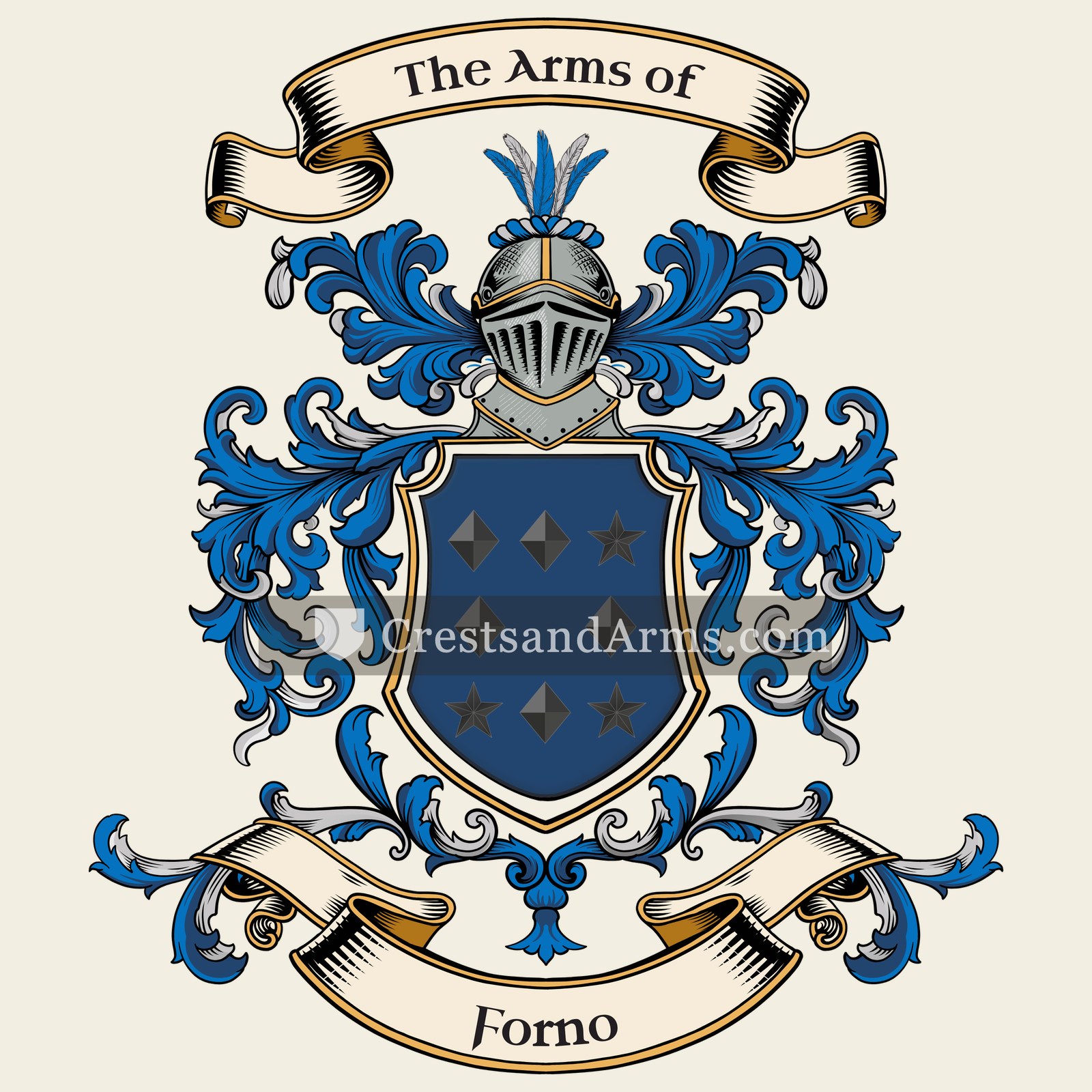


 fireZeal and purification