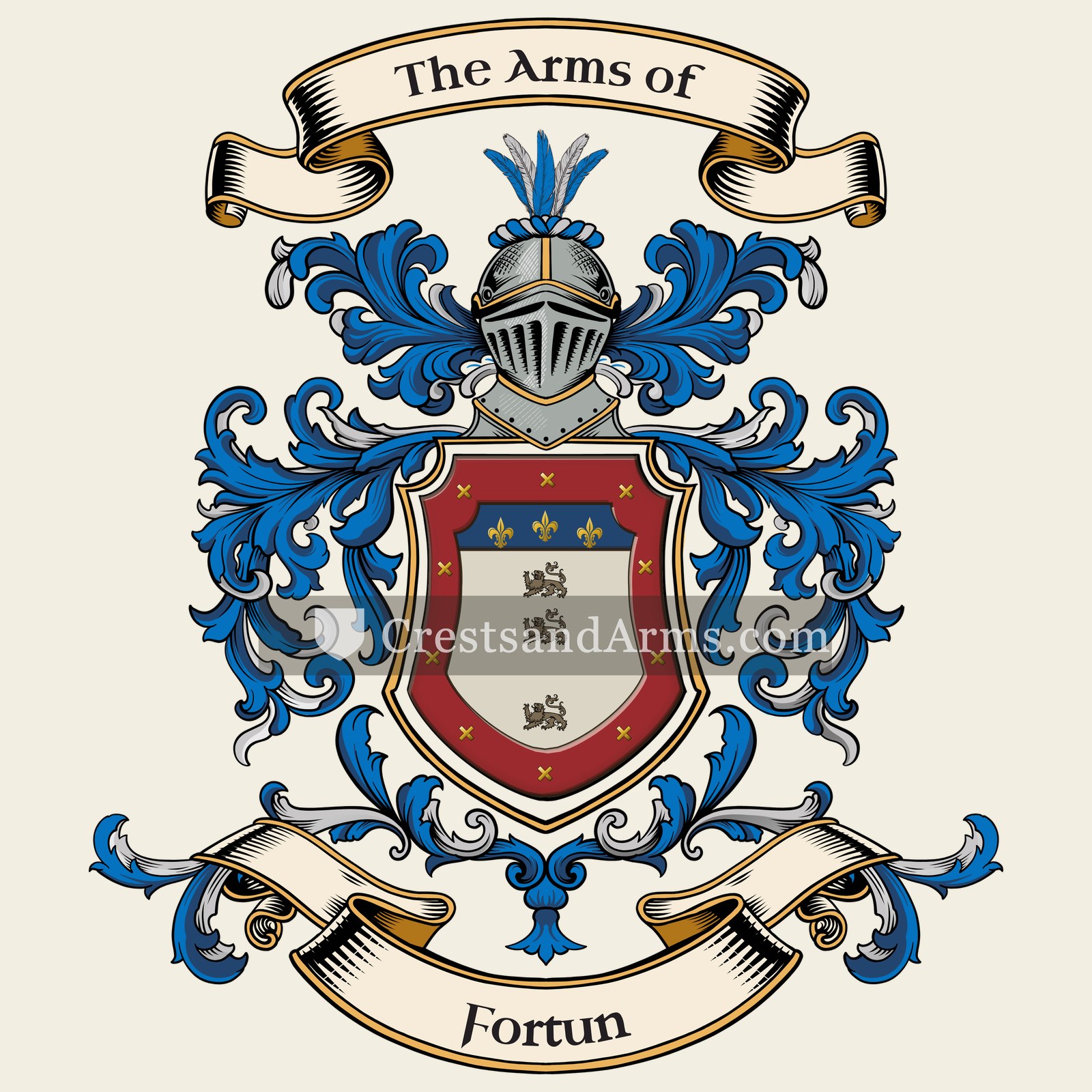
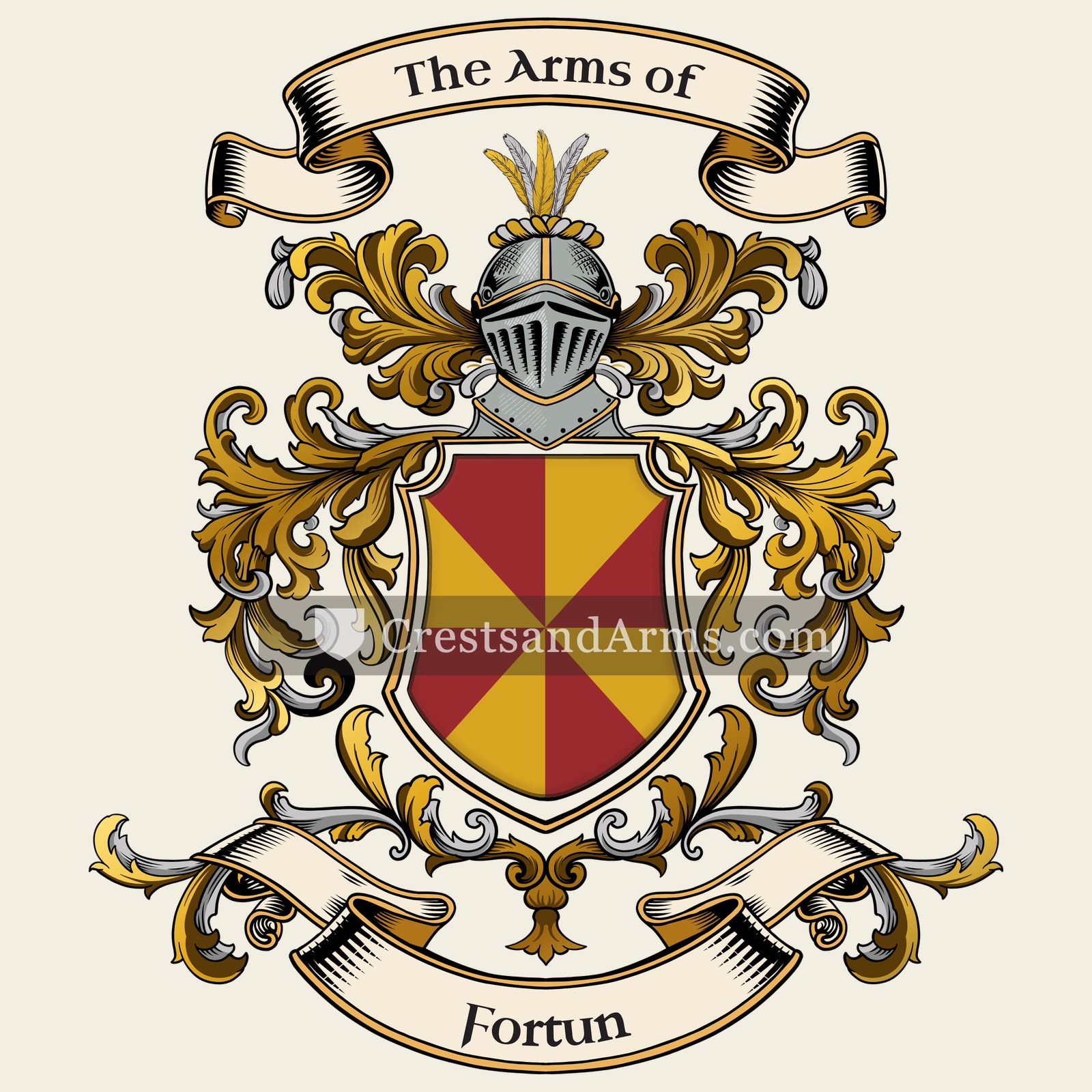
A record of documented arms, meaning and origin, researched for the Fortun family lines. Documented in 2 countries.
Reg. 6486 · Spanish, D–F
Coat of Arms & Family Crest Details
Symbols on this shield
chiefAuthority, wisdom and dominion
lionCourage, strength and royalty
fleur de lisPurity, light, and the sixth son
saltire coupedResolution, and the cross of St Andrew
Colours
Silver (Argent)Means: Peace and sincerity
Blue (Azure)Means: Loyalty and truth
Red (Gules)Means: Military strength
Gold (Or)Means: Generosity
Historical info
Source
J. B. Rietstap, Armorial Général, Gouda: G. B. van Goor Zonen, 1884–87
Blazon (the actual original written record)
“D'arg. à trois onces (animaux) au nat., l'une sur l'autre; au chef d'azur, ch. de trois fleurs-de-lis d'or. L'écu entouré d'une bord. de gu., ch. de dix flanchis d'or, 3 en chef, 3 en p. et 2 à chaque flanc, l'un sur l'autre.”
SpainMurcie, c. 1722
Digital archive packCoat of arms PNG, gold border print PDF, vector SVG and the certificate of authenticity. Sent to your email in minutes.
Map of Spain showing where the Fortun arms are recorded
The Fortun arms were recorded in Murcie, c. 1722.
This is where the arms were entered in the register. Families often moved to other parts of the country, so the same name can turn up in more than one region.
The body that granted and recorded arms in Spain in this period.
Philip V of Spain
Sovereign of the period
Philip V of Spain
1714–1724
Reigning in Spain when the Fortun arms are first recorded.
How Arms Worked in Spain
In Spain, a coat of arms was considered a form of property that belonged to the entire family line. These arms were passed down from a father to all his children equally. Younger branches of the family usually kept the original design without needing to add any special marks to distinguish their specific line.
Granting authority
The Cronista Rey de Armas was the official body that regulated and granted coats of arms throughout Spain.
How they got arms
Families often obtained their arms through royal grants or by proving their noble status to the official heraldic authority.
Where arms were recorded
Coats of arms were officially recorded in the registers of the Cronista Rey de Armas starting in 1496.
The family's standing
Recorded among the armigerous families of Spain.
Origin & History of the Fortun Family in Spain
The family name Fortun traces its roots to the Latin word *fortunatus*, which means lucky or prosperous. In the context of Spain, the name gained prominence as a patronymic, meaning it was often passed down to signify descent from an ancestor named Fortun. By the early 18th century, the family established a notable presence in the region of Murcia. Records from 1722 confirm that members of the family were active participants in the social and economic life of this southeastern Spanish city. During this era, families like the Fortuns often integrated into the local administration or agricultural sectors that defined the Murcian landscape. Their presence in the city during this period suggests they were part of the established community that helped shape the local culture and regional identity of Murcia long before the modern era.
Coat of Arms & Family Crest Details
Colours
Gold (Or)Means: Generosity
Red (Gules)Means: Military strength
Historical info
Source
Sir Bernard Burke, The General Armory of England, Scotland, Ireland and Wales, London: Harrison & Sons, 1884
Blazon (the actual original written record)
“Gyronny of eight or and gu”
Englandc. 1620
Digital archive packCoat of arms PNG, gold border print PDF, vector SVG and the certificate of authenticity. Sent to your email in minutes.
Map of England showing where the Fortun arms are recorded
The Fortun arms were recorded in England, c. 1620.
Arms such as these were typically recorded in York.
Yorkshire is the largest of the English counties, and it held more gentry families than any other. Land there was split among a great many households rather than a few, so a great many of them carried arms.
This is where the arms were entered in the register. Families often moved to other parts of the country, so the same name can turn up in more than one region.
The body that granted and recorded arms in England in this period.
James VI and I
Sovereign of the period
James VI and I
1603–1625
Reigning in Spain when the Fortun arms are first recorded.
How Arms Worked in England
English heraldry allowed arms to be shared by all legitimate descendants of the original owner. These symbols were treated as personal property that moved through the generations to all children. While the eldest son kept the original design, other family members could use the same shield without needing to change it or register their own unique versions.
Granting authority
The College of Arms in London has regulated the use of coats of arms throughout England and Wales since 1484.
How they got arms
Families typically obtained their coats of arms through a formal grant from the Crown or by proving their ancient right to them.
Where arms were recorded
All official coats of arms are recorded in the registers kept at the College of Arms, which date back to the fifteenth century.
The family's standing
Recorded among the armigerous families of England.
Origin & History of the Fortun Family in England
The surname Fortun carries a history deeply rooted in the linguistic shifts of medieval England, where it likely emerged as a descriptive nickname for a person considered lucky or prosperous. By the early 17th century, the family had established a notable presence in the historic city of York. Records from 1620 confirm that members of the Fortun family were active participants in the social and economic life of this northern hub. During this era, York served as a vital center for trade and administration, and families like the Fortuns were often integrated into the local merchant or craft guilds that defined the city’s character. Their presence in such a prominent location suggests that the family was well-settled and connected to the broader developments of the region during the transition into the Stuart period.
Fortun Meaning & Related Branches
Root word
Fortunus
A Latin term derived from the concept of luck or chance.
This name
FortunRefers to a person who is fortunate, lucky, or blessed with good success.
also spelled
Martinez
Fortun
Martinezz Fortun
Documented Sources
J. B. Rietstap, Armorial Général, Gouda: G. B. van Goor Zonen, 1884–87
Archivo General de la Región de Murcia, Protocolos Notariales de Murcia, 1722
Moll, Francesc de Borja, Els llinatges catalans, 1959
Pérez de Castro, Ramón, Historia de la ciudad de Murcia, 1982
Digital archive packCoat of arms PNG, gold border print PDF, vector SVG and the certificate of authenticity. Sent to your email in minutes.


 chiefAuthority, wisdom and dominion
 lionCourage, strength and royalty
 fleur de lisPurity, light, and the sixth son
 saltire coupedResolution, and the cross of St Andrew
 chiefAuthority, wisdom and dominion
 lionCourage, strength and royalty
 fleur de lisPurity, light, and the sixth son
 saltire coupedResolution, and the cross of St Andrew