Map of Switzerland showing where the Fossa arms are recorded
The Fossa arms were recorded in Genève, c. 1745.
This is where the arms were entered in the register. Families often moved to other parts of the country, so the same name can turn up in more than one region.
The body that granted and recorded arms in Switzerland in this period.
How Arms Worked in Switzerland
In Switzerland, coats of arms were not restricted to the nobility and were often adopted by common citizens and families. These symbols were passed down through generations to show family identity. When branches of a family grew, they often changed small details of the design to distinguish their own line from the original group.
Granting authority
Cantonal and civic authorities managed the use of coats of arms within their specific regions and local jurisdictions.
How they got arms
Families typically assumed their own coats of arms based on local custom rather than receiving them from a central monarch.
Where arms were recorded
Arms were recorded in various cantonal and civic registers starting from the fourteenth century throughout the Swiss region.
The family's standing
Recorded among the armigerous families of Switzerland.
Origin & History of the Fossa Family in Switzerland
The family name Fossa has deep roots in the Swiss region, with documented evidence confirming their presence in Geneva as early as 1745. The name itself is derived from the Latin word for a ditch, trench, or canal, which suggests that the earliest ancestors likely lived near a prominent waterway or a defensive fortification. During the mid-eighteenth century, Geneva was a growing center of commerce and intellectual life, and families like the Fossa were often integrated into the local urban fabric as skilled tradespeople or merchants. Because Geneva served as a crossroads for travelers and refugees moving through Europe, the family name likely traveled along trade routes before establishing a firm foothold in the city. By settling in this region, the Fossa family became part of the unique social structure of the Republic of Geneva, where they contributed to the local community for generations.
Coat of Arms & Family Crest Details
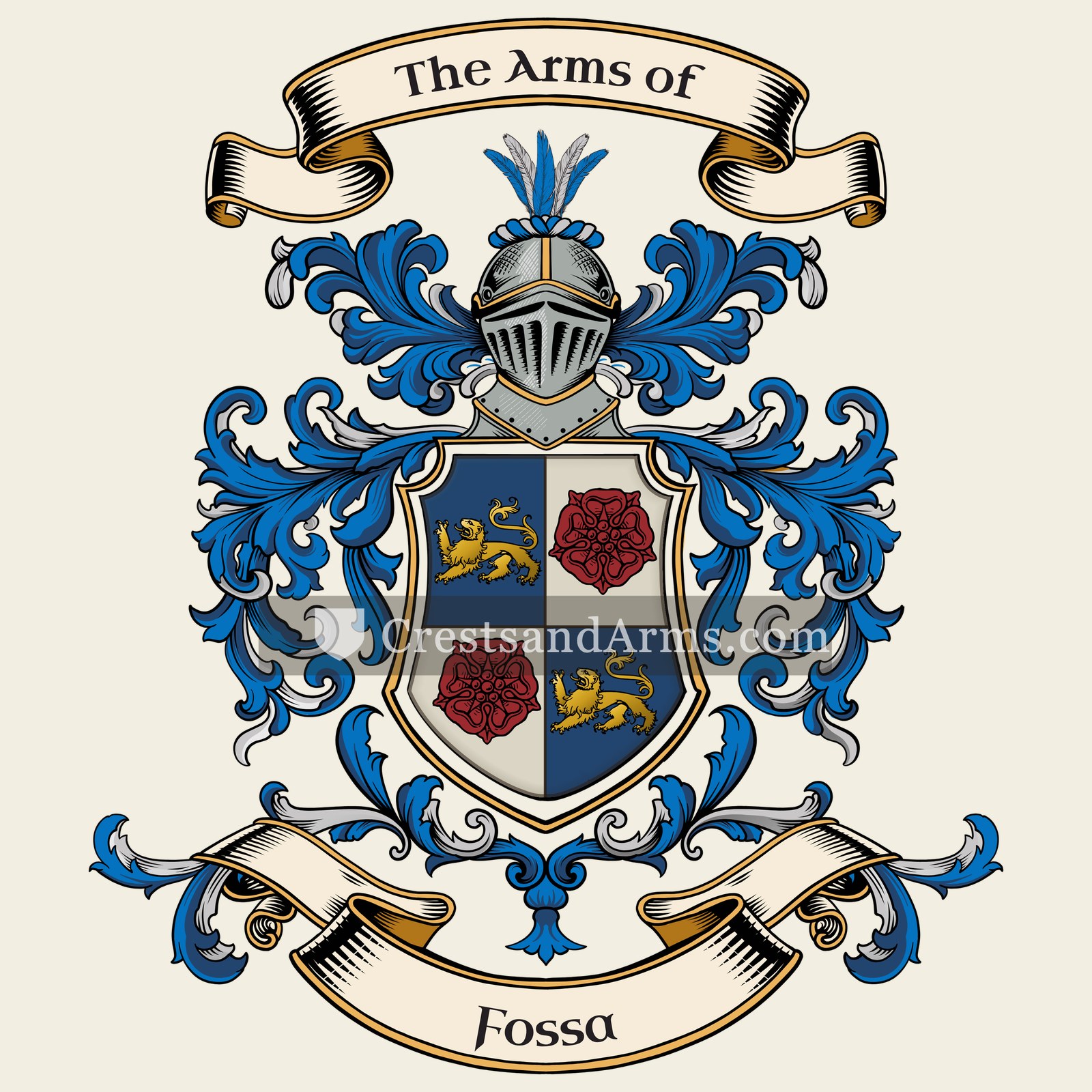
Symbols on this shield
lionCourage, strength and royalty
roseThe seventh son, and beauty with grace
Colours
Blue (Azure)Means: Loyalty and truth
Silver (Argent)Means: Peace and sincerity
Gold (Or)Means: Generosity
Red (Gules)Means: Military strength
Historical info
Source
J. B. Rietstap, Armorial Général, Gouda: G. B. van Goor Zonen, 1884–87
Blazon (the actual original written record)
“Ec.: aux 1 et 4 d'azur au lion d'or; aux 2 et 3 d'arg. à une rose de gu. Cq. cour. C.: le lion, iss., tenant dans ses pattes la rose; entre un vol coupé, à dextre d'arg. sur gu., à sen. d'or sur azur. L.: à dextre d'or et d'azur, à sen. d'arg. et de gu.”
Germanyc. 1765
Digital archive packCoat of arms PNG, gold border print PDF, vector SVG and the certificate of authenticity. Sent to your email in minutes.
Map of Germany showing where the Fossa arms are recorded
The Fossa arms were recorded in Germany, c. 1765.
Arms such as these were typically recorded in Bavaria.
Bavaria was a country of old landed families and walled market towns. Estates passed down the same line for centuries, and both the landowners and the leading townsmen kept arms, which is why so many Bavarian names sit in the registers.
This is where the arms were entered in the register. Families often moved to other parts of the country, so the same name can turn up in more than one region.
The body that granted and recorded arms in Germany in this period.
Francis I, Holy Roman Emperor
Sovereign of the period
Francis I, Holy Roman Emperor
1745–1765
Reigning in Switzerland when the Fossa arms are first recorded.
How Arms Worked in Germany
In the Holy Roman Empire, coats of arms were often granted to individuals by the Emperor or his representatives. These arms were then passed down through the generations to all legitimate descendants of the original holder. Younger branches of a family usually kept the same shield design without needing to change it, as the arms belonged to the entire lineage.
Granting authority
The Holy Roman Emperor held the sole power to grant new coats of arms throughout his vast imperial territories.
How they got arms
Families typically obtained their coats of arms through a formal imperial grant or by proving their noble status to the authorities.
Where arms were recorded
These grants were officially recorded in the Imperial Chancery registers, which began keeping formal records of such honors during the Middle Ages.
The family's standing
Recorded among the armigerous families of Germany.
Origin & History of the Fossa Family in Germany
The family name Fossa has deep roots in the southern German region of Bavaria, where records confirm members of the family were established by 1765. The name itself is derived from the Latin word for a ditch, trench, or canal, which suggests that the earliest ancestors were likely people who lived near a significant waterway or worked in land drainage and irrigation. During the eighteenth century, Bavaria was a landscape defined by its agricultural traditions and complex river systems, making the name a practical description of where a family lived or how they contributed to their local community. As these early family members settled into the Bavarian countryside, they became part of the social fabric of the region, living as farmers, laborers, or tradespeople who helped manage the fertile land. By tracing the name back to this period, we see a family deeply connected to the geography of southern Germany and the essential work of maintaining the local environment.
Fossa Meaning & Related Branches
Root word
Fossa
Latin term for a ditch, trench, or pit.
This name
FossaA topographic surname for someone who lived near a ditch or trench.
also spelled
Fossaa
Documented Sources
J. B. Rietstap, Armorial Général, Gouda: G. B. van Goor Zonen, 1884–87
Archives d'État de Genève, Registres du Conseil d'État
Archives d'État de Genève, État civil et registres paroissiaux
Galiffe, Jacques-Auguste, Notices généalogiques sur les familles genevoises, 1829
Senebier, Jean, Histoire littéraire de Genève, 1786
Digital archive packCoat of arms PNG, gold border print PDF, vector SVG and the certificate of authenticity. Sent to your email in minutes.



 lionCourage, strength and royalty
 roseThe seventh son, and beauty with grace