Map of England showing where the Fourman arms are recorded
The Fourman arms were recorded in Leicester, c. 1538.
Leicestershire was grazing country, and wool and cattle made steady money rather than spectacular fortunes. Steady money bought manors, and manors are what brought families into the registers.
This is where the arms were entered in the register. Families often moved to other parts of the country, so the same name can turn up in more than one region.
The body that granted and recorded arms in England in this period.
Henry VIII of England
Sovereign of the period
Henry VIII of England
1509–1547
Reigning in England when the Fourman arms are first recorded.
How Arms Worked in England
English heraldry allowed arms to be shared by all legitimate descendants of the original owner. These symbols were treated as personal property that moved through the generations to all children. While the eldest son kept the original design, other family members could use the same shield without needing to change it or register their own unique versions.
Granting authority
The College of Arms in London has regulated the use of coats of arms throughout England and Wales since 1484.
How they got arms
Families typically obtained their coats of arms through a formal grant from the Crown or by proving their ancient right to them.
Where arms were recorded
All official coats of arms are recorded in the registers kept at the College of Arms, which date back to the fifteenth century.
The family's standing
Recorded among the armigerous families of Leicester.
Origin & History of the Fourman Family in England
The history of the Fourman name in England is rooted in the social and administrative changes of the sixteenth century. By 1538, the family was established in Leicester, a period that coincided with the introduction of mandatory parish registers under the order of Thomas Cromwell. During this era, surnames were becoming increasingly fixed as a way for the government to track citizens for tax and legal purposes. The name likely evolved from an occupational description, referring to a person who worked as a foreman or a leader of a group of laborers. As the family settled into the Leicester area, they became part of the local fabric of English society, living through the transition from the medieval period to the early modern age. Their presence in the official records of the time suggests they were ordinary working people who contributed to the local economy and community life of the English Midlands.
Coat of Arms & Family Crest Details
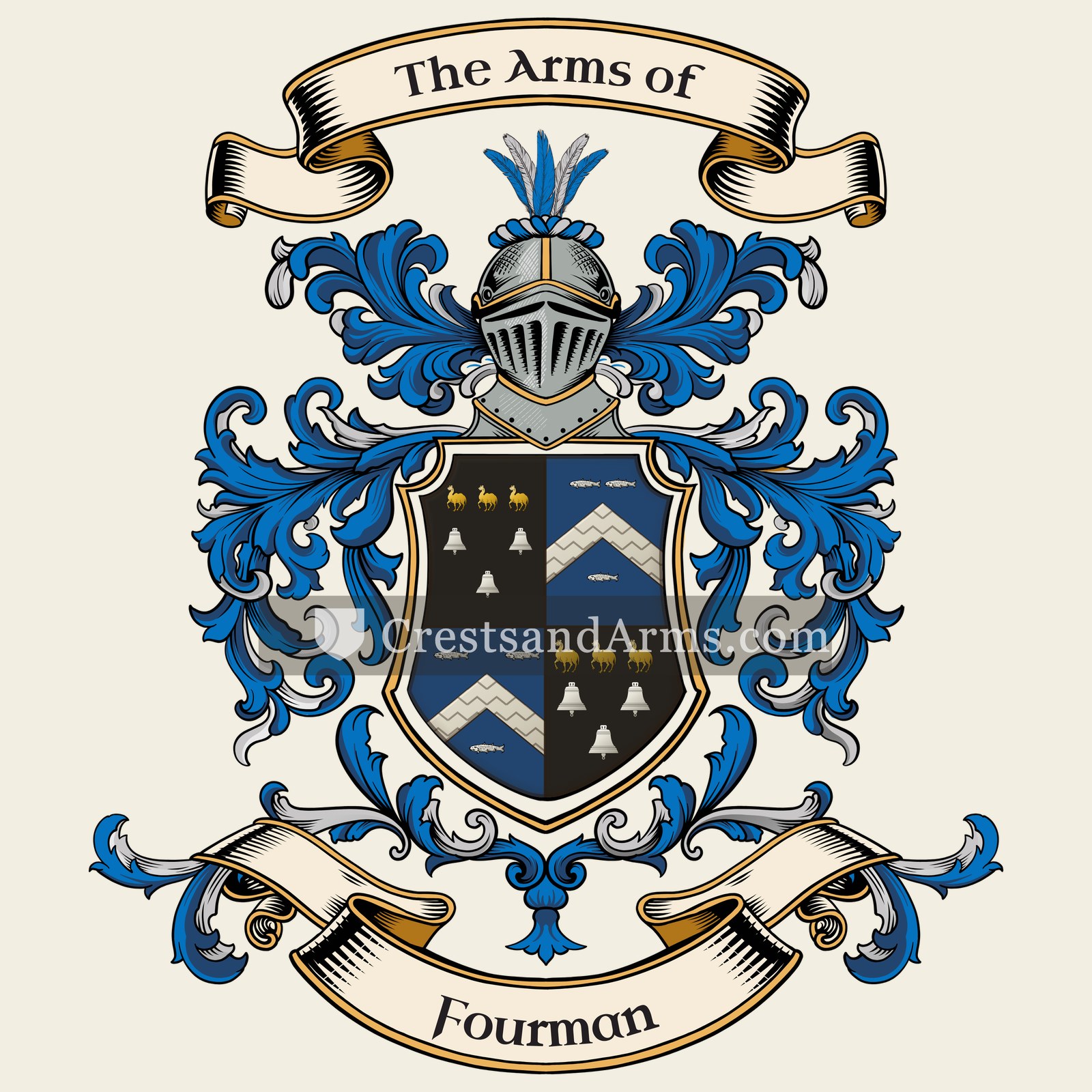
Symbols on this shield
chevronProtection, and faithful service completed
camelPatience and perseverance under burden
bellA call to prayer, and a warning given
fishA true and generous mind, and Christian faith
Colours
Black (Sable)Means: Constancy
Blue (Azure)Means: Loyalty and truth
Silver (Argent)Means: Peace and sincerity
Gold (Or)Means: Generosity
Historical info
Source
Sir Bernard Burke, The General Armory of England, Scotland, Ireland and Wales, London: Harrison & Sons, 1884
Blazon (the actual original written record)
“Quarterly, 1st and 4th, sa. three camels' heads erased or, each with a bell ar. attached to a collar gu. about her neck, for FORMAN; 2nd and 3rd, az. a chev. betw. three salmon haurient ar., for FISHER”
FifeLuthrie · Fife, c. 1555
Digital archive packCoat of arms PNG, gold border print PDF, vector SVG and the certificate of authenticity. Sent to your email in minutes.
Map of Scotland showing where the Fourman arms are recorded
The Fourman arms were recorded in Fife, c. 1555.
Fife was farming country between two firths, with royal palaces and old burghs along its coast. Its landed families were numerous and close to the court, and closeness to the court brought arms.
This is where the arms were entered in the register. Families often moved to other parts of the country, so the same name can turn up in more than one region.
The body that granted and recorded arms in Scotland in this period.
Mary, Queen of Scots
Sovereign of the period
Mary, Queen of Scots
1542–1567
Reigning in England when the Fourman arms are first recorded.
How Arms Worked in Scotland
Scottish heraldry is unique because it treats a coat of arms as a piece of personal property protected by law. Only one person can own a specific design at any given time. When a family grows, the head keeps the original shield while other relatives must apply for their own distinct version with slight changes to prove their specific identity.
Granting authority
The Court of the Lord Lyon acts as the official body that regulates and controls all heraldic matters throughout Scotland.
How they got arms
Individuals obtain a legal right to their arms through a formal petition process that confirms their identity and family connection.
Where arms were recorded
All valid coats of arms are officially entered into the Public Register of All Arms and Bearings starting from 1672.
The family's standing
Recorded among the armigerous families of Fife.
Origin & History of the Fourman Family in Scotland
The history of the Fourman family in Scotland begins with documented records appearing in the region of Fife during the mid-sixteenth century. By 1555, the name was established within this coastal area, which served as a vital hub for trade and local governance during the Scottish Renaissance. Families in Fife at this time were often deeply connected to the land and the evolving social structures of the burghs. The name likely functioned as a descriptive identifier, potentially linked to the professional roles or specific locations occupied by early ancestors as they navigated the transition from feudal obligations to more independent livelihoods. As the family integrated into the local community, they participated in the daily life of a region defined by its proximity to the royal court and its active ports. This early presence in Fife suggests that the Fourman family was part of the foundational fabric of the Scottish Lowlands during a period of significant religious and political change.
Fourman Meaning & Related Branches
Root word
Furman
An occupational term for a person who drives a cart or wagon.
This name
FourmanA variant spelling denoting a carrier of goods or a wagon driver.
also spelled
Foreman
Fourman
Documented Sources
Sir Bernard Burke, The General Armory of England, Scotland, Ireland and Wales, London: Harrison & Sons, 1884
Burn, John Southerden. The History of Parish Registers in England. 1862
Leicestershire, Leicester and Rutland Record Office. Parish Registers of St. Martin, Leicester. DE 1573/1
Digital archive packCoat of arms PNG, gold border print PDF, vector SVG and the certificate of authenticity. Sent to your email in minutes.


 chevronProtection, and faithful service completed
 chiefAuthority, wisdom and dominion
 lionCourage, strength and royalty
 martletA younger son, who must win his own land
 anchorHope, and steadfastness in trouble
 chevronProtection, and faithful service completed
 chiefAuthority, wisdom and dominion
 lionCourage, strength and royalty
 martletA younger son, who must win his own land
 anchorHope, and steadfastness in trouble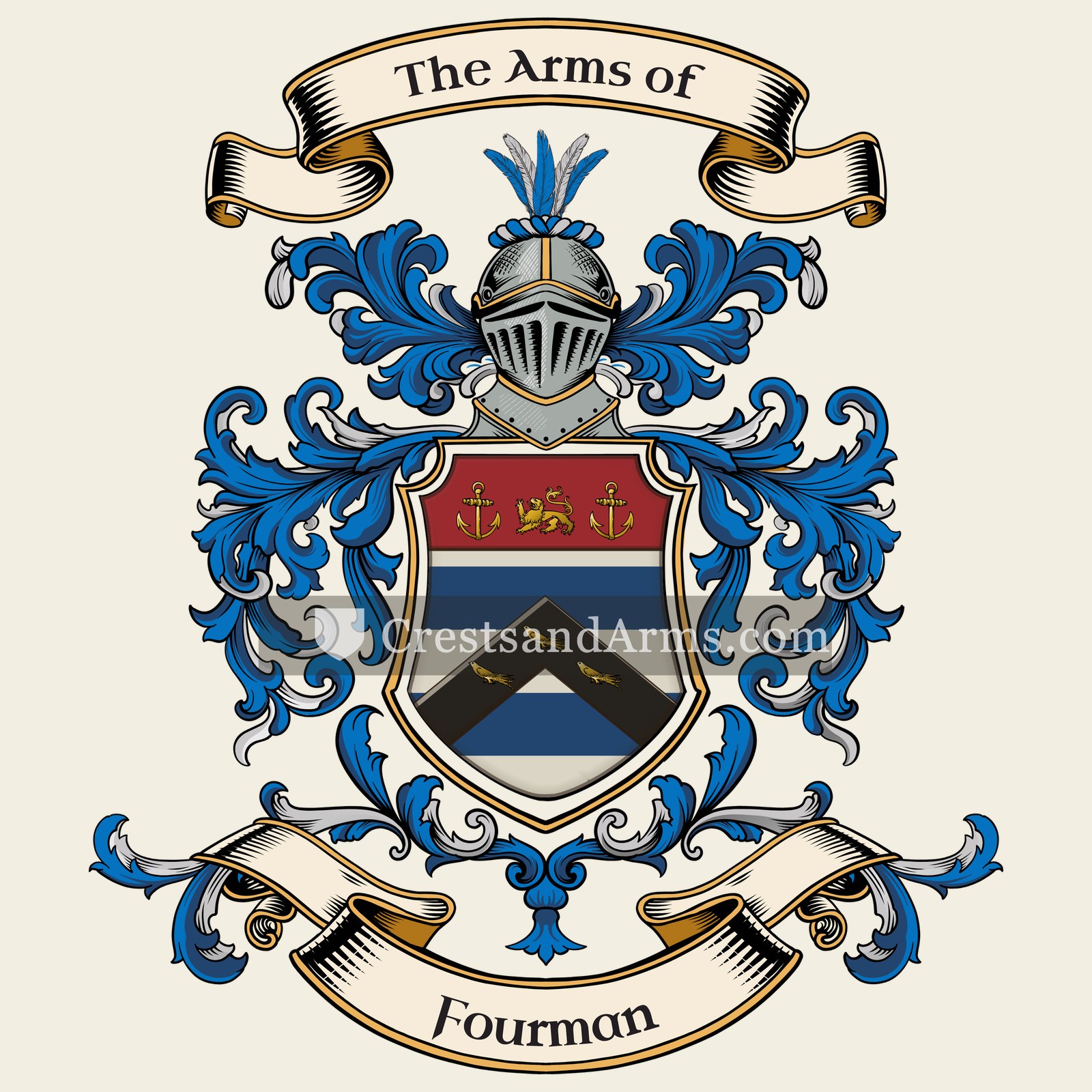


 camelPatience and perseverance under burden
 bellA call to prayer, and a warning given
 fishA true and generous mind, and Christian faith