Map of France showing where the Fouse arms are recorded
The Fouse arms were recorded in Lorraine, c. 1611.
Lorraine sat on the border between France and the German lands, and border country bred soldiers. Families here held small estates and served in arms, and a fighting man was exactly the sort who carried a shield of his own.
This is where the arms were entered in the register. Families often moved to other parts of the country, so the same name can turn up in more than one region.
The body that granted and recorded arms in France in this period.
Louis XIII of France
Sovereign of the period
Louis XIII of France
1610–1617
Reigning in France when the Fouse arms are first recorded.
How Arms Worked in France
In France, a coat of arms was a mark of honor that passed down through the male line to all legitimate descendants. Families often used the same shield without changes to show their shared heritage. If a branch wanted to stand out, they could add a small mark to their shield to show their specific place in the family tree.
Granting authority
The Juge d'armes de France acted as the official authority that regulated and verified coats of arms across the country.
How they got arms
Families typically inherited their arms from ancestors, though they could also receive them through royal grants or by proving their noble status.
Where arms were recorded
Coats of arms were officially recorded in the Armorial Général de France, which began its main collection in the year 1696.
The family's standing
Recorded among the armigerous families of Lorraine.
Origin & History of the Fouse Family in France
The Fouse family name traces its roots to the historical region of Lorraine, which is located in modern-day France near the border of Germany. Records confirm that members of the family were living in this area as early as 1611. During this period, the region was a crossroads for many different cultures and languages, which often led to variations in how names were spelled and recorded. The name itself is believed to be a variation of the Germanic word *fuss*, which translates to foot. This suggests that the original family members may have been known for their work as foot soldiers or perhaps for being travelers who were always on the move. As the family grew, they became part of the local agricultural and tradesman communities that defined life in the Lorraine countryside before many later generations eventually migrated to other parts of Europe and eventually the Americas.
Fouse Meaning & Related Branches
Root word
Fous
Old French term for a madman or a fool.
This name
FouseA descriptive nickname for an eccentric or foolish individual.
also spelled
Fausse
Fouse
Faus
Foz
Documented Sources
J. B. Rietstap, Armorial Général, Gouda: G. B. van Goor Zonen, 1884–87
Bouteiller, Ernest de. Dictionnaire topographique de l'ancien département de la Moselle. 1874
Archives départementales de la Moselle. Registres paroissiaux et d'état civil. 1611
Digital archive packCoat of arms PNG, gold border print PDF, vector SVG and the certificate of authenticity. Sent to your email in minutes.


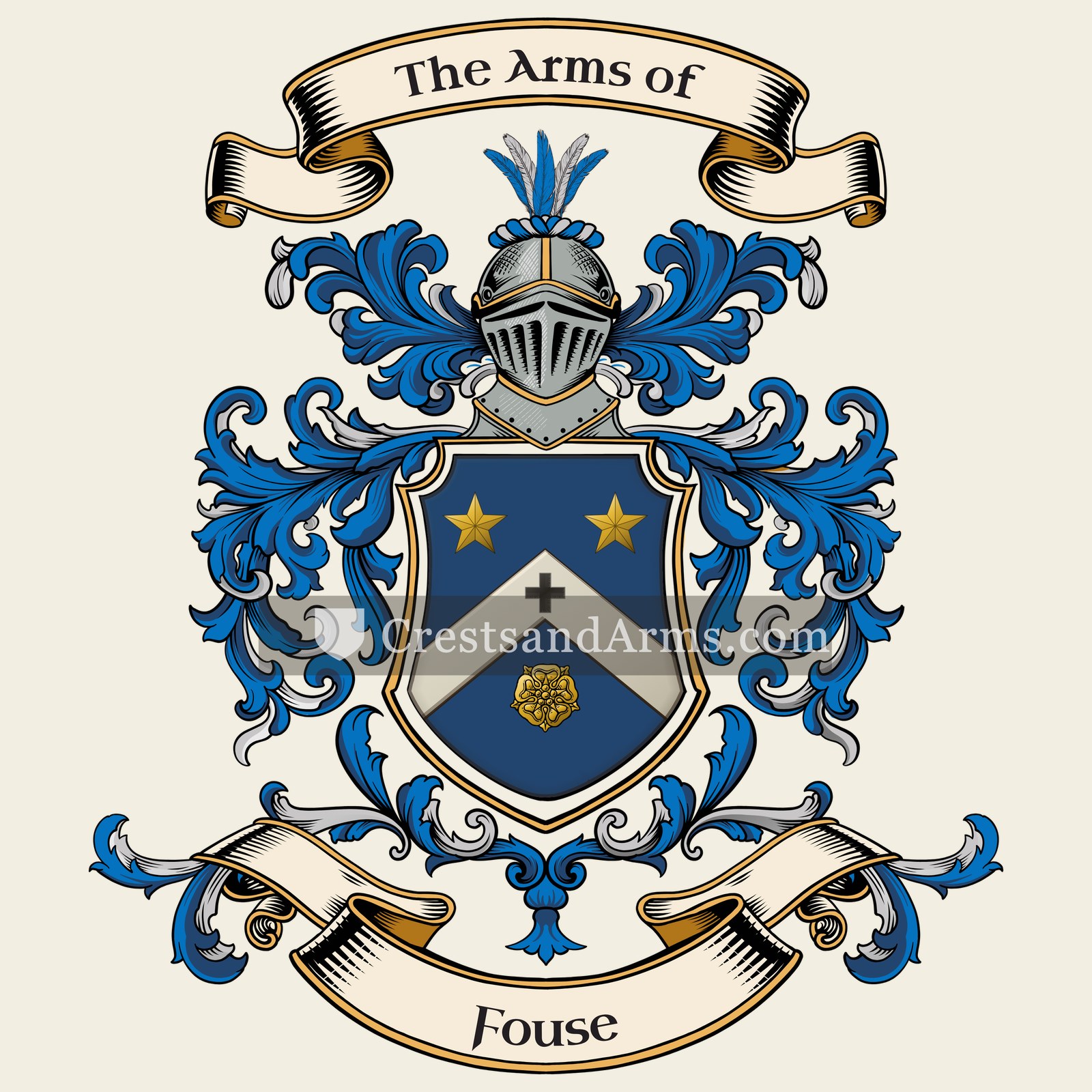
 chevronProtection, and faithful service completed
 cross symbolChristian faith and service
 mulletThe third son, and a divine quality from above
 roseThe seventh son, and beauty with grace
 chevronProtection, and faithful service completed
 cross symbolChristian faith and service
 mulletThe third son, and a divine quality from above
 roseThe seventh son, and beauty with grace