Map of France showing where the Francke arms are recorded
The Francke arms were recorded in Flandre, c. 1663.
Flandre grew rich on cloth, and its towns were among the busiest in Europe. Merchant families bought land with their profits and took arms to go with it, so trade put as many names in the registers here as land did.
This is where the arms were entered in the register. Families often moved to other parts of the country, so the same name can turn up in more than one region.
The body that granted and recorded arms in France in this period.
Louis XIV of France
Sovereign of the period
Louis XIV of France
1643–1715
Reigning in France when the Francke arms are first recorded.
How Arms Worked in France
In France, a coat of arms was a mark of honor that passed down through the male line to all legitimate descendants. Families often used the same shield without changes to show their shared heritage. If a branch wanted to stand out, they could add a small mark to their shield to show their specific place in the family tree.
Granting authority
The Juge d'armes de France acted as the official authority that regulated and verified coats of arms across the country.
How they got arms
Families typically inherited their arms from ancestors, though they could also receive them through royal grants or by proving their noble status.
Where arms were recorded
Coats of arms were officially recorded in the Armorial Général de France, which began its main collection in the year 1696.
The family's standing
Recorded among the armigerous families of Flandre.
Origin & History of the Francke Family in France
The family name Francke carries a rich history that is deeply rooted in the cultural landscape of northern France and the surrounding border regions. By the mid-17th century, the name was firmly established in the territory of Flandre, a region known for its complex history of shifting borders and vibrant trade networks. During this era, families with this surname were often integrated into the local administrative and social structures of the Flemish provinces. The name itself reflects a connection to the Frankish tribes that historically influenced the development of the region, serving as a linguistic link to the early medieval period. As the family settled in Flandre by 1663, they participated in the daily life of a society defined by its unique blend of French and Germanic influences. Their presence in these official records suggests that they were part of the established community during a time of significant political transition in the French kingdom.
Coat of Arms & Family Crest Details
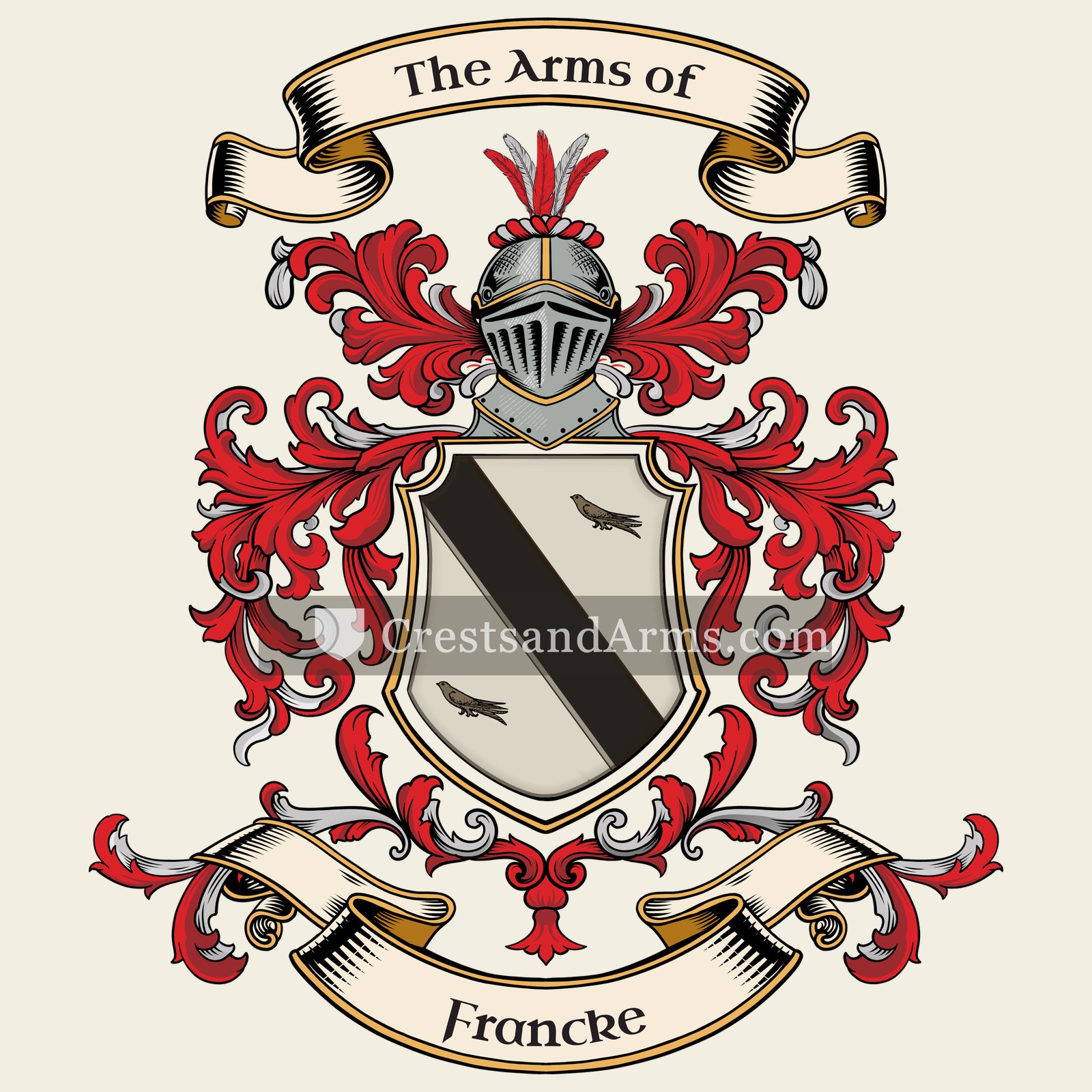
Symbols on this shield
bendDefence, and the scarf of a commander
martletA younger son, who must win his own land
Colours
Silver (Argent)Means: Peace and sincerity
Black (Sable)Means: Constancy
Historical info
Source
Sir Bernard Burke, The General Armory of England, Scotland, Ireland and Wales, London: Harrison & Sons, 1884
Blazon (the actual original written record)
“Ar. a bend engr. sa. betw. two Cornish choughs ppr”
LincolnGrimsby · Lincoln, c. 1620
Digital archive packCoat of arms PNG, gold border print PDF, vector SVG and the certificate of authenticity. Sent to your email in minutes.
Map of England showing where the Francke arms are recorded
The Francke arms were recorded in Lincoln, c. 1620.
Lincolnshire was rich farming country, and its wealth was spread across many middling families. Households of that size bought land and took arms, and the county holds a large share of English names.
This is where the arms were entered in the register. Families often moved to other parts of the country, so the same name can turn up in more than one region.
The body that granted and recorded arms in England in this period.
James VI and I
Sovereign of the period
James VI and I
1603–1625
Reigning in France when the Francke arms are first recorded.
How Arms Worked in England
English heraldry allowed arms to be shared by all legitimate descendants of the original owner. These symbols were treated as personal property that moved through the generations to all children. While the eldest son kept the original design, other family members could use the same shield without needing to change it or register their own unique versions.
Granting authority
The College of Arms in London has regulated the use of coats of arms throughout England and Wales since 1484.
How they got arms
Families typically obtained their coats of arms through a formal grant from the Crown or by proving their ancient right to them.
Where arms were recorded
All official coats of arms are recorded in the registers kept at the College of Arms, which date back to the fifteenth century.
The family's standing
Recorded among the armigerous families of Lincoln.
Origin & History of the Francke Family in England
The surname Francke carries a rich history that traces back to the Germanic roots of the name, which signifies a person from the land of the Franks. While the name originated on the European continent, it became established in England through centuries of migration and trade. By the year 1620, records confirm that members of the Francke family were living in the historic city of Lincoln. During this period, Lincoln was a vital regional hub, and families like the Franckes were often involved in the local merchant class or the professional trades that supported the city’s cathedral and market economy. As these individuals settled into English life, they integrated into the local community while maintaining the unique identity tied to their ancestral name. This transition highlights how families moved across borders to build new lives, eventually becoming a permanent part of the English social landscape.
Coat of Arms & Family Crest Details
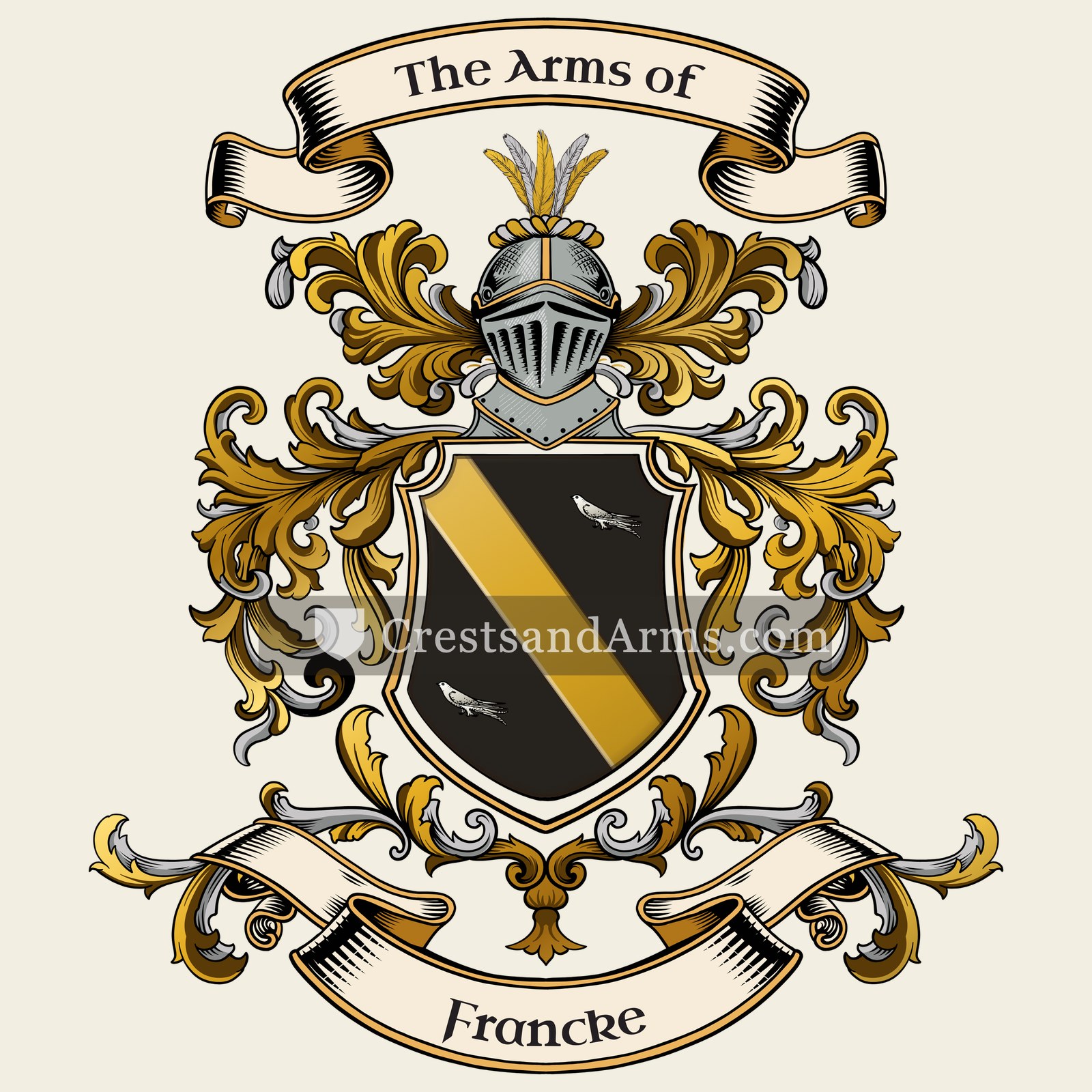
Symbols on this shield
bendDefence, and the scarf of a commander
martletA younger son, who must win his own land
Colours
Black (Sable)Means: Constancy
Gold (Or)Means: Generosity
Silver (Argent)Means: Peace and sincerity
Historical info
Source
Sir Bernard Burke, The General Armory of England, Scotland, Ireland and Wales, London: Harrison & Sons, 1884
Blazon (the actual original written record)
“Sa. a bend dancettée or, betw. two martlets ar”
DublinDublin, c. 1620
Digital archive packCoat of arms PNG, gold border print PDF, vector SVG and the certificate of authenticity. Sent to your email in minutes.
Map of Ireland showing where the Francke arms are recorded
The Francke arms were recorded in Dublin, c. 1620.
Dublin was the seat of government in Ireland and the place where grants were sought and recorded. Families with business at the castle or the courts settled nearby, and settling there put their arms on record.
This is where the arms were entered in the register. Families often moved to other parts of the country, so the same name can turn up in more than one region.
The body that granted and recorded arms in Ireland in this period.
James VI and I
Sovereign of the period
James VI and I
1603–1625
Reigning in France when the Francke arms are first recorded.
How Arms Worked in Ireland
The Ulster King of Arms granted coats of arms to individuals who proved their social standing and good character. These symbols were typically inherited by all legitimate descendants of the original holder. If a family branch wanted a unique look, they could apply for a specific change to their design through the office to ensure their identity remained distinct.
Granting authority
The Ulster King of Arms acted as the official body that regulated and issued all coats of arms throughout Ireland.
How they got arms
Families obtained their arms through formal grants issued by the office after proving their eligibility and paying the required fees.
Where arms were recorded
All official grants were recorded in the registers held by the Ulster King of Arms starting from the year 1552.
The family's standing
Recorded among the armigerous families of Dublin.
Origin & History of the Francke Family in Ireland
The family name Francke arrived in Ireland during a period of significant migration and social change in the early seventeenth century. By 1620, records confirm that members of the Francke family were already established in Dublin, which was then a bustling center of trade and administration. The name itself is rooted in Germanic origins, often associated with the Frankish people, and it likely traveled to Ireland through merchants or soldiers seeking new opportunities in the capital city. As these early settlers integrated into Dublin society, they participated in the growing urban economy, moving away from their continental roots to become part of the city’s diverse population. This transition marked the beginning of the family’s long-standing presence in Ireland, where they adapted to the local customs and political landscape of the time.
Francke Meaning & Related Branches
Root word
Francus
A member of the Frankish tribe or a free man.
This name
FranckeDerived from the Germanic tribal name referring to a free person or a Frank.
also spelled
Franke
Frankee
Frank
Related arms
Frankevariant spelling
Frankvariant spelling
Justicerecorded with Francke, same area
Newshamrecorded with Francke, same area
Documented Sources
J. B. Rietstap, Armorial Général, Gouda: G. B. van Goor Zonen, 1884–87
Archives départementales du Nord, Registres paroissiaux de la Flandre française
Braudel, Fernand, L'Identité de la France, 1986
Le Roy Ladurie, Emmanuel, Histoire de France des régions, 2001
Digital archive packCoat of arms PNG, gold border print PDF, vector SVG and the certificate of authenticity. Sent to your email in minutes.


 saltireResolution, and St Andrew's cross
 lionCourage, strength and royalty
 saltireResolution, and St Andrew's cross
 lionCourage, strength and royalty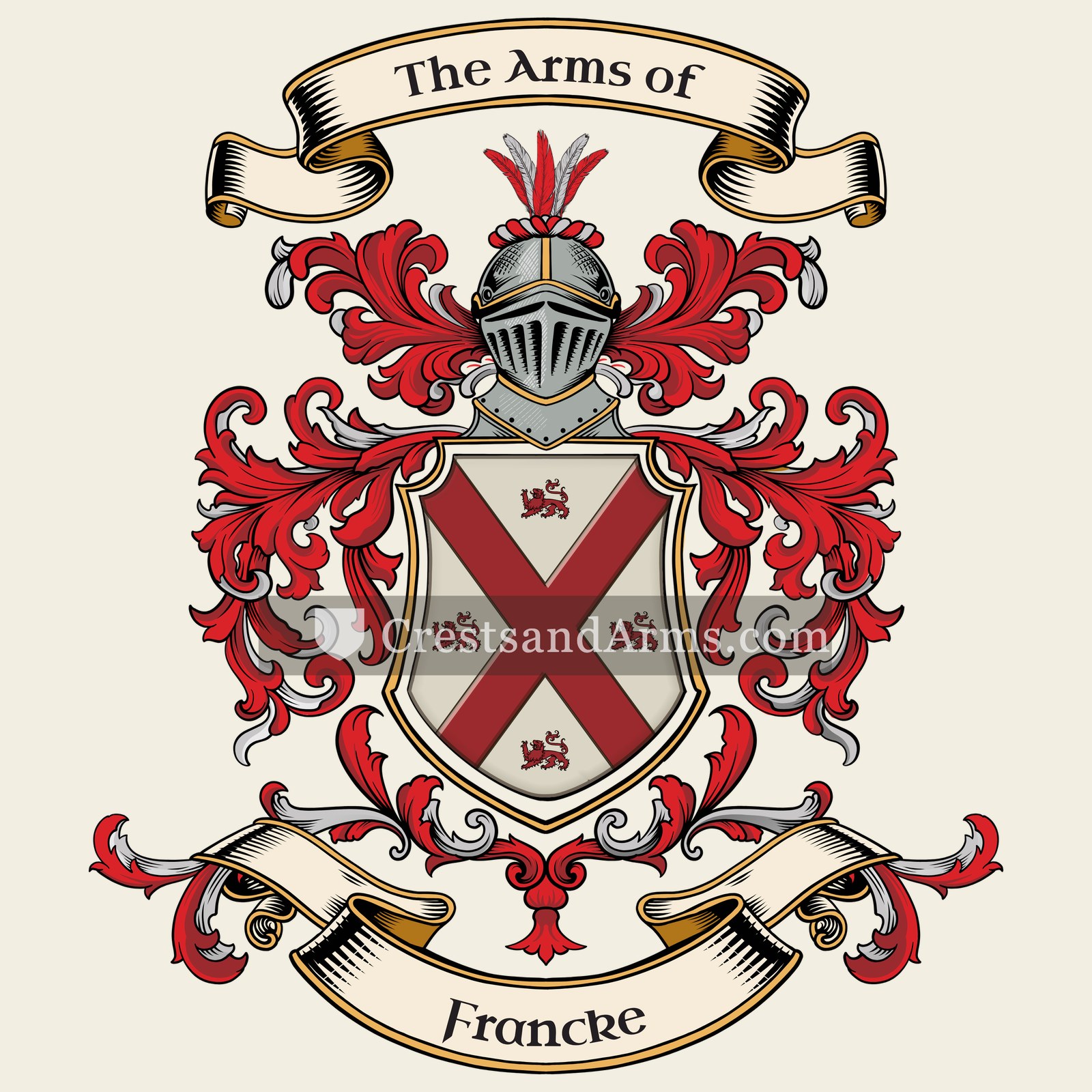


 bendDefence, and the scarf of a commander
 martletA younger son, who must win his own land