Map of Denmark showing where the Franke arms are recorded
The Franke arms were recorded in Denmark, c. 1722.
Arms such as these were typically recorded in Sjaælland.
Zealand held the Danish court, the crown's offices and Copenhagen itself. Families who served the king kept estates within reach of it, and royal service was the ordinary route to a coat of arms.
This is where the arms were entered in the register. Families often moved to other parts of the country, so the same name can turn up in more than one region.
The body that granted and recorded arms in Denmark in this period.
Frederik IV of Denmark
Sovereign of the period
Frederik IV of Denmark
1699–1730
Reigning in Denmark when the Franke arms are first recorded.
How Arms Worked in Denmark
Danish heraldry during this period was closely tied to noble status and royal favor rather than being open to all citizens. Arms were typically granted by the monarch to individuals, and these symbols were then shared by all members of the noble house. If a family line died out, the right to use those specific arms ended with them.
Granting authority
The Danish royal chancery held the power to issue and regulate official coats of arms for the kingdom.
How they got arms
Families usually received their arms through a formal royal grant that confirmed their noble status and rights.
Where arms were recorded
These grants were officially recorded in the Danish Royal Chancery records starting in the sixteenth century.
The family's standing
Recorded among the armigerous families of Denmark.
Origin & History of the Franke Family in Denmark
The history of the Franke family in Denmark begins with roots that trace back to the early eighteenth century on the island of Sjaelland. By 1722, records confirm that members of the family were already established in this region, living during a time when Denmark was transitioning toward more structured record-keeping for its citizens. The name itself is linked to the historical Germanic tribes known as the Franks, suggesting that the family’s ancestors likely migrated north from Central Europe to settle in the Danish landscape. As these early family members integrated into local society, they became part of the agricultural and merchant communities that defined life on Sjaelland. Over the following generations, the Franke name became a permanent fixture in the local population, reflecting the broader patterns of migration and settlement that shaped the demographic history of the Danish islands.
Coat of Arms & Family Crest Details
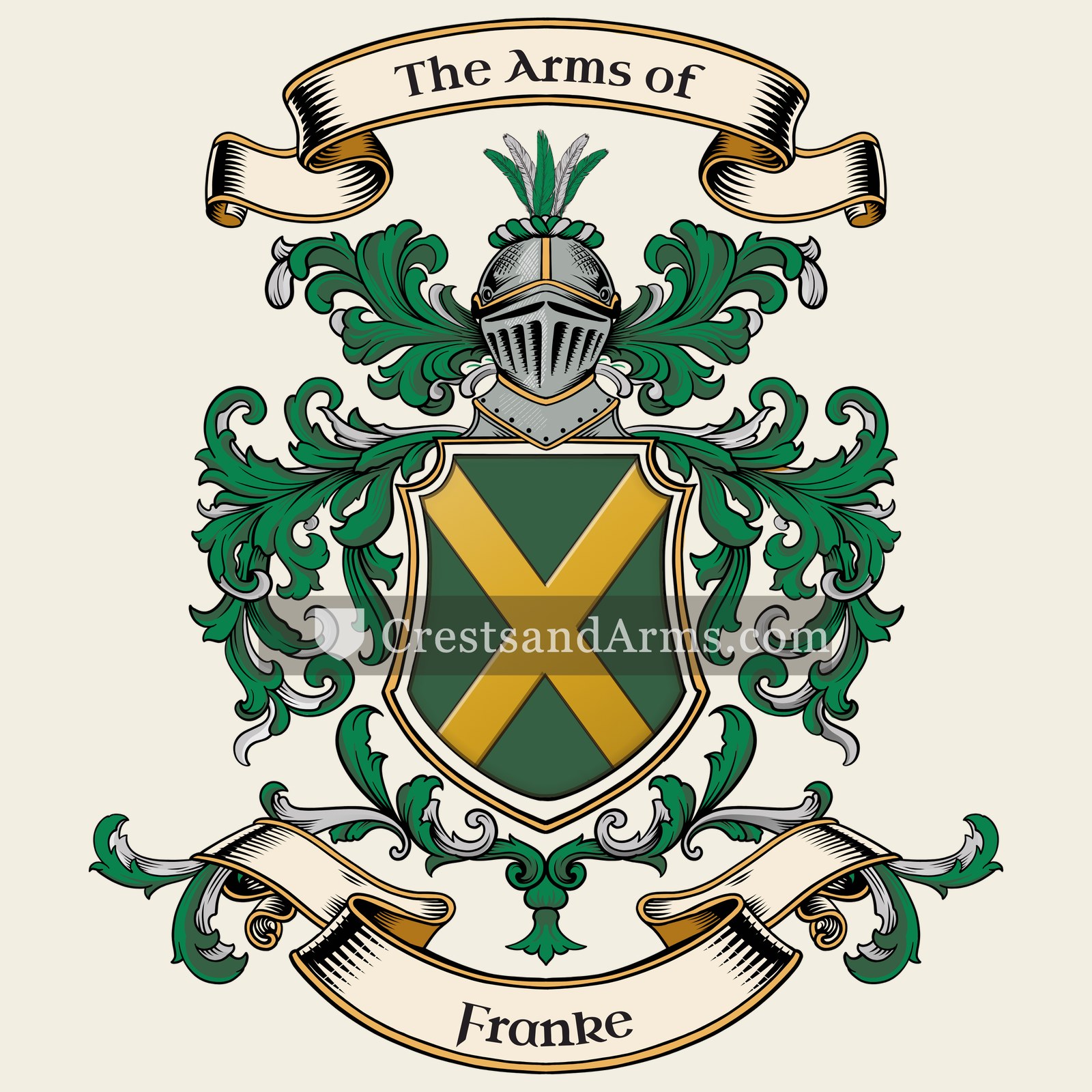
Symbols on this shield
saltireResolution, and St Andrew's cross
Colours
Green (Vert)Means: Hope
Gold (Or)Means: Generosity
Historical info
Source
Sir Bernard Burke, The General Armory of England, Scotland, Ireland and Wales, London: Harrison & Sons, 1884
Blazon (the actual original written record)
“Vert a saltire or (another, fusily)”
Englandc. 1620
Digital archive packCoat of arms PNG, gold border print PDF, vector SVG and the certificate of authenticity. Sent to your email in minutes.
Map of England showing where the Franke arms are recorded
The Franke arms were recorded in England, c. 1620.
Arms such as these were typically recorded in York.
Yorkshire is the largest of the English counties, and it held more gentry families than any other. Land there was split among a great many households rather than a few, so a great many of them carried arms.
This is where the arms were entered in the register. Families often moved to other parts of the country, so the same name can turn up in more than one region.
The body that granted and recorded arms in England in this period.
James VI and I
Sovereign of the period
James VI and I
1603–1625
Reigning in Denmark when the Franke arms are first recorded.
How Arms Worked in England
English heraldry allowed arms to be shared by all legitimate descendants of the original owner. These symbols were treated as personal property that moved through the generations to all children. While the eldest son kept the original design, other family members could use the same shield without needing to change it or register their own unique versions.
Granting authority
The College of Arms in London has regulated the use of coats of arms throughout England and Wales since 1484.
How they got arms
Families typically obtained their coats of arms through a formal grant from the Crown or by proving their ancient right to them.
Where arms were recorded
All official coats of arms are recorded in the registers kept at the College of Arms, which date back to the fifteenth century.
The family's standing
Recorded among the armigerous families of England.
Origin & History of the Franke Family in England
The surname Franke has deep roots in the Germanic languages, originally serving as a descriptor for someone who belonged to the Frankish people or, more broadly, a person considered to be free. While the name is closely associated with continental Europe, it established a clear presence in England by the early seventeenth century. By 1620, records confirm that members of the Franke family were living in the historic city of York. During this era, York was a bustling center of trade and religious life, and families like the Frankes were often integrated into the local merchant or artisan classes. These early English settlers likely arrived through the steady migration patterns that connected northern England to the Low Countries and the German states. As they settled into life in York, the family name evolved alongside the English language, eventually becoming a permanent part of the region’s social fabric.
Franke Meaning & Related Branches
Root word
Franko
A Germanic tribal name meaning free or javelin.
This name
FrankeRefers to a person of Frankish origin or a free man.
also spelled
Frank
Francke
Frankey
Frankee
Franck
Related arms
Franckevariant spelling
Francquévariant spelling
Frankvariant spelling
Frankhvariant spelling
Documented Sources
J. B. Rietstap, Armorial Général, Gouda: G. B. van Goor Zonen, 1884–87
Rigsarkivet (Danish National Archives), Kirkebøger (Parish Registers), Sjaelland Diocese
Rigsarkivet (Danish National Archives), Folketællinger (Census Records)
Jørgensen, Bent, Dansk Navneleksikon, 1994
Stigum, Peter, Den danske bonde gennem 6000 år, 1964
Digital archive packCoat of arms PNG, gold border print PDF, vector SVG and the certificate of authenticity. Sent to your email in minutes.


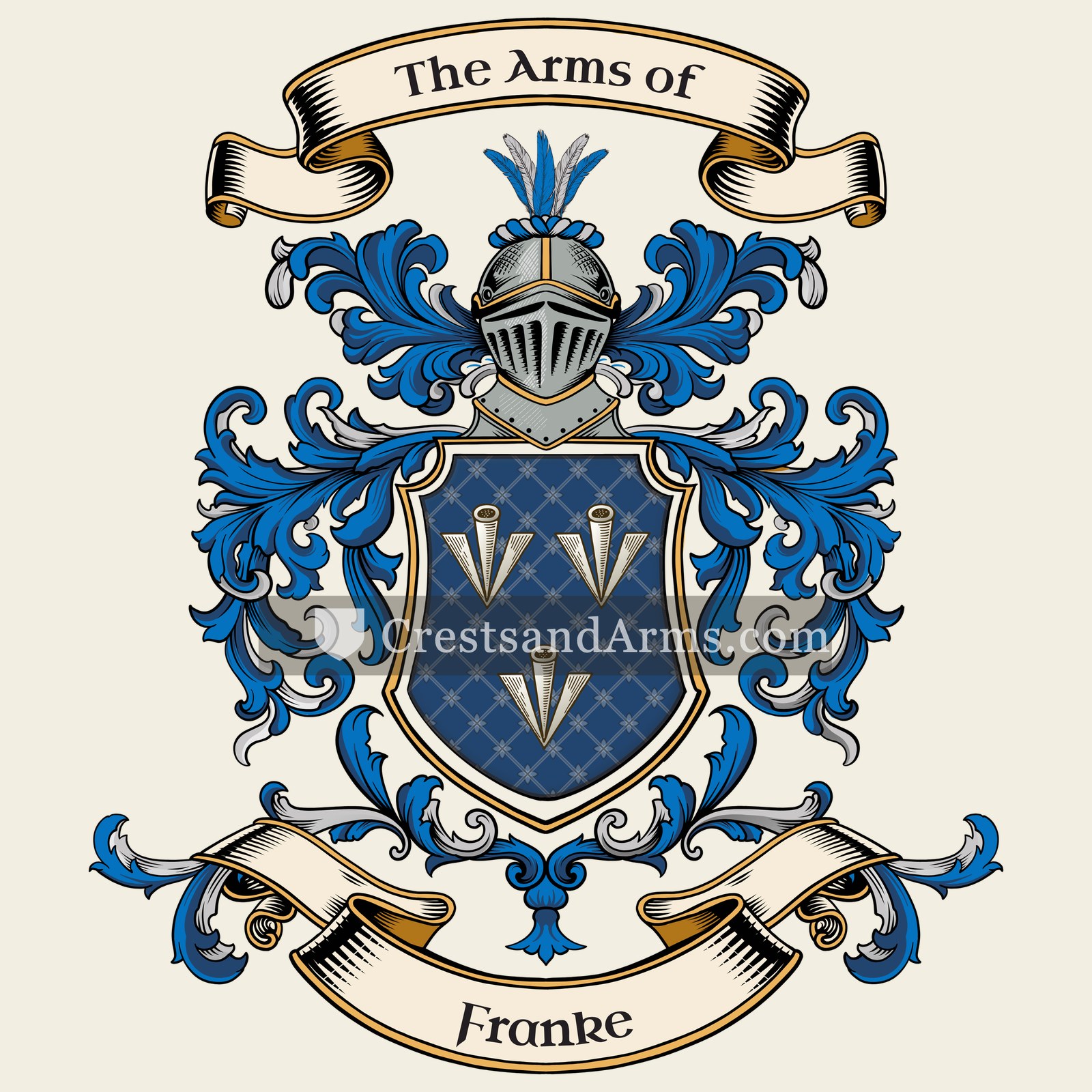
 arrowReadiness for battle, and affliction endured
 arrowReadiness for battle, and affliction endured


 saltireResolution, and St Andrew's cross