Map of Belgium showing where the Frankovic arms are recorded
The Frankovic arms were recorded in Liege, c. 1737.
Liege was a prosperous town and its surrounding country, living on metalworking and trade. Merchant families grew rich, bought land outside the walls, and took arms as landowners rather than tradesmen.
This is where the arms were entered in the register. Families often moved to other parts of the country, so the same name can turn up in more than one region.
The body that granted and recorded arms in Belgium in this period.
Charles VI, Holy Roman Emperor
Sovereign of the period
Charles VI, Holy Roman Emperor
1711–1740
Reigning in Belgium when the Frankovic arms are first recorded.
How Arms Worked in Belgium
In Belgium, a coat of arms is considered personal property that is passed down through the male line to legitimate descendants. Families often use the same shield design across generations to show their shared heritage. If a branch of the family wants to change the design, they must apply for an official update to their specific version of the arms.
Granting authority
The Conseil héraldique is the official body that regulates and approves all coats of arms in Belgium.
How they got arms
Families obtain their coats of arms through formal royal grants or by confirming their historical right to use existing designs.
Where arms were recorded
All approved coats of arms are officially recorded in the public registers of the Conseil héraldique since 1844.
The family's standing
Recorded among the armigerous families of Liege.
Origin & History of the Frankovic Family in Belgium
The surname Frankovic carries deep roots that trace back to the Slavic regions of Central and Eastern Europe, where it functioned as a patronymic name meaning son of Franko. While the name is traditionally associated with the Balkan Peninsula, the presence of the family in Liège by 1737 suggests a significant migration pattern during the eighteenth century. At that time, Liège was a thriving industrial and cultural hub within the Prince-Bishopric of Liège, attracting skilled laborers and merchants from across the continent. The family likely moved to this region to take advantage of the growing opportunities in trade or metalwork that defined the city during the Enlightenment. By settling in such a cosmopolitan urban center, the early members of the Frankovic family integrated into a diverse society, bridging their Slavic origins with the complex social landscape of Western Europe.
Frankovic Meaning & Related Branches
Root word
Frank
A member of the Germanic tribe known as the Franks.
This name
FrankovicA patronymic surname meaning son of the Frank or son of the free man.
also spelled
Francot
Frankott
Frankote
Documented Sources
J. B. Rietstap, Armorial Général, Gouda: G. B. van Goor Zonen, 1884–87
Kruhek, Milan. Hrvatska pogranična utvrđenja kroz stoljeća, 1995
Pirenne, Henri. Histoire de Belgique: Des origines à la fin du XIIe siècle, 1902
Archives de l'État à Liège, Registres paroissiaux de la ville de Liège, 1730–1740
Digital archive packCoat of arms PNG, gold border print PDF, vector SVG and the certificate of authenticity. Sent to your email in minutes.


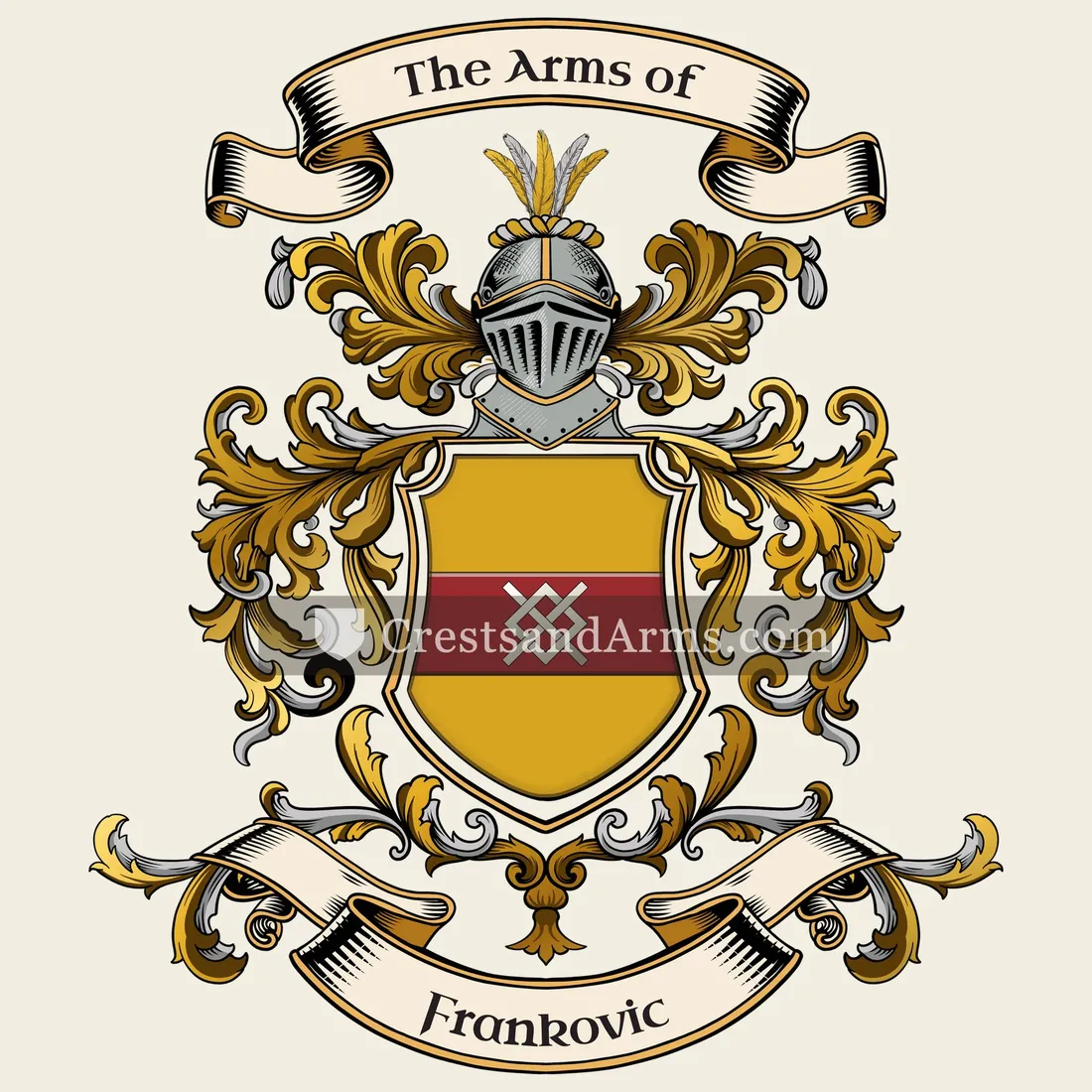
 fessThe military belt, and readiness to serve
 fretPersuasion, and the net that holds
 fessThe military belt, and readiness to serve
 fretPersuasion, and the net that holds