Map of Belgium showing where the Franqui arms are recorded
The Franqui arms were recorded in Luxemb, c. 1626.
This is where the arms were entered in the register. Families often moved to other parts of the country, so the same name can turn up in more than one region.
The body that granted and recorded arms in Belgium in this period.
Philip IV of Spain
Sovereign of the period
Philip IV of Spain
1621–1665
Reigning in Belgium when the Franqui arms are first recorded.
How Arms Worked in Belgium
In Belgium, a coat of arms is considered personal property that is passed down through the male line to legitimate descendants. Families often use the same shield design across generations to show their shared heritage. If a branch of the family wants to change the design, they must apply for an official update to their specific version of the arms.
Granting authority
The Conseil héraldique is the official body that regulates and approves all coats of arms in Belgium.
How they got arms
Families obtain their coats of arms through formal royal grants or by confirming their historical right to use existing designs.
Where arms were recorded
All approved coats of arms are officially recorded in the public registers of the Conseil héraldique since 1844.
The family's standing
Recorded among the armigerous families of Belgium.
Origin & History of the Franqui Family in Belgium
The family name Franqui carries a rich history rooted in the border regions of Western Europe, with documented evidence placing members of the family in Luxembourg as early as 1626. The name itself is closely linked to the historical term "Frank," which originally referred to a person of free status or someone belonging to the Frankish tribes that settled across the region during the Middle Ages. Over time, the name evolved as a way to identify individuals who lived in specific territories or held certain social positions within the feudal system. By the 17th century, families bearing this name were well-established in the Luxembourgish countryside, where they likely participated in the agricultural and administrative life of the duchy. This early presence suggests that the Franqui family was deeply integrated into the local community during a period of significant political and social transition in the heart of Europe.
Related Branches & Arms
Root word
Francus
A Latin term referring to a free man or a Frankish person.
This name
FranquiA surname of Germanic origin denoting a person who was a free man or from the Frankish tribe.
also spelled
Franquyn
Franckin
Franquine
Frankin
Documented Sources
J. B. Rietstap, Armorial Général, Gouda: G. B. van Goor Zonen, 1884–87
Archives nationales de Luxembourg, État civil et registres paroissiaux (1600–1700)
Archives de l'État à Arlon, Fonds de la Cour féodale du Luxembourg
Muller, Jean-Claude, Les familles luxembourgeoises: Origines et évolution, 1994
Trausch, Gilbert, Histoire du Luxembourg: Le destin européen d'un petit pays, 2003
Digital archive packCoat of arms PNG, gold border print PDF, vector SVG and the certificate of authenticity. Sent to your email in minutes.


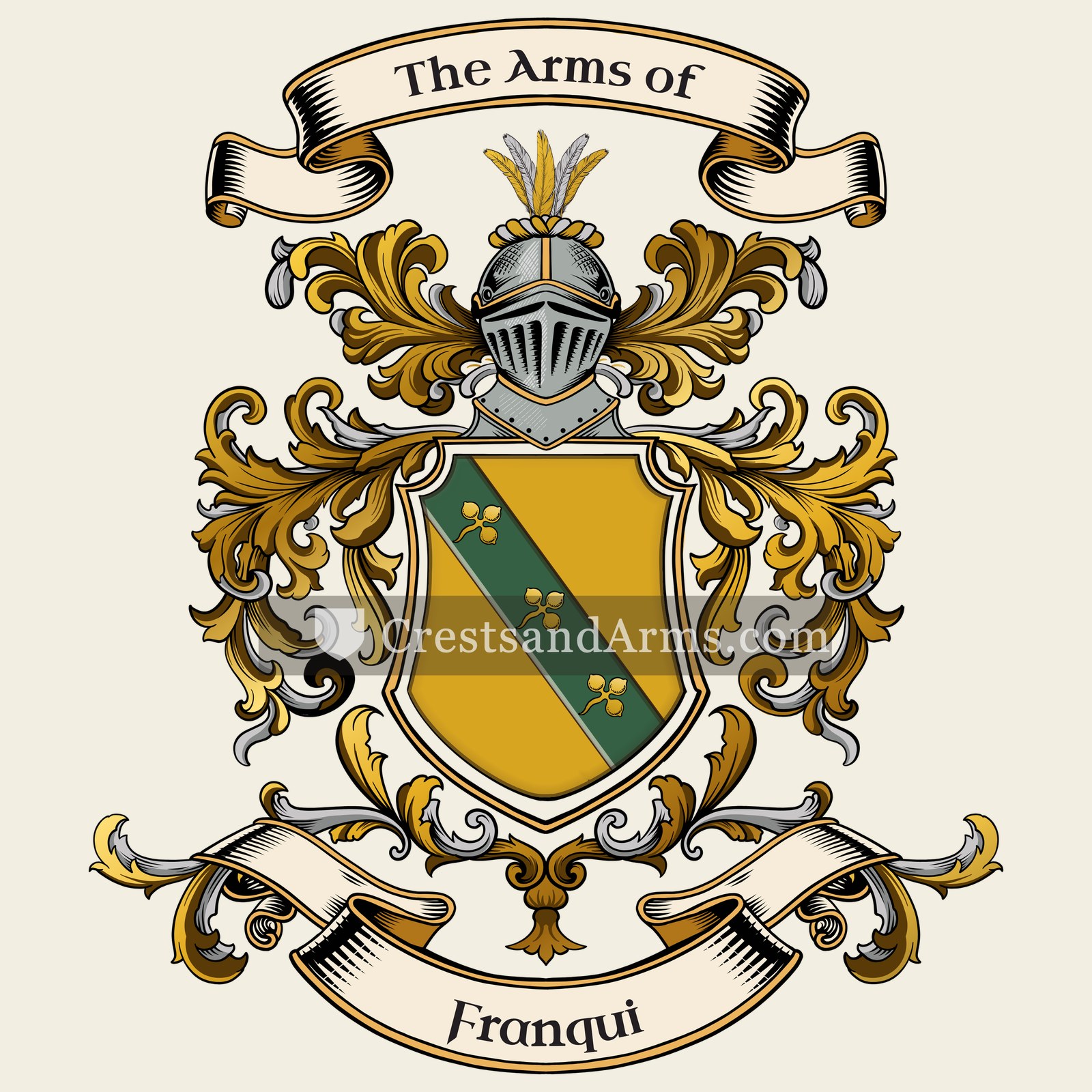
 bendDefence, and the scarf of a commander
 trefoilPerpetuity, and the Trinity
 bendDefence, and the scarf of a commander
 trefoilPerpetuity, and the Trinity