Map of England showing where the Frawley arms are recorded
The Frawley arms were recorded in Lancaster, c. 1620.
Lancashire was divided among a great many small landed families, more than most northern counties. Estates were passed down whole rather than split up, so the same names hold the same ground for centuries in the records.
This is where the arms were entered in the register. Families often moved to other parts of the country, so the same name can turn up in more than one region.
The body that granted and recorded arms in England in this period.
James VI and I
Sovereign of the period
James VI and I
1603–1625
Reigning in England when the Frawley arms are first recorded.
How Arms Worked in England
English heraldry allowed arms to be shared by all legitimate descendants of the original owner. These symbols were treated as personal property that moved through the generations to all children. While the eldest son kept the original design, other family members could use the same shield without needing to change it or register their own unique versions.
Granting authority
The College of Arms in London has regulated the use of coats of arms throughout England and Wales since 1484.
How they got arms
Families typically obtained their coats of arms through a formal grant from the Crown or by proving their ancient right to them.
Where arms were recorded
All official coats of arms are recorded in the registers kept at the College of Arms, which date back to the fifteenth century.
The family's standing
Recorded among the armigerous families of Lancaster.
Origin & History of the Frawley Family in England
The family name Frawley finds its roots in the Gaelic traditions of Ireland, where it evolved from the name Ó Fearghail. This name is derived from the word fear, meaning man, and gal, meaning valor, which suggests that the early family members were known for their courage. By the early seventeenth century, the family had established a presence in various regions, including a notable settlement in Lancaster by 1620. During this era, families often moved due to shifting political landscapes and the search for new opportunities in growing trade centers. Those who settled in Lancaster during this period likely integrated into the local community as skilled laborers or tradespeople, helping to build the foundations of the town. Over time, the spelling of the name transitioned from its original Irish form into the version used today, reflecting the way names were adapted as families moved across different regions and interacted with English-speaking populations.
Frawley Meaning & Related Branches
Root word
Fraoch
An Old Irish term referring to heather or a wild, fierce nature.
This name
FrawleyDerived from an Irish Gaelic nickname for a person with a fierce or wild temperament.
also spelled
Ferley
Ferwly
Fuerley
Pherwley
Documented Sources
Sir Bernard Burke, The General Armory of England, Scotland, Ireland and Wales, London: Harrison & Sons, 1884
MacLysaght, Edward. The Surnames of Ireland. 1985
Woulfe, Patrick. Sloinnte Gaedheal is Gall: Irish Names and Surnames. 1923


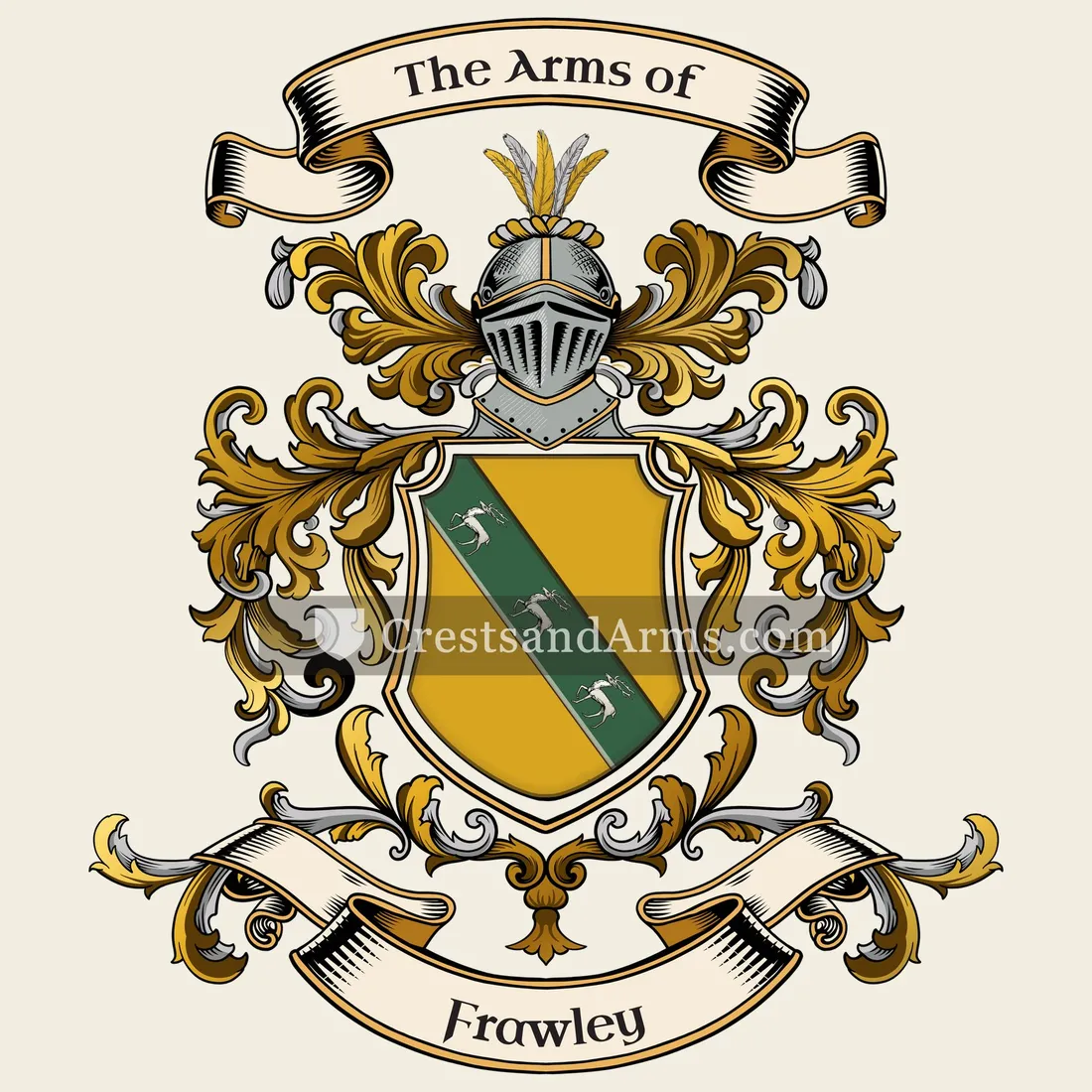
 bendDefence, and the scarf of a commander
 stagPeace and harmony, and one who will not fight unprovoked
 bendDefence, and the scarf of a commander
 stagPeace and harmony, and one who will not fight unprovoked