Map of Italy showing where the Fred arms are recorded
The Fred arms were recorded in Ile-de-France, c. 1775.
Ile-de-France is the country around Paris, and proximity to the court mattered. Families who served the crown were rewarded with land near it, and land near the capital carried arms almost as a matter of course.
This is where the arms were entered in the register. Families often moved to other parts of the country, so the same name can turn up in more than one region.
The body that granted and recorded arms in Italy in this period.
Alvise Giovanni Mocenigo
Sovereign of the period
Alvise Giovanni Mocenigo
1763–1778
Reigning in Italy when the Fred arms are first recorded.
How Arms Worked in Italy
In the Italian states, coats of arms were often used by noble families to show their status and history. These symbols were passed down through the generations to all legitimate male descendants. Younger branches of a family usually kept the original design but sometimes added small changes to distinguish their specific line from the main branch.
Granting authority
Various local rulers and city governments controlled the use of coats of arms across the different Italian states.
How they got arms
Families often assumed their own arms or received them as official grants from local lords, popes, or city councils.
Where arms were recorded
Arms were recorded in local city archives or private family books rather than in one single national register.
The family's standing
Recorded among the armigerous families of Ile-de-France.
Origin & History of the Fred Family in Italy
The family name Fred carries a history deeply rooted in the cultural landscape of the Ile-de-France region during the late eighteenth century. By 1775, records indicate that members of this family were already established within this historic heartland of France. The name likely evolved from ancient Germanic roots, as the prefix "fred" is derived from the Old High German word "frid," which translates to peace or protection. In the social context of the 1700s, families living in the areas surrounding Paris were often tied to the land or specific local trades, and the name may have served as a way to distinguish this particular lineage within their community. As the family navigated the shifting political climate of pre-revolutionary France, they remained a part of the local fabric, contributing to the regional identity of the Ile-de-France long before the name spread to other parts of the world.
Fred Meaning & Related Branches
Root word
Friduric
Derived from Germanic elements meaning peaceful ruler.
This name
FredA diminutive form of Frederick, signifying a peaceful and powerful leader.
also spelled
Fredy
Freddy
Documented Sources
J. B. Rietstap, Armorial Général, Gouda: G. B. van Goor Zonen, 1884–87
Dauzat, Albert, Dictionnaire étymologique des noms de famille et prénoms de France, 1951
Archives Nationales de France, Série Y: Châtelet de Paris, inventaire des scellés et inventaires après décès, 1775
Morlet, Marie-Thérèse, Dictionnaire étymologique des noms de famille, 1991
Digital archive packCoat of arms PNG, gold border print PDF, vector SVG and the certificate of authenticity. Sent to your email in minutes.


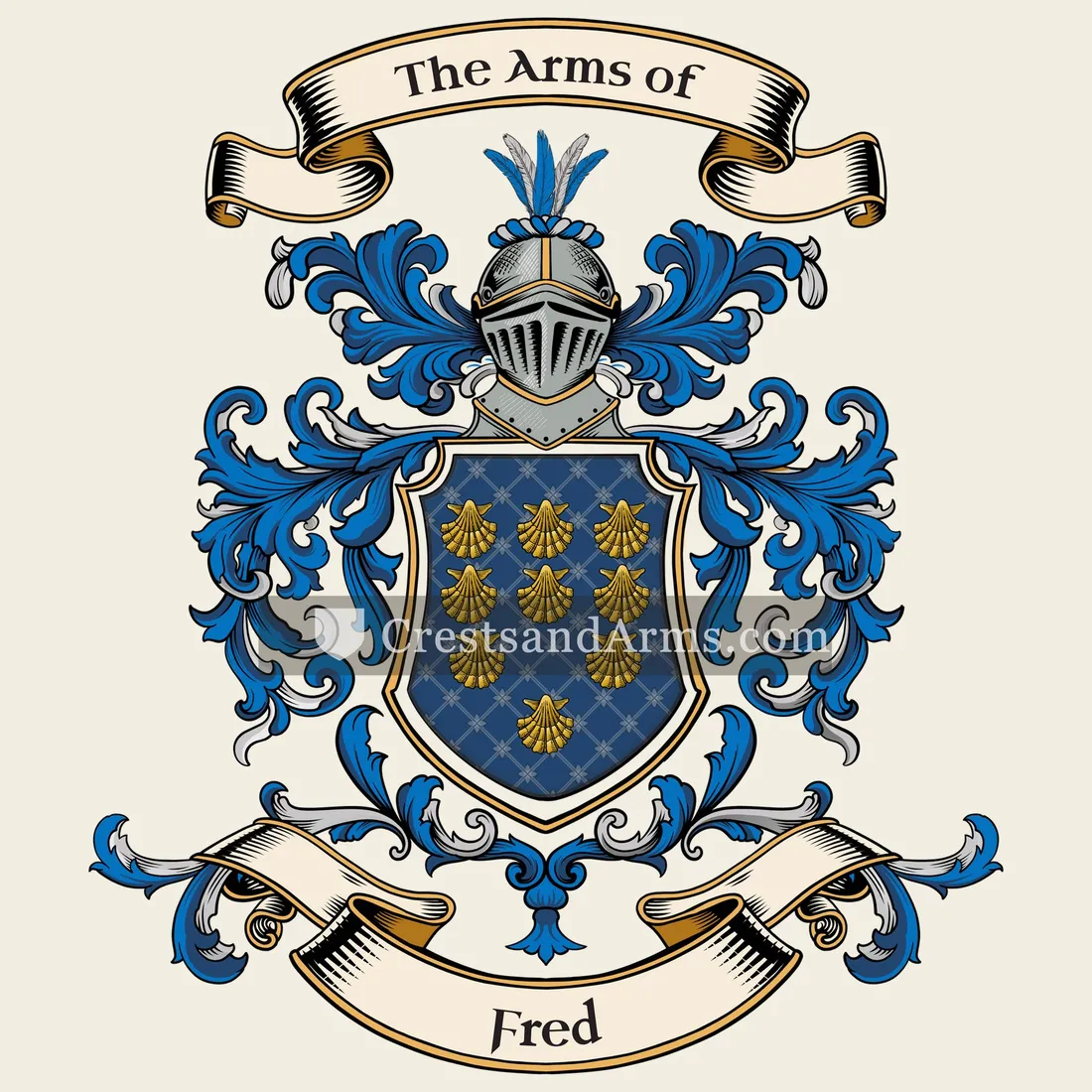
 escallopThe pilgrim's shell, and a long journey made
 escallopThe pilgrim's shell, and a long journey made