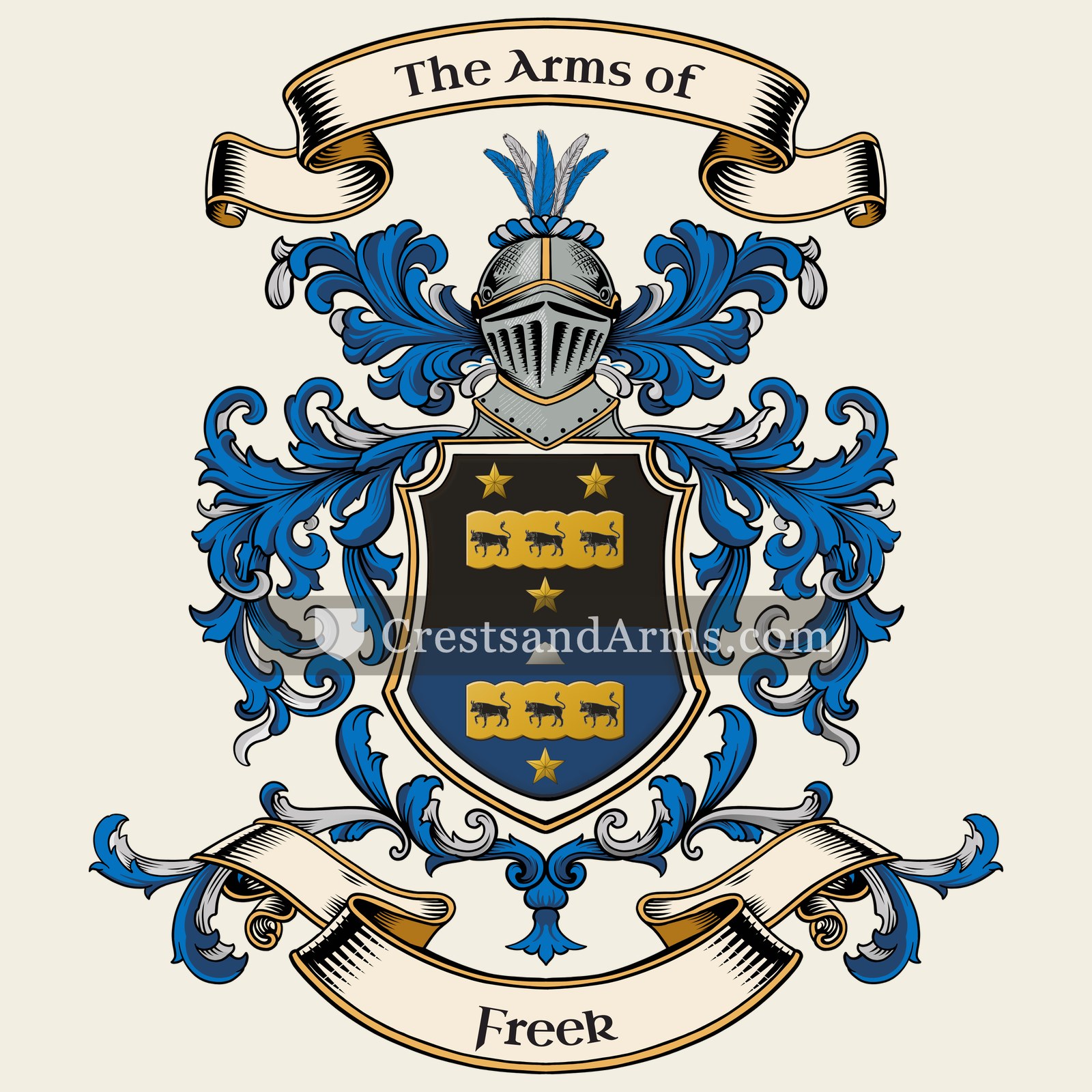
A record of documented arms, meaning and origin, researched for the Freek family lines. Documented in 2 countries.
Reg. 1201 · Britain, D–F
Coat of Arms & Family Crest Details
Symbols on this shield
fessThe military belt, and readiness to serve
mountThe ground held, and steadfastness upon it
bullValour and generosity
mulletThe third son, and a divine quality from above
Colours
Black (Sable)Means: Constancy
Blue (Azure)Means: Loyalty and truth
Gold (Or)Means: Generosity
Historical info
Source
J. B. Rietstap, Armorial Général, Gouda: G. B. van Goor Zonen, 1884–87
Blazon (the actual original written record)
“Coupé: au 1 de sa. à la fasce engr. d'or, ch. de trois rencontres de boeuf du champ et acc. de trois étoiles (6) du sec., rangées en chef; au 2 d'azur à la fasce engr. d'or, ch. de trois rencontres de boeuf de sa., mouv. d'un rocher au nat. et tenant entre ses dents une étoile (6) d'or. D.: INTEGRITY.”
SurreySurrey, c. 1882
Digital archive packCoat of arms PNG, gold border print PDF, vector SVG and the certificate of authenticity. Sent to your email in minutes.
Map of Britain showing where the Freek arms are recorded
The Freek arms were recorded in Surrey, c. 1882.
Surrey sat just south of London and filled up with families who had made money in the City. Buying an estate there was the usual next step, and an estate was the usual reason to take arms.
This is where the arms were entered in the register. Families often moved to other parts of the country, so the same name can turn up in more than one region.
The body that granted and recorded arms in Britain in this period.
Victoria
Sovereign of the period
Victoria
1837–1901
Reigning in Britain when the Freek arms are first recorded.
How Arms Worked in Britain
English heraldry allowed arms to be shared by all legitimate descendants of the original owner. These symbols were treated as personal property that moved through the generations to all children. While the eldest son kept the original design, other family members could use the same shield without needing to change it or register their own unique versions.
Granting authority
The College of Arms in London has regulated the use of coats of arms throughout England and Wales since 1484.
How they got arms
Families typically obtained their coats of arms through a formal grant from the Crown or by proving their ancient right to them.
Where arms were recorded
All official coats of arms are recorded in the registers kept at the College of Arms, which date back to the fifteenth century.
The family's standing
Recorded among the armigerous families of Surrey.
Origin & History of the Freek Family in Britain
The surname Freek is a rare name that likely emerged as a descriptive nickname or a variation of older Germanic or Old English roots. While the name appears in various forms across Northern Europe, its presence in Britain became more distinct during the nineteenth century. By 1882, records confirm that members of the family were established in the county of Surrey. During this era, Surrey was transitioning from a rural landscape into a region increasingly influenced by the growth of nearby London. Families like the Freeks often moved to these areas to take advantage of new employment opportunities in trade and local industry. As the family settled into the community, they became part of the working fabric of Victorian England, contributing to the local economy and the social development of the region during a time of rapid national expansion.
Coat of Arms & Family Crest Details
Symbols on this shield
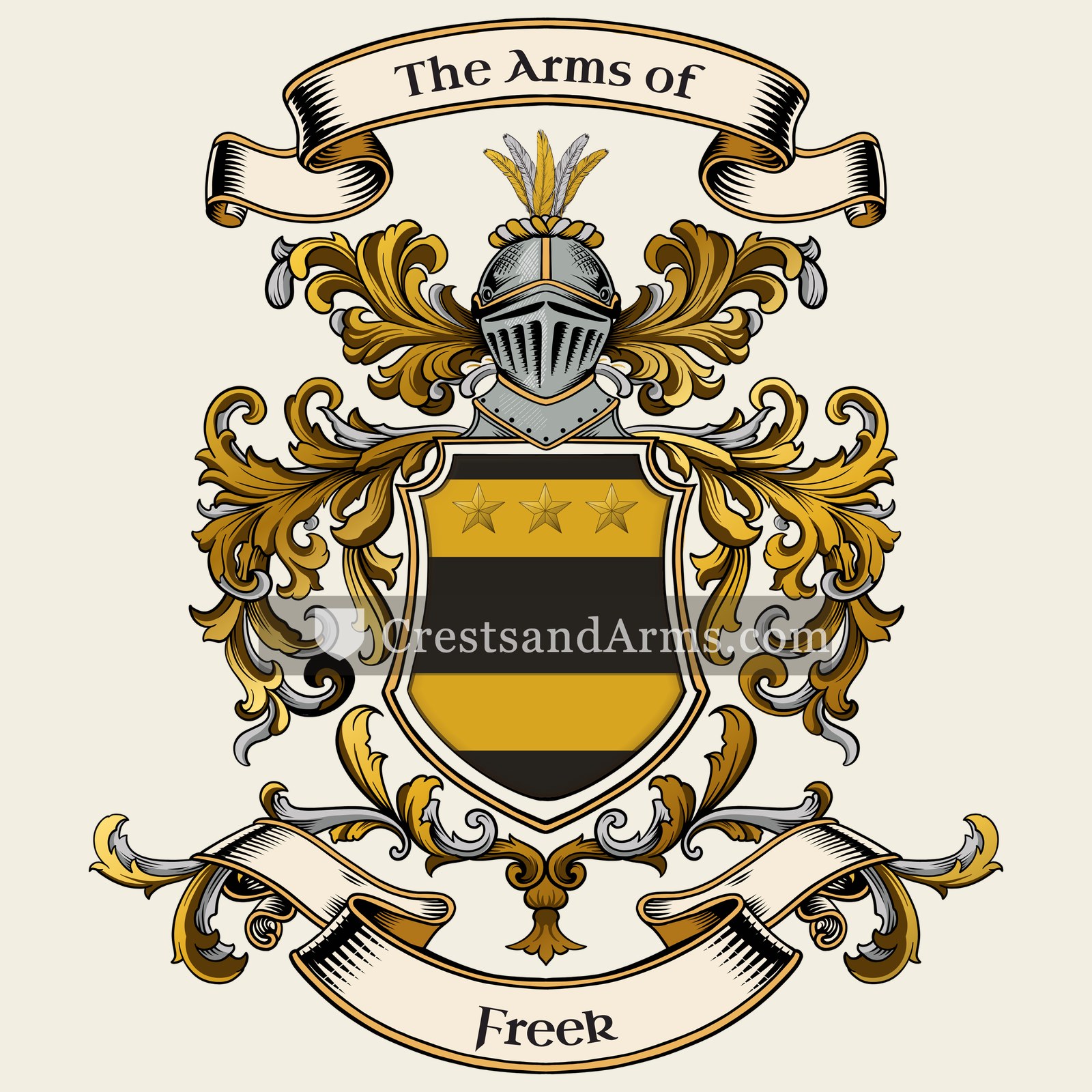
mulletThe third son, and a divine quality from above
Colours
Black (Sable)Means: Constancy
Gold (Or)Means: Generosity
Historical info
Source
Sir Bernard Burke, The General Armory of England, Scotland, Ireland and Wales, London: Harrison & Sons, 1884
Blazon (the actual original written record)
“Sa. two bars or, in chief three mullets of the last”
DorsetEwern Courtney · Dorset, c. 1620
Digital archive packCoat of arms PNG, gold border print PDF, vector SVG and the certificate of authenticity. Sent to your email in minutes.
Map of England showing where the Freek arms are recorded
The Freek arms were recorded in Dorset, c. 1620.
Dorset was quiet farming and grazing country along the south coast. Its gentry were middling rather than grand, but they held their manors for a very long time, and long holding is what puts a name in the records.
This is where the arms were entered in the register. Families often moved to other parts of the country, so the same name can turn up in more than one region.
The body that granted and recorded arms in England in this period.
James VI and I
Sovereign of the period
James VI and I
1603–1625
Reigning in Britain when the Freek arms are first recorded.
How Arms Worked in England
English heraldry allowed arms to be shared by all legitimate descendants of the original owner. These symbols were treated as personal property that moved through the generations to all children. While the eldest son kept the original design, other family members could use the same shield without needing to change it or register their own unique versions.
Granting authority
The College of Arms in London has regulated the use of coats of arms throughout England and Wales since 1484.
How they got arms
Families typically obtained their coats of arms through a formal grant from the Crown or by proving their ancient right to them.
Where arms were recorded
All official coats of arms are recorded in the registers kept at the College of Arms, which date back to the fifteenth century.
The family's standing
Recorded among the armigerous families of Dorset.
Origin & History of the Freek Family in England
The surname Freek has deep roots in the English county of Dorset, where records confirm the family was well-established by the year 1620. The name likely originated as a descriptive nickname, as the word "frek" was used in Middle English to describe someone who was bold, eager, or energetic. During the seventeenth century, families in rural areas like Dorset often lived as tenant farmers or tradespeople, working the land and participating in the local parish life. Because spelling was not standardized at the time, the name appeared in various forms in church registers and legal documents, reflecting how the local dialect influenced the way names were written down by clerks. By settling in the coastal and agricultural landscapes of the West Country, the early members of the Freek family became part of the long history of English village life, contributing to the local community through their labor and their presence in the regional records of the era.
Freek Meaning & Related Branches
Root word
Fredericus
Derived from Germanic elements meaning peaceful ruler.
This name
FreekA diminutive form of Frederick, signifying a peaceful and powerful leader.
also spelled
Freek
Freak
Documented Sources
J. B. Rietstap, Armorial Général, Gouda: G. B. van Goor Zonen, 1884–87
General Register Office, England and Wales Civil Registration Birth Index, 1882
The National Archives, Census Returns of England and Wales, 1881, Series RG11
Digital archive packCoat of arms PNG, gold border print PDF, vector SVG and the certificate of authenticity. Sent to your email in minutes.


 fessThe military belt, and readiness to serve
 mountThe ground held, and steadfastness upon it
 bullValour and generosity
 mulletThe third son, and a divine quality from above
 fessThe military belt, and readiness to serve
 mountThe ground held, and steadfastness upon it
 bullValour and generosity
 mulletThe third son, and a divine quality from above