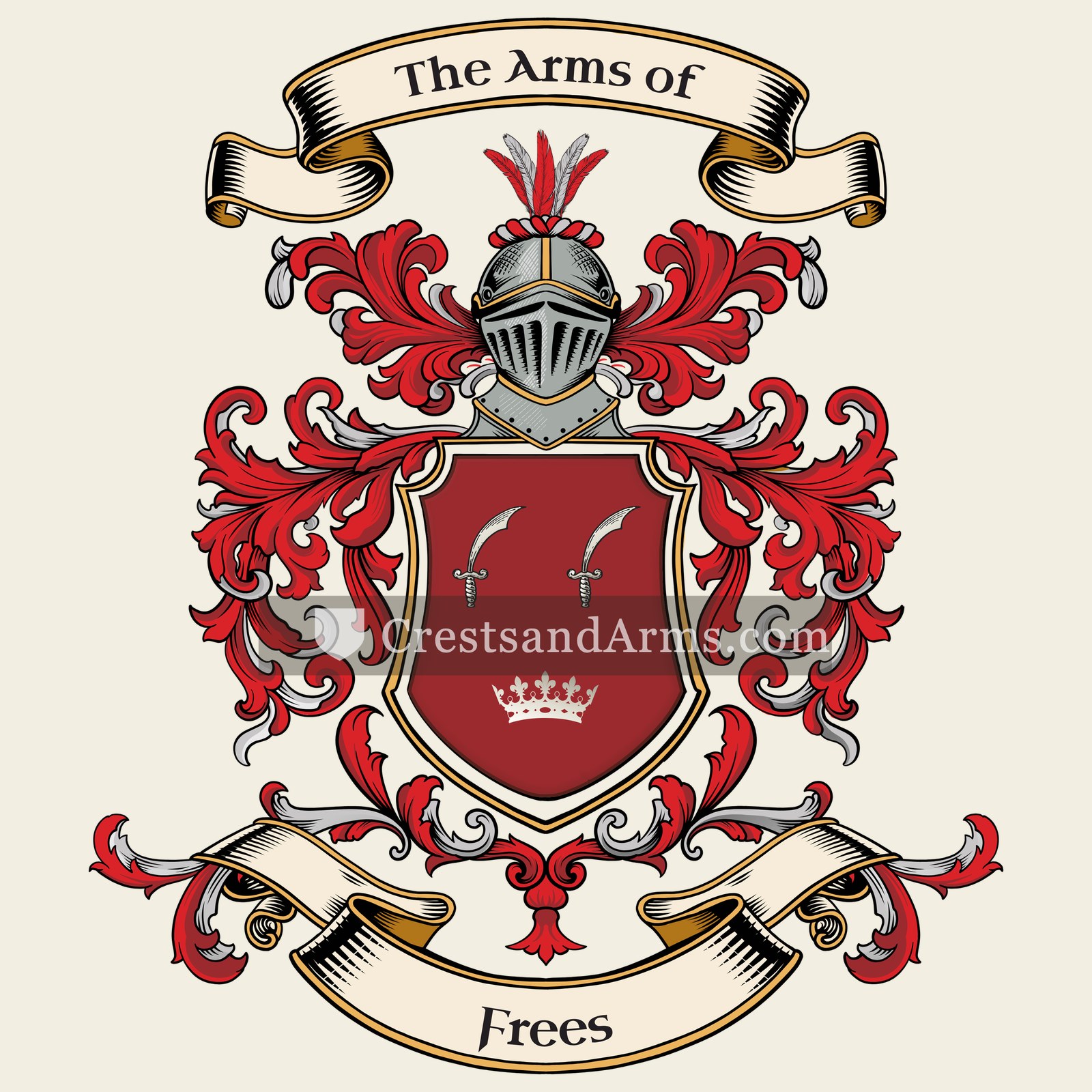
A record of documented arms, meaning and origin, researched for the Frees family lines. Documented in 3 countries.
Reg. 2779 · French, D–F
Coat of Arms & Family Crest Details
Symbols on this shield
sickleThe harvest, and the reaping of what was sown
mulletThe third son, and a divine quality from above
Colours
Red (Gules)Means: Military strength
Silver (Argent)Means: Peace and sincerity
Gold (Or)Means: Generosity
Historical info
Source
J. B. Rietstap, Armorial Général, Gouda: G. B. van Goor Zonen, 1884–87
Blazon (the actual original written record)
“De gu. à une bêche d'arg., emm. d'or, le fer en bas et terminé en deux pointes; ladite bêche accostée de deux étoiles d'or. Deux cq. cour. C.: 1º un homme iss., hab. d'arg. au rabat de gu., les manches retr. du même, tenant la bêche de l'écu, posée sur son épaule; l. d'arg. et de gu.; 2º un demi-vol coupé d'or sur gu., à deux étoiles de l'un à l'autre; l. d'or et de gu.”
AlsaceAlsace, c. 1757
Digital archive packCoat of arms PNG, gold border print PDF, vector SVG and the certificate of authenticity. Sent to your email in minutes.
Map of France showing where the Frees arms are recorded
The Frees arms were recorded in Alsace, c. 1757.
Alsace lay between France and the German lands and belonged to both at different times. Its families held small estates and served whichever side ruled, and men who served in arms carried arms of their own.
This is where the arms were entered in the register. Families often moved to other parts of the country, so the same name can turn up in more than one region.
The body that granted and recorded arms in France in this period.
Louis XV of France
Sovereign of the period
Louis XV of France
1715–1774
Reigning in France when the Frees arms are first recorded.
How Arms Worked in France
In France, a coat of arms was a mark of honor that passed down through the male line to all legitimate descendants. Families often used the same shield without changes to show their shared heritage. If a branch wanted to stand out, they could add a small mark to their shield to show their specific place in the family tree.
Granting authority
The Juge d'armes de France acted as the official authority that regulated and verified coats of arms across the country.
How they got arms
Families typically inherited their arms from ancestors, though they could also receive them through royal grants or by proving their noble status.
Where arms were recorded
Coats of arms were officially recorded in the Armorial Général de France, which began its main collection in the year 1696.
The family's standing
Recorded among the armigerous families of Alsace.
Origin & History of the Frees Family in France
The family name Frees has deep roots in the Alsace region of France, where records confirm members of the family were established by 1757. During this era, Alsace was a unique cultural crossroads located between France and Germany, which often led to the blending of linguistic traditions and naming customs. The name itself likely originated as a descriptive term or a variation of local Germanic and French dialects spoken in the Rhine Valley. Families in this area were often deeply connected to the land, working as farmers or skilled tradespeople in small villages that survived through centuries of shifting political borders. By the mid-18th century, the Frees family was part of a stable community that maintained detailed parish records, which helped preserve their presence in the region during a time of significant social change. These early ancestors were witnesses to the complex history of the Alsatian frontier, living through a period where local identity was shaped by both the French crown and the cultural heritage of the surrounding territories.
Coat of Arms & Family Crest Details
Symbols on this shield
lionCourage, strength and royalty
Colours
Black (Sable)Means: Constancy
Gold (Or)Means: Generosity
Historical info
Source
J. B. Rietstap, Armorial Général, Gouda: G. B. van Goor Zonen, 1884–87
Blazon (the actual original written record)
“Coupé de sa. sur or; à un lion, ayant une tête de jeune fille, de l'un en l'autre. C.: le lion, iss. (Branche de la fam. Fries, en Franconie, qui portait: Coupé d'azur sur or, au lion de l'un en l'autre).”
Austriac. 1451
Digital archive packCoat of arms PNG, gold border print PDF, vector SVG and the certificate of authenticity. Sent to your email in minutes.
Map of Austria showing where the Frees arms are recorded
The Frees arms were recorded in Austria, c. 1451.
Arms such as these were typically recorded in Tyrol.
Tyrol was mountain country in western Austria, where the valleys were held by families who had been there a very long time. Old tenure counted for more than money, and old families carried arms.
This is where the arms were entered in the register. Families often moved to other parts of the country, so the same name can turn up in more than one region.
Region
Tyrol
First recorded
1451
Granting Authority for the Frees Arms
Imperial and Royal chancery
Sodacan · CC BY-SA 3.0
The body that granted and recorded arms in Austria in this period.
How Arms Worked in Austria
Austrian coats of arms were often linked directly to noble titles granted by the Emperor. These symbols belonged to the entire family line rather than just one individual. When a family grew, new branches kept the original design without needing to change it. This system allowed all members of a noble house to share the same identity across many generations.
Granting authority
The Imperial and Royal chancery managed all heraldic matters and controlled the official granting of arms throughout the Austrian lands.
How they got arms
Families typically received their arms through a formal imperial decree that often accompanied the elevation of a person to noble status.
Where arms were recorded
Official records of these grants were kept in the Imperial Register of Nobility which began its formal documentation process in 1453.
The family's standing
Recorded among the armigerous families of Austria.
Origin & History of the Frees Family in Austria
The family name Frees has deep roots in the rugged landscape of the Austrian Tyrol, where records confirm members of the family were established as early as 1451. During this period, the name likely emerged as a descriptive term for people who held a status of independence or freedom within the rigid social structures of the Middle Ages. Living in the high alpine valleys, these early ancestors were often involved in the local agricultural and mining economies that defined the region. Because the Tyrol served as a vital crossroads for trade between Italy and the German lands, the family would have been part of a vibrant community shaped by constant movement and cultural exchange. Over the centuries, the name persisted as a mark of their long-standing connection to the mountain villages and the resilient spirit of the Tyrolean people.
Coat of Arms & Family Crest Details
Symbols on this shield
swordJustice, and military honour
crownSovereignty, authority and just reward
Colours
Red (Gules)Means: Military strength
Silver (Argent)Means: Peace and sincerity
Historical info
Source
J. B. Rietstap, Armorial Général, Gouda: G. B. van Goor Zonen, 1884–87
Blazon (the actual original written record)
“De gu. à deux épées d'arg., passées en saut. dans une couronne d'arg., les pointes en bas. C.: un griffon iss. de gu., tenant de ses pattes une épée d'arg. en pal.”
GermanyFrancfort s, c. 1765
Digital archive packCoat of arms PNG, gold border print PDF, vector SVG and the certificate of authenticity. Sent to your email in minutes.
Map of Germany showing where the Frees arms are recorded
The Frees arms were recorded in Francfort s, c. 1765.
This is where the arms were entered in the register. Families often moved to other parts of the country, so the same name can turn up in more than one region.
The body that granted and recorded arms in Germany in this period.
Francis I, Holy Roman Emperor
Sovereign of the period
Francis I, Holy Roman Emperor
1745–1765
Reigning in France when the Frees arms are first recorded.
How Arms Worked in Germany
In the Holy Roman Empire, coats of arms were often granted to individuals by the Emperor or his representatives. These arms were then passed down through the generations to all legitimate descendants of the original holder. Younger branches of a family usually kept the same shield design without needing to change it, as the arms belonged to the entire lineage.
Granting authority
The Holy Roman Emperor held the sole power to grant new coats of arms throughout his vast imperial territories.
How they got arms
Families typically obtained their coats of arms through a formal imperial grant or by proving their noble status to the authorities.
Where arms were recorded
These grants were officially recorded in the Imperial Chancery registers, which began keeping formal records of such honors during the Middle Ages.
The family's standing
Recorded among the armigerous families of Germany.
Origin & History of the Frees Family in Germany
The family name Frees has deep roots in the German-speaking regions of Europe, where it likely originated as a descriptive term for a person who held the status of a free citizen. During the Middle Ages, many people were tied to the land under feudal systems, but those known as "Frei" or "Frees" were often individuals who had gained their independence from local lords. By the mid-eighteenth century, the family was firmly established in the bustling trade hub of Frankfurt. Records from 1765 show that members of the Frees family were active participants in the social and economic life of this city. As Frankfurt served as a major center for commerce and banking, families living there during this period were often connected to the guilds or the growing merchant class. This environment allowed the family to integrate into the urban fabric of Germany during a time of significant cultural and political transition.
Frees Meaning & Related Branches
Root word
Fris
A Germanic term referring to a person from Frisia.
This name
FreesA topographic or habitational name denoting someone who originated from the Frisian region.
also spelled
Fryes
Frees
Freeze
Documented Sources
J. B. Rietstap, Armorial Général, Gouda: G. B. van Goor Zonen, 1884–87
Archives Départementales du Bas-Rhin, Registres paroissiaux et d'état civil, 1757
Kintz, Jean-Pierre, La société alsacienne au XVIIIe siècle, 1984
Livet, Georges, L'Alsace et les Alsaciens, 1982
Digital archive packCoat of arms PNG, gold border print PDF, vector SVG and the certificate of authenticity. Sent to your email in minutes.


 sickleThe harvest, and the reaping of what was sown
 mulletThe third son, and a divine quality from above
 sickleThe harvest, and the reaping of what was sown
 mulletThe third son, and a divine quality from above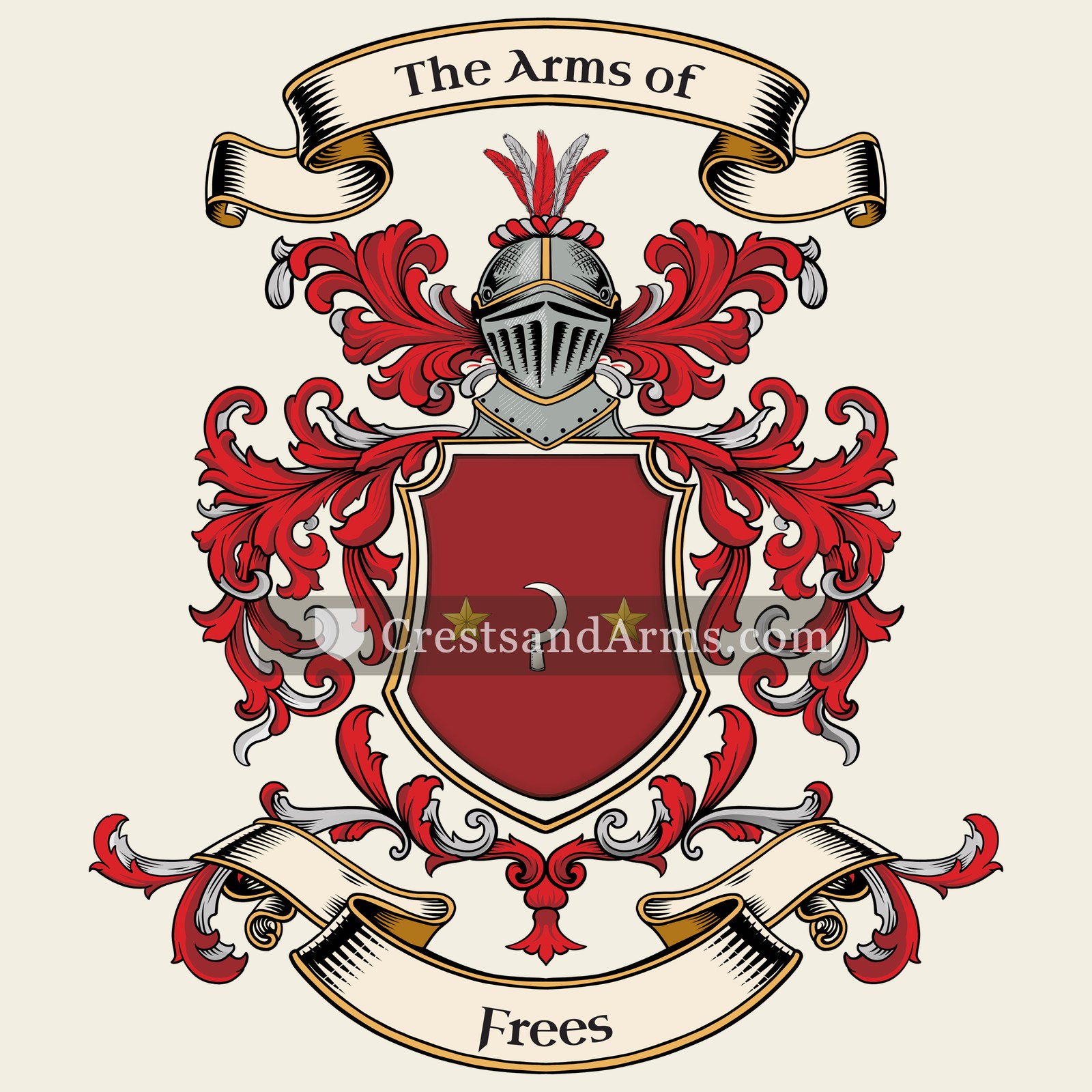


 lionCourage, strength and royalty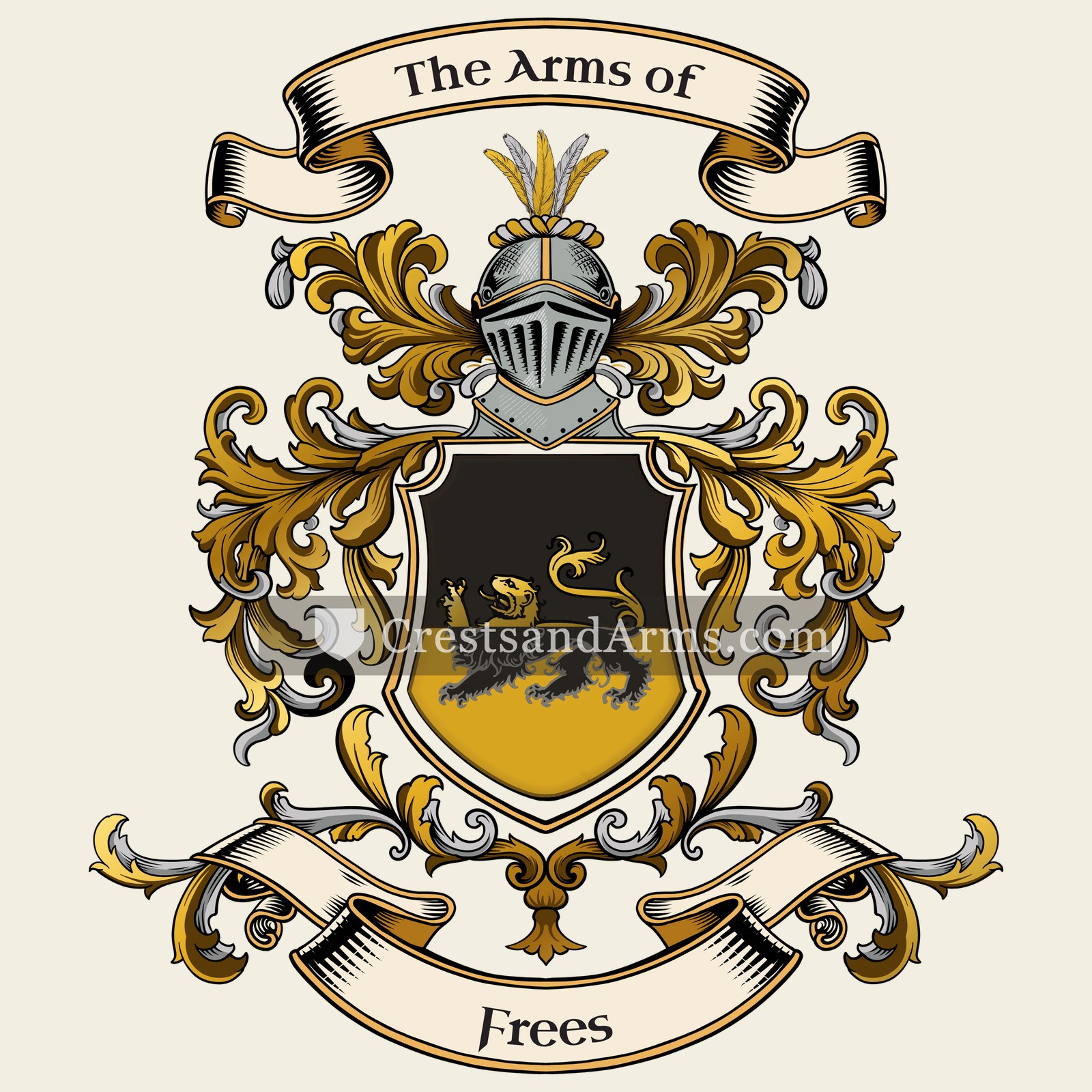

 swordJustice, and military honour
 crownSovereignty, authority and just reward