Map of France showing where the Freet arms are recorded
The Freet arms were recorded in Bretagne, c. 1663.
More families held coats of arms in Bretagne than anywhere else in France. The land was divided into many small estates rather than a few large ones, so far more households counted as gentry, and each needed a shield of its own to be told apart.
This is where the arms were entered in the register. Families often moved to other parts of the country, so the same name can turn up in more than one region.
The body that granted and recorded arms in France in this period.
Louis XIV of France
Sovereign of the period
Louis XIV of France
1643–1715
Reigning in France when the Freet arms are first recorded.
How Arms Worked in France
In France, a coat of arms was a mark of honor that passed down through the male line to all legitimate descendants. Families often used the same shield without changes to show their shared heritage. If a branch wanted to stand out, they could add a small mark to their shield to show their specific place in the family tree.
Granting authority
The Juge d'armes de France acted as the official authority that regulated and verified coats of arms across the country.
How they got arms
Families typically inherited their arms from ancestors, though they could also receive them through royal grants or by proving their noble status.
Where arms were recorded
Coats of arms were officially recorded in the Armorial Général de France, which began its main collection in the year 1696.
The family's standing
Recorded among the armigerous families of Bretagne.
Origin & History of the Freet Family in France
The history of the Freet family in France is deeply rooted in the rugged landscape of the Bretagne region, where records confirm their presence as early as 1663. During the seventeenth century, families in this coastal area often lived in small, tight-knit rural communities centered around agriculture or maritime trade. The name likely evolved from local linguistic patterns common to the western provinces, reflecting the way people identified themselves by their occupation or their specific place of residence within a parish. Life in Bretagne at this time was heavily influenced by the Catholic Church, which kept meticulous registers of births, marriages, and deaths. These documents serve as the primary window into the daily lives of the Freet ancestors, showing a family that navigated the social and economic shifts of the French countryside during the reign of King Louis XIV. By maintaining a steady presence in the region, the family became part of the enduring cultural fabric of Brittany, contributing to the distinct traditions and history that define the area to this day.
Meaning of the Freet family crest colors & symbols
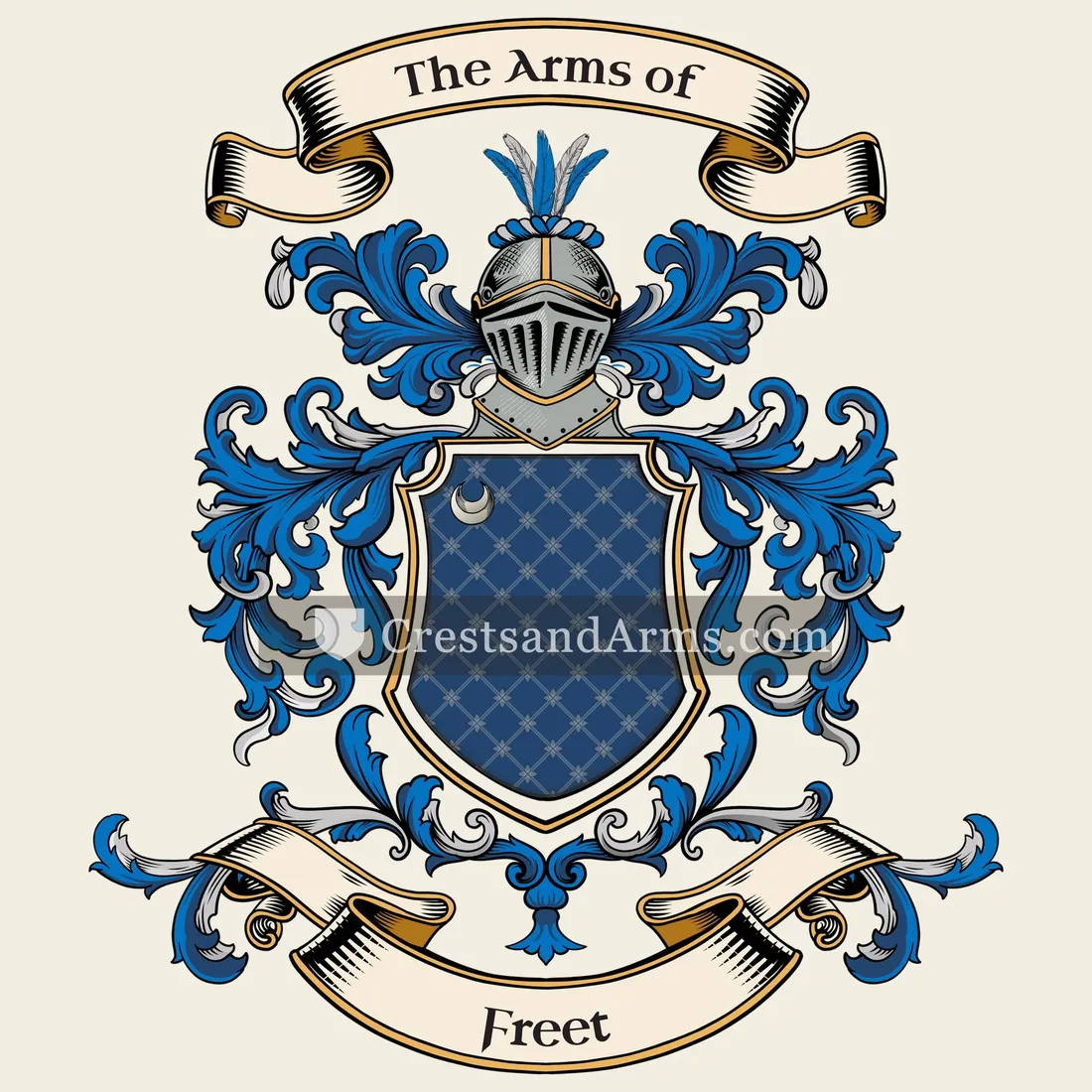
Symbols on this shield
crescentHonour by the sovereign, and the second son
Colours
Blue (Azure)Means: Loyalty and truth
Silver (Argent)Means: Peace and sincerity
Historical info
Source
J. B. Rietstap, Armorial Général, Gouda: G. B. van Goor Zonen, 1884–87
Blazon (the actual original written record)
“D'azur à la bande d'arg., treillissée de gu. et acc. au canton sen. du chef d'un croiss. d'arg.”
SwitzerlandValais, c. 1745
Digital archive packCoat of arms PNG, gold border print PDF, vector SVG and the certificate of authenticity. Sent to your email in minutes.
Map of Switzerland showing where the Freet arms are recorded
The Freet arms were recorded in Valais, c. 1745.
This is where the arms were entered in the register. Families often moved to other parts of the country, so the same name can turn up in more than one region.
The body that granted and recorded arms in Switzerland in this period.
How Arms Worked in Switzerland
In Switzerland, coats of arms were not restricted to the nobility and were often adopted by common citizens and families. These symbols were passed down through generations to show family identity. When branches of a family grew, they often changed small details of the design to distinguish their own line from the original group.
Granting authority
Cantonal and civic authorities managed the use of coats of arms within their specific regions and local jurisdictions.
How they got arms
Families typically assumed their own coats of arms based on local custom rather than receiving them from a central monarch.
Where arms were recorded
Arms were recorded in various cantonal and civic registers starting from the fourteenth century throughout the Swiss region.
The family's standing
Recorded among the armigerous families of Switzerland.
Origin & History of the Freet Family in Switzerland
The history of the Freet family in Switzerland is deeply rooted in the rugged landscape of the Valais region. By the mid-18th century, members of the family were already established residents in this alpine territory, which was then a collection of independent districts known as the Republic of the Seven Decades. Life in Valais during the 1700s was defined by high-altitude agriculture and the seasonal movement of livestock between mountain pastures. Families like the Freets often lived in tight-knit village communities where they navigated the complex local laws and religious traditions of the Catholic Valais. Because the region served as a vital gateway for trade routes crossing the Alps, the family likely participated in the local exchange of goods and mountain commerce that sustained these isolated communities. Their presence in the historical record by 1745 reflects a long-standing commitment to the land and the distinct cultural identity of the Swiss mountain people.
Freet Meaning & Related Branches
Root word
Francus
Latin term meaning free man or a person of Frankish origin.
This name
FreetA locative or descriptive surname denoting a person who was free or from the Frankish region.
also spelled
Forett
Forete
Forret
Foray
Documented Sources
J. B. Rietstap, Armorial Général, Gouda: G. B. van Goor Zonen, 1884–87
Archives départementales du Morbihan, Registres paroissiaux et d'état civil, 1663
Gautier, Hervé, Histoire de la Bretagne, 1993
Le Moyne de La Borderie, Arthur, Histoire de Bretagne, 1905
Digital archive packCoat of arms PNG, gold border print PDF, vector SVG and the certificate of authenticity. Sent to your email in minutes.


 pine coneLife and fertility
 pine coneLife and fertility
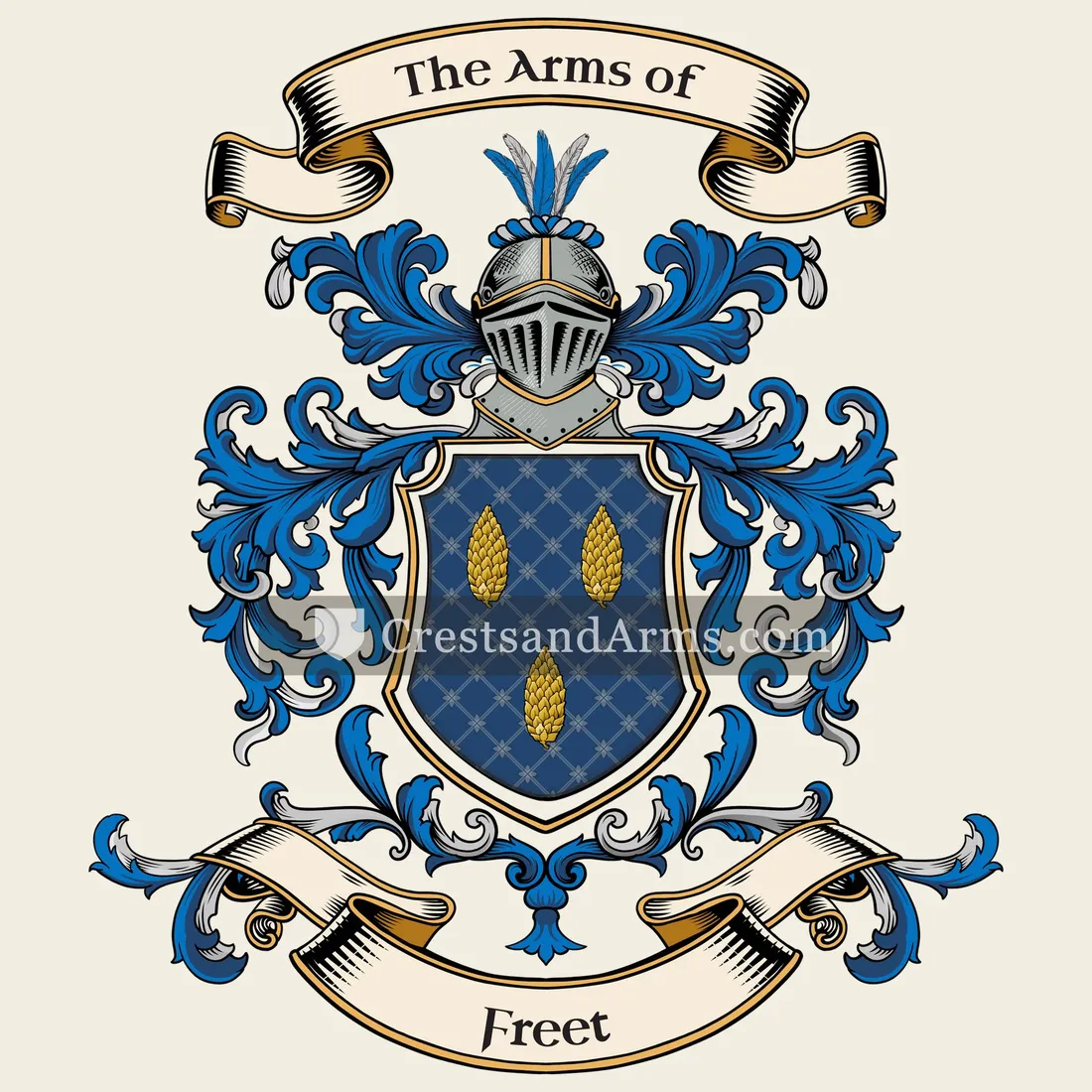


 crescentHonour by the sovereign, and the second son