A record of documented arms, meaning and origin, researched for the Frelich family lines. Documented in 2 countries.
Reg. 0826 · Swedish, D–F
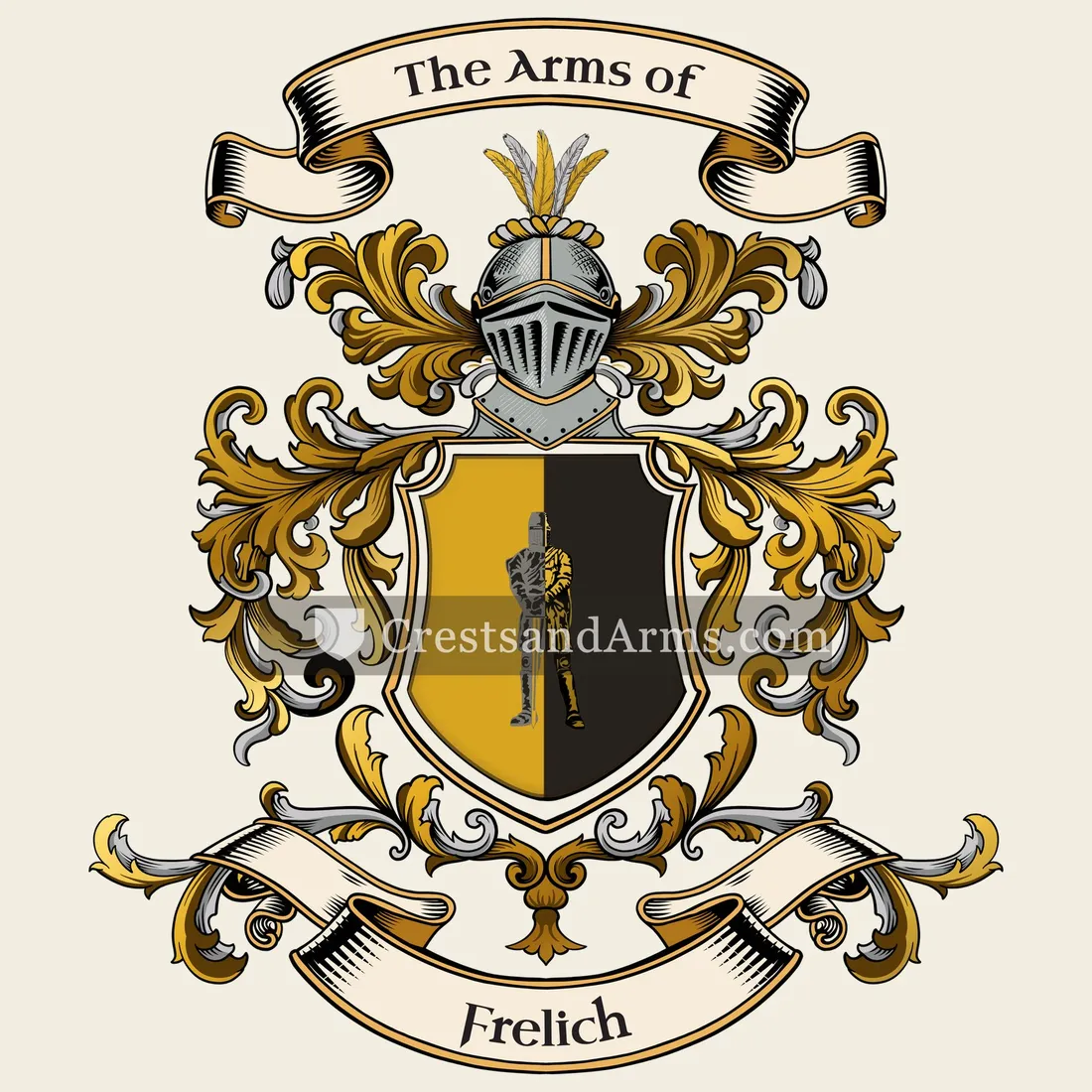
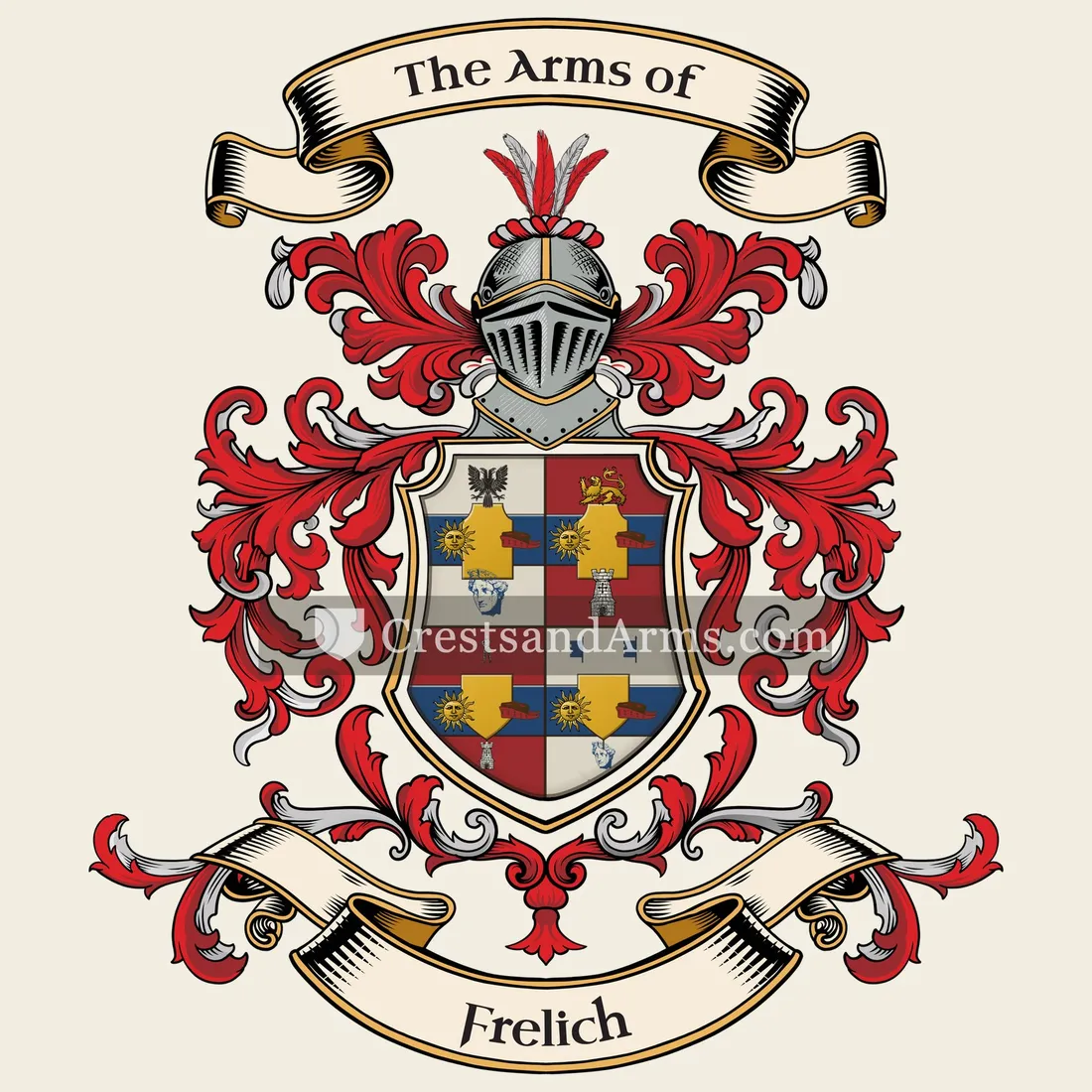
Meaning of the Frelich family crest colors & symbols
Symbols on this shield
fessThe military belt, and readiness to serve
eagleNobility, strength and a keen mind
sunGlory, splendour and the source of life
hat or capDignity, and the honour of office
womanGrace, and the founding of a house
lionCourage, strength and royalty
towerGrandeur and solidity, and a stronghold defended
knightChivalry and service in arms
flag / pennantA command held, and a following kept
Colours
Silver (Argent)Means: Peace and sincerity
Red (Gules)Means: Military strength
Blue (Azure)Means: Loyalty and truth
Gold (Or)Means: Generosity
Black (Sable)Means: Constancy
Historical info
Source
J. B. Rietstap, Armorial Général, Gouda: G. B. van Goor Zonen, 1884–87
Blazon (the actual original written record)
“Ec.: au 1 d'arg. à une aigle de profil de sa., cont., la tête tournée à dextre, le vol levé; au 2 de gu. au lion reg. d'or; au 3 coupé de gu. sur sa.; à un chevalier, arm. de toutes pièces, tenant une épée et monté sur un cheval galopant, le tout d'arg., br. sur le coupé; au 4 coupé: a. d'arg. à deux bannières, l'une d'azur et l'autre d'or, passées en saut.; b. de sin. ch. à dextre de deux tubes de canon d'or, passés en saut., et à sen. d'une pile de boulets d'or. A la fasce d'azur, br. sur l'écartelé et ch. à dextre d'un soleil d'or et à sen. d'un chapeau de gu. Sur le tout un écusson éc., timbré de deux couronnes accostées: aux 1 et 4 d'or à une femme iss., hab. d'azur, les manches jusqu'aux coudes, cour. de feuillage de sin. et supp. de chacune de ses mains levées une couronne de laurier de sin.; aux 2 et 3 coupé d'arg. sur azur, à une tour de gu., br. sur le coupé. Trois cq. cour. C.: 1° une tour d'arg., entre un vol de gu. et d'arg.; 2° la femme iss. du surtout; 3° un lion iss. d'or. S.: à dextre un lion reg. d'or; à sen. une aigle reg. de sa.”
Swedenc. 1706
Digital archive packCoat of arms PNG, gold border print PDF, vector SVG and the certificate of authenticity. Sent to your email in minutes.
Map of Sweden showing where the Frelich arms are recorded
The Frelich arms were recorded in Sweden, c. 1706.
Arms such as these were typically recorded in Stockholm.
Stockholm held the Swedish court and the House of Nobility, where every noble family's arms were entered and kept. Families ennobled for service registered there, which is why so many are recorded around the city.
This is where the arms were entered in the register. Families often moved to other parts of the country, so the same name can turn up in more than one region.
The body that granted and recorded arms in Sweden in this period.
Carl XII of Sweden
Sovereign of the period
Carl XII of Sweden
1697–1718
Reigning in Sweden when the Frelich arms are first recorded.
How Arms Worked in Sweden
In Sweden, a coat of arms belonged to a noble family as a whole rather than just one individual. These arms were passed down through the generations to all legitimate descendants. Younger branches of the family used the same shield without needing to change it. This system ensured that the entire lineage shared the same identity and status under the law.
Granting authority
The Riddarhuset, or House of Nobility, regulated all noble coats of arms in Sweden under royal authority.
How they got arms
Families received their coats of arms through royal grants of nobility which were then officially registered with the House.
Where arms were recorded
Coats of arms were officially recorded in the Swedish House of Nobility register starting in the year 1626.
The family's standing
Recorded among the armigerous families of Sweden.
Origin & History of the Frelich Family in Sweden
The family name Frelich has deep roots in the urban environment of Stockholm, where records confirm members of the family were living as early as 1706. During this period, Stockholm was a growing center of trade and administration, and families with names like Frelich often integrated into the city’s professional and merchant classes. The name itself suggests a connection to the German-speaking regions of Europe, as many families migrated to Sweden during the seventeenth and eighteenth centuries to participate in the country’s expanding economy. These early ancestors likely navigated the social and political shifts of the Swedish Empire, establishing a foundation in the capital that allowed the family to persist through generations. By settling in Stockholm, the Frelich family became part of the diverse population that helped shape the city into a major northern European hub.
Meaning of the Frelich family crest colors & symbols
Symbols on this shield
knightChivalry and service in arms
Colours
Gold (Or)Means: Generosity
Black (Sable)Means: Constancy
Historical info
Source
J. B. Rietstap, Armorial Général, Gouda: G. B. van Goor Zonen, 1884–87
Blazon (the actual original written record)
“Parti d'or et de sa.: à un homme, la tête tort. de gu., hab. d'une soutane de l'un en l'autre, le bras sen. étendu. C.: la figure, iss.”
GermanyNeuburg Bav, c. 1765
Digital archive packCoat of arms PNG, gold border print PDF, vector SVG and the certificate of authenticity. Sent to your email in minutes.
Map of Germany showing where the Frelich arms are recorded
The Frelich arms were recorded in Neuburg Bav, c. 1765.
This is where the arms were entered in the register. Families often moved to other parts of the country, so the same name can turn up in more than one region.
The body that granted and recorded arms in Germany in this period.
Francis I, Holy Roman Emperor
Sovereign of the period
Francis I, Holy Roman Emperor
1745–1765
Reigning in Sweden when the Frelich arms are first recorded.
How Arms Worked in Germany
In the Holy Roman Empire, coats of arms were often granted to individuals by the Emperor or his representatives. These arms were then passed down through the generations to all legitimate descendants of the original holder. Younger branches of a family usually kept the same shield design without needing to change it, as the arms belonged to the entire lineage.
Granting authority
The Holy Roman Emperor held the sole power to grant new coats of arms throughout his vast imperial territories.
How they got arms
Families typically obtained their coats of arms through a formal imperial grant or by proving their noble status to the authorities.
Where arms were recorded
These grants were officially recorded in the Imperial Chancery registers, which began keeping formal records of such honors during the Middle Ages.
The family's standing
Recorded among the armigerous families of Germany.
Origin & History of the Frelich Family in Germany
The surname Frelich traces its roots to the German language, where it evolved from the Middle High German word *vrölich*, meaning cheerful or joyful. In the context of eighteenth-century Bavaria, this name likely served as a descriptive nickname for a person with a bright or happy disposition. By 1765, records confirm that members of the Frelich family were firmly established in the town of Neuburg an der Donau. During this era, Neuburg was a significant administrative center within the Electorate of Bavaria, and families living there were often involved in the local craft guilds or agricultural trade that supported the region. As the family grew, they became part of the social fabric of this historic riverside town, living through a period of regional stability and cultural development under the Wittelsbach dynasty. The presence of the family in Neuburg suggests they were integrated into the local community, likely participating in the religious and civic life that defined small-town German existence during the late Enlightenment.
Frelich Meaning & Related Branches
Root word
Frölich
Germanic term meaning happy, joyful, or cheerful.
This name
FrelichA descriptive surname originally used to identify a person with a happy or merry disposition.
also spelled
Frolick
Frolik
Documented Sources
J. B. Rietstap, Armorial Général, Gouda: G. B. van Goor Zonen, 1884–87
Stockholm City Archives (Stockholms stadsarkiv), Mantalslängder för Stockholms stad 1706
Lennart Andersson Palm, Folkmängden i Sveriges socknar och städer 1571–1850, 2001
Birgitta Lager, Stockholms befolkning under 1700-talet, 1970
Digital archive packCoat of arms PNG, gold border print PDF, vector SVG and the certificate of authenticity. Sent to your email in minutes.