Map of Germany showing where the Frese arms are recorded
The Frese arms were recorded in Hambourg, c. 1765.
This is where the arms were entered in the register. Families often moved to other parts of the country, so the same name can turn up in more than one region.
The body that granted and recorded arms in Germany in this period.
Francis I, Holy Roman Emperor
Sovereign of the period
Francis I, Holy Roman Emperor
1745–1765
Reigning in Germany when the Frese arms are first recorded.
How Arms Worked in Germany
In the Holy Roman Empire, coats of arms were often granted to individuals by the Emperor or his representatives. These arms were then passed down through the generations to all legitimate descendants of the original holder. Younger branches of a family usually kept the same shield design without needing to change it, as the arms belonged to the entire lineage.
Granting authority
The Holy Roman Emperor held the sole power to grant new coats of arms throughout his vast imperial territories.
How they got arms
Families typically obtained their coats of arms through a formal imperial grant or by proving their noble status to the authorities.
Where arms were recorded
These grants were officially recorded in the Imperial Chancery registers, which began keeping formal records of such honors during the Middle Ages.
The family's standing
Recorded among the armigerous families of Germany.
Origin & History of the Frese Family in Germany
The surname Frese is deeply rooted in the linguistic traditions of Northern Germany, particularly within the regions surrounding the Elbe River. The name is widely considered to be an ethnic descriptor, likely originating as a nickname for someone who hailed from the coastal region of Friesland or who had close ties to the Frisian people. By the mid-18th century, families bearing this name were well-established in the bustling port city of Hamburg. As a major center for trade and maritime activity, Hamburg served as a hub where individuals with the name Frese participated in the city’s growing merchant class and civic life. Records confirm that members of the family were active residents of the city by 1765, contributing to the social and economic fabric of this influential Hanseatic town during a period of significant urban expansion.
Coat of Arms & Family Crest Details
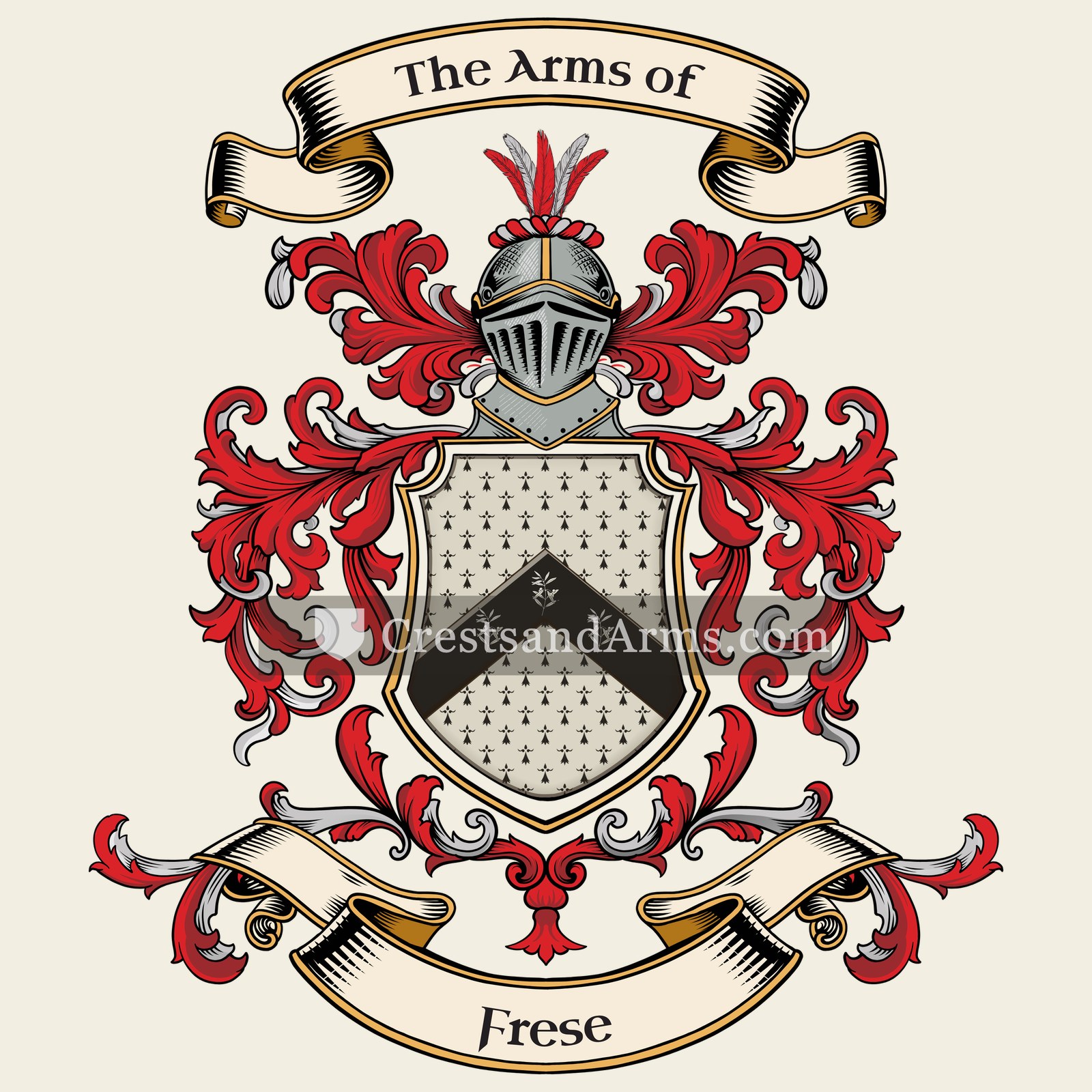
Symbols on this shield
chevronProtection, and faithful service completed
branchPeace, and new growth
Colours
ErmineMeans: Dignity
Black (Sable)Means: Constancy
Silver (Argent)Means: Peace and sincerity
Historical info
Source
Sir Bernard Burke, The General Armory of England, Scotland, Ireland and Wales, London: Harrison & Sons, 1884
Blazon (the actual original written record)
“Erm. on a chev. sa. three withered branches ar”
Englandc. 1620
Digital archive packCoat of arms PNG, gold border print PDF, vector SVG and the certificate of authenticity. Sent to your email in minutes.
Map of England showing where the Frese arms are recorded
The Frese arms were recorded in England, c. 1620.
Arms such as these were typically recorded in York.
Yorkshire is the largest of the English counties, and it held more gentry families than any other. Land there was split among a great many households rather than a few, so a great many of them carried arms.
This is where the arms were entered in the register. Families often moved to other parts of the country, so the same name can turn up in more than one region.
The body that granted and recorded arms in England in this period.
James VI and I
Sovereign of the period
James VI and I
1603–1625
Reigning in Germany when the Frese arms are first recorded.
How Arms Worked in England
English heraldry allowed arms to be shared by all legitimate descendants of the original owner. These symbols were treated as personal property that moved through the generations to all children. While the eldest son kept the original design, other family members could use the same shield without needing to change it or register their own unique versions.
Granting authority
The College of Arms in London has regulated the use of coats of arms throughout England and Wales since 1484.
How they got arms
Families typically obtained their coats of arms through a formal grant from the Crown or by proving their ancient right to them.
Where arms were recorded
All official coats of arms are recorded in the registers kept at the College of Arms, which date back to the fifteenth century.
The family's standing
Recorded among the armigerous families of England.
Origin & History of the Frese Family in England
The family name Frese has roots that stretch back to the northern regions of Europe, but its presence in England became firmly established by the early seventeenth century. By 1620, records indicate that members of the Frese family were living in the historic city of York. During this period, York was a bustling center of trade and religious life, and families like the Freses were often involved in the local merchant guilds or skilled crafts that kept the city thriving. The name itself is thought to be a variation of terms describing someone from the Frisia region, suggesting that the family likely arrived in England as part of the long history of migration and trade across the North Sea. As these early settlers integrated into English society, they contributed to the local economy and social fabric of Yorkshire, leaving behind a legacy that is still tied to the city’s deep historical archives.
Frese Meaning & Related Branches
Root word
Friso
An ancient Germanic tribal name referring to the Frisians.
This name
FreseA topographic or ethnic surname denoting a person who originated from the Frisia region.
also spelled
Freese
Freze
Frees
Related arms
Annenbergsimilar arms
Fabricius de Lipesesimilar arms
Gastlein de Morenwöllsimilar arms
Documented Sources
J. B. Rietstap, Armorial Général, Gouda: G. B. van Goor Zonen, 1884–87
Bahlow, Hans. Deutsches Namenlexikon: Familien- und Vornamen nach Ursprung und Sinn erklärt. 1967


 legStrength and swiftness
 legStrength and swiftness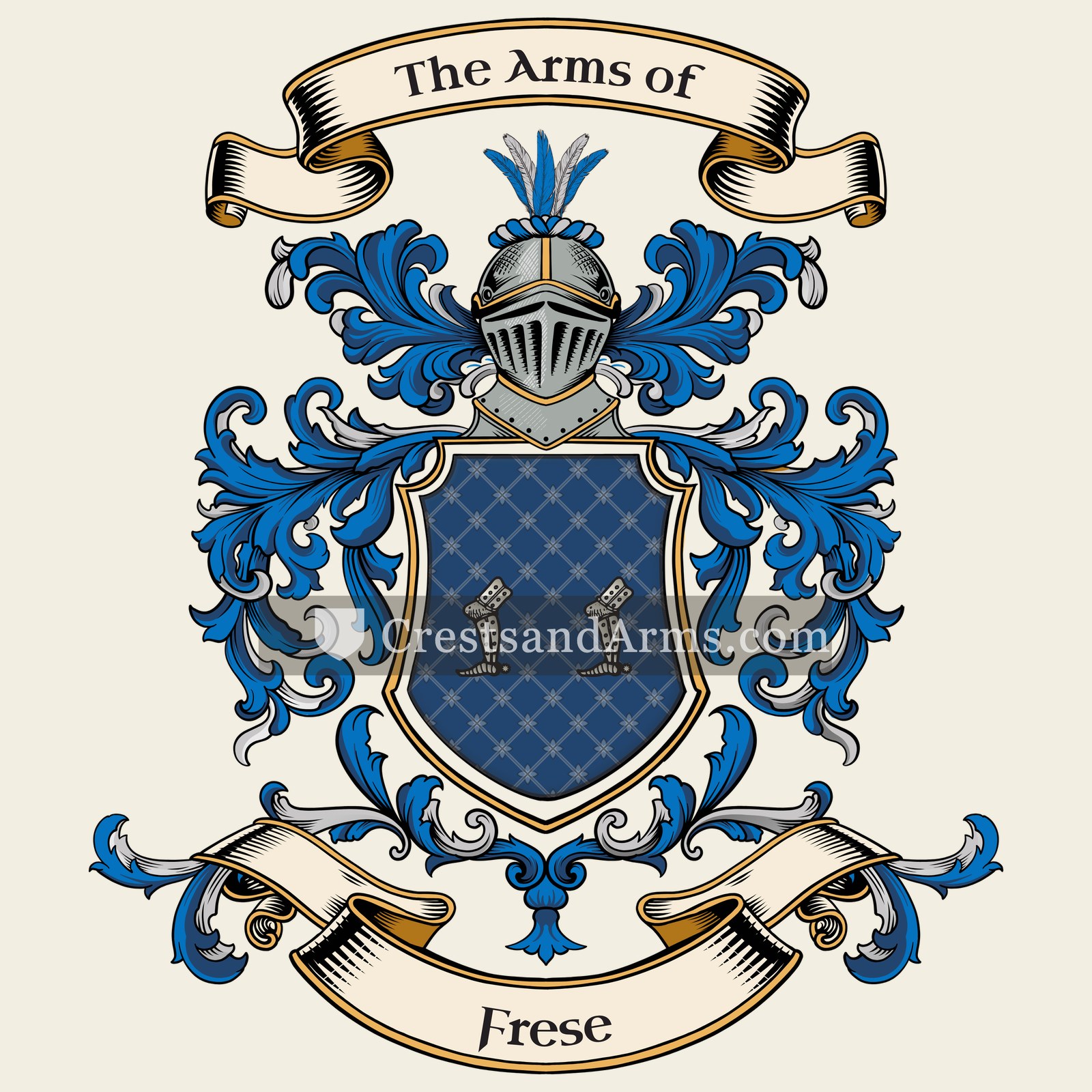


 chevronProtection, and faithful service completed
 branchPeace, and new growth