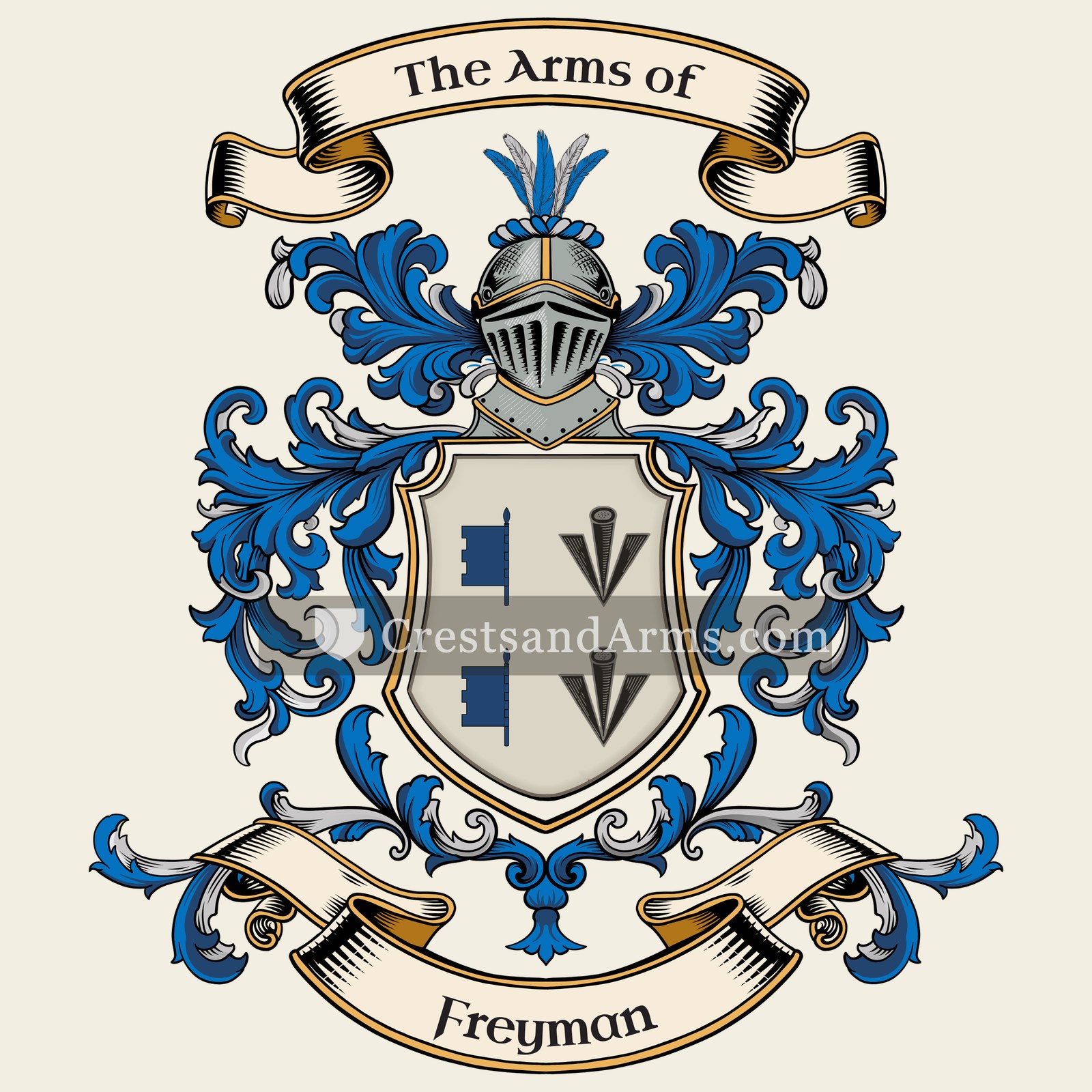
A record of documented arms, meaning and origin, researched for the Freyman family of Poland.
Reg. 1133 · Polish, D–F
Coat of Arms & Family Crest Details
Symbols on this shield
flag / pennantA command held, and a following kept
arrowReadiness for battle, and affliction endured
Colours
Silver (Argent)Means: Peace and sincerity
Blue (Azure)Means: Loyalty and truth
Historical info
Source
J. B. Rietstap, Armorial Général, Gouda: G. B. van Goor Zonen, 1884–87
Blazon (the actual original written record)
“D'arg. à deux bannières adossées d'azur, ch. chacune d'un croiss. d'arg., celui à dextre tourné et celui à sen. cont., les bannières attachées à des lances de tournoi d'or, arm. d'arg., passées en saut., le tout acc. de deux flèches d'arg., empennées d'azur, posées en pals, 1 en chef et 1 en p. C.: une flèche de l'écu, entre quatre bannières adossées, pareilles à celles de l'écu.”
LivoniaLivonia, c. 1666
Digital archive packCoat of arms PNG, gold border print PDF, vector SVG and the certificate of authenticity. Sent to your email in minutes.
Map of Poland showing where the Freyman arms are recorded
The Freyman arms were recorded in Livonia, c. 1666.
Livonia was Baltic country held by a small number of landed families who kept their estates for centuries. Land there passed down whole rather than being divided, and long unbroken tenure is what fills a register.
This is where the arms were entered in the register. Families often moved to other parts of the country, so the same name can turn up in more than one region.
Region
Livonia
First recorded
1666
Granting Authority for the Freyman Arms
Ennoblement by the Sejm
Author: Olek Remesz · CC BY-SA 3.0
The body that granted and recorded arms in Poland in this period.
John II Casimir Vasa
Sovereign of the period
John II Casimir Vasa
1648–1668
Reigning in Poland when the Freyman arms are first recorded.
How Arms Worked in Poland
Polish noble families shared a single coat of arms across many different surnames, creating large clans rather than individual designs. These symbols were held collectively by all members of the clan regardless of their specific family name. When a new family joined the nobility, they were adopted into an existing clan and began using that group's established shield.
Granting authority
The Sejm, which was the Polish parliament, held the power to grant noble status and the right to bear arms.
How they got arms
Families typically received their coat of arms through a formal act of ennoblement granted by the Sejm for distinguished service.
Where arms were recorded
These grants were officially recorded in the Crown Metrica, which served as the central archive for state documents starting in the sixteenth century.
The family's standing
Recorded among the armigerous families of Livonia.
Origin & History of the Freyman Family in Poland
The surname Freyman has deep roots in the Baltic region, with historical records confirming that members of the family were established in Livonia by 1666. The name itself is derived from the Germanic term meaning free man, which historically identified individuals who were not bound by serfdom or feudal obligations to a local lord. During the seventeenth century, Livonia was a complex territory influenced by Swedish, Polish, and German cultures, creating a unique environment for families to settle and grow. Early Freymans in this area often served as landholders or officials, integrating into the local administrative structures of the time. By maintaining their status as free individuals, the family was able to navigate the shifting political borders of the Baltic coast while preserving their identity across generations.
Freyman Meaning & Related Branches
Root word
Frei
Germanic term meaning free or independent.
This name
FreymanAn occupational or descriptive name for a free man or a person of independent status.
also spelled
Freiman
Freymane
Frayman
Freyman
Documented Sources
J. B. Rietstap, Armorial Général, Gouda: G. B. van Goor Zonen, 1884–87
Kruus, Hans. Eesti ajalugu (History of Estonia), 1946
Ligi, Herbert. Eesti talurahva olukord ja klassivõitlus Liivi sõja algul (The situation and class struggle of the Estonian peasantry at the beginning of the Livonian War), 1961
Estonian Historical Archives (Eesti Ajalooarhiiv), Livonian Land Registry Records (Liivimaa maaregistri dokumendid), 1660-1670
Digital archive packCoat of arms PNG, gold border print PDF, vector SVG and the certificate of authenticity. Sent to your email in minutes.


 flag / pennantA command held, and a following kept
 arrowReadiness for battle, and affliction endured
 flag / pennantA command held, and a following kept
 arrowReadiness for battle, and affliction endured