A record of documented arms, meaning and origin, researched for the Friedberg family lines. Documented in 2 countries.
Reg. 9168 · Swiss, D–F
Coat of Arms & Family Crest Details
Symbols on this shield
mountThe ground held, and steadfastness upon it
towerGrandeur and solidity, and a stronghold defended
mulletThe third son, and a divine quality from above
Colours
Gold (Or)Means: Generosity
Green (Vert)Means: Hope
Red (Gules)Means: Military strength
Historical info
Source
J. B. Rietstap, Armorial Général, Gouda: G. B. van Goor Zonen, 1884–87
Blazon (the actual original written record)
“D'or à un château sommé de deux tours de sin., acc. en chef de trois étoiles de gu., 2 et 1, la dernière entre les deux tours, et en p. d'une montagne de trois coupeaux, au nat. C.: une femme iss., les cheveux épars, tenant de chaque main une banderole d'or. L. d'or et de sa.”
Switzerlandc. 1745
Digital archive packCoat of arms PNG, gold border print PDF, vector SVG and the certificate of authenticity. Sent to your email in minutes.
Map of Switzerland showing where the Friedberg arms are recorded
The Friedberg arms were recorded in Switzerland, c. 1745.
Arms such as these were typically recorded in Bern.
Bern was the largest of the Swiss cantons and ran itself, with its own council and its own courts. Its governing families held office for generations, and office of that kind carried a shield with it.
This is where the arms were entered in the register. Families often moved to other parts of the country, so the same name can turn up in more than one region.
The body that granted and recorded arms in Switzerland in this period.
How Arms Worked in Switzerland
In Switzerland, coats of arms were not restricted to the nobility and were often adopted by common citizens and families. These symbols were passed down through generations to show family identity. When branches of a family grew, they often changed small details of the design to distinguish their own line from the original group.
Granting authority
Cantonal and civic authorities managed the use of coats of arms within their specific regions and local jurisdictions.
How they got arms
Families typically assumed their own coats of arms based on local custom rather than receiving them from a central monarch.
Where arms were recorded
Arms were recorded in various cantonal and civic registers starting from the fourteenth century throughout the Swiss region.
The family's standing
Recorded among the armigerous families of Switzerland.
Origin & History of the Friedberg Family in Switzerland
The family name Friedberg has deep roots in the Swiss canton of Bern, where records confirm members of the family were established by 1745. The name itself is topographic in origin, likely derived from the German words for peace and mountain or fortified hill. During the eighteenth century, families in this region often identified themselves by the specific lands they occupied or the local landmarks near their homes. In Bern, the Friedbergs were part of the social and economic fabric of a city that was then a powerful center of trade and politics. As the family grew, they integrated into the local administrative systems, which required careful documentation of births, marriages, and property ownership. These early records show that the family was well-integrated into the Swiss way of life, participating in the local community and contributing to the stability of the region during a time of significant transition in Europe.
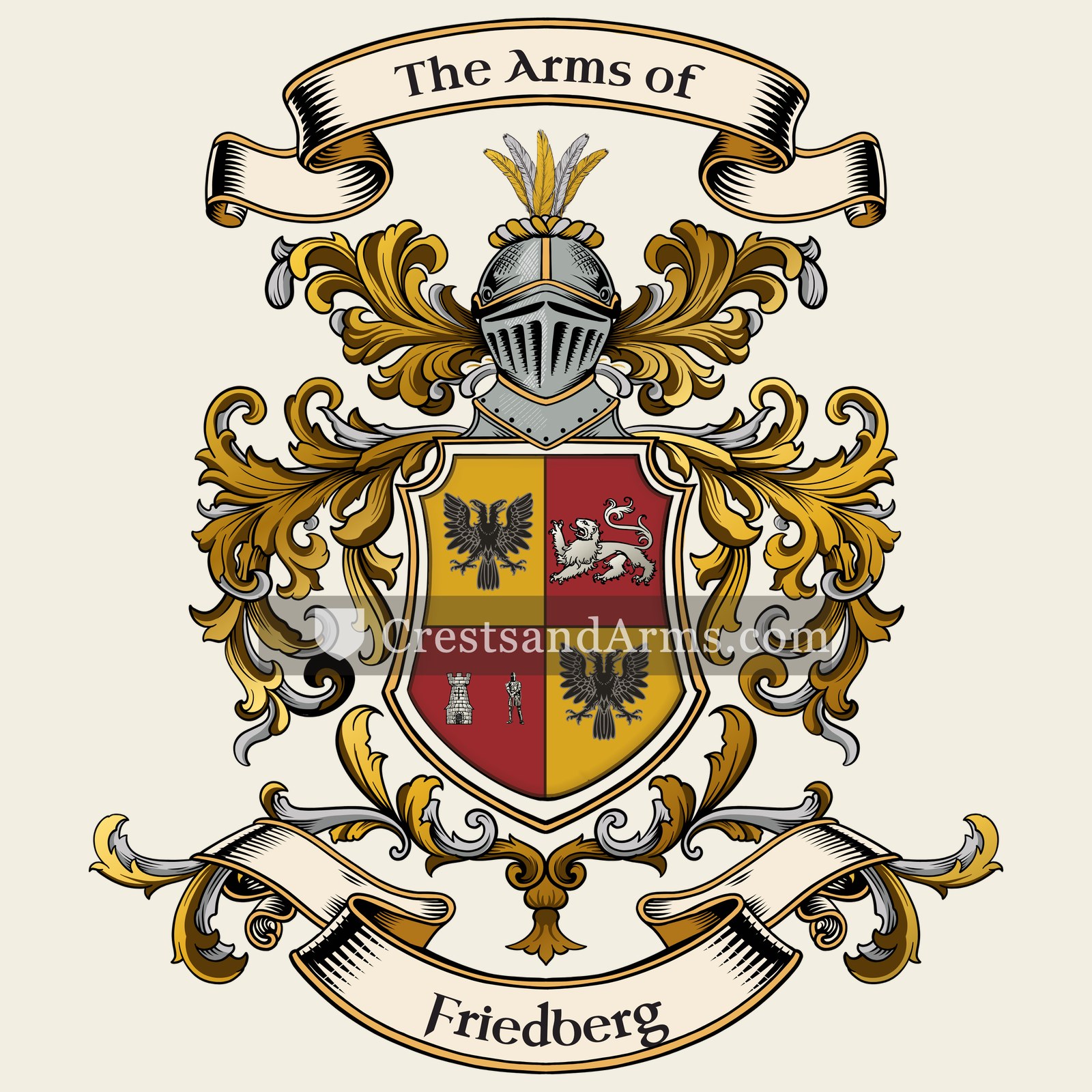
Coat of Arms & Family Crest Details
Symbols on this shield
eagleNobility, strength and a keen mind
lionCourage, strength and royalty
towerGrandeur and solidity, and a stronghold defended
knightChivalry and service in arms
Colours
Gold (Or)Means: Generosity
Red (Gules)Means: Military strength
Black (Sable)Means: Constancy
Silver (Argent)Means: Peace and sincerity
Historical info
Source
J. B. Rietstap, Armorial Général, Gouda: G. B. van Goor Zonen, 1884–87
Blazon (the actual original written record)
“Ec.: aux 1 et 4 d'or à l'aigle de sa., languée de gu., celle du 1 cont.; au 2 de gu. au lion d'arg., lamp. de gu.; au 3 de gu. à un mur crén. d'arg., maçonné de sa., et un chevalier iss., mouv. du mur, posé de front, arm. de toutes pièces d'arg., lisé d'or, la visière levée, tenant de sa main dextre une épée flamboyante d'arg. garnie d'or, la main sen. appuyée sur sa hanche et tenant une palme de sin., devant laquelle une bombe allumée s'enfonce dans ledit mur. Cq. cour. C.: le chevalier iss. du 3, entre six pennons, trois de chaque côté l'un sur l'autre: à dextre le premier fascé d'or et d'azur, le deuxième losangé de gu. et d'arg., le troisième fascé d'arg. et d'azur et ch. du chiffre F. III.; à sen. le premier losangé d'arg. et de gu., le deuxième fascé d'azur et d'or, le troisième fascé de sa. et d'or et ch. du chiffre F. III. L.: à dextre d'or et de sa., à sen. d'arg. et d'azur.”
Austriac. 1772
Digital archive packCoat of arms PNG, gold border print PDF, vector SVG and the certificate of authenticity. Sent to your email in minutes.
Map of Austria showing where the Friedberg arms are recorded
The Friedberg arms were recorded in Austria, c. 1772.
Arms such as these were typically recorded in Tyrol.
Tyrol was mountain country in western Austria, where the valleys were held by families who had been there a very long time. Old tenure counted for more than money, and old families carried arms.
This is where the arms were entered in the register. Families often moved to other parts of the country, so the same name can turn up in more than one region.
Region
Tyrol
First recorded
1772
Granting Authority for the Friedberg Arms
Imperial and Royal chancery
Sodacan · CC BY-SA 3.0
The body that granted and recorded arms in Austria in this period.
Joseph II, Holy Roman Emperor
Sovereign of the period
Joseph II, Holy Roman Emperor
1765–1790
Reigning in Switzerland when the Friedberg arms are first recorded.
How Arms Worked in Austria
Austrian coats of arms were often linked directly to noble titles granted by the Emperor. These symbols belonged to the entire family line rather than just one individual. When a family grew, new branches kept the original design without needing to change it. This system allowed all members of a noble house to share the same identity across many generations.
Granting authority
The Imperial and Royal chancery managed all heraldic matters and controlled the official granting of arms throughout the Austrian lands.
How they got arms
Families typically received their arms through a formal imperial decree that often accompanied the elevation of a person to noble status.
Where arms were recorded
Official records of these grants were kept in the Imperial Register of Nobility which began its formal documentation process in 1453.
The family's standing
Recorded among the armigerous families of Austria.
Origin & History of the Friedberg Family in Austria
The family name Friedberg is a topographic surname, meaning it was originally derived from a specific place rather than a trade or a personal trait. In the German language, the name combines the words for peace and mountain or fortified hill. By the year 1772, records confirm that members of the Friedberg family were well-established in the Tyrol region of Austria. During this era, families in the Alpine areas often settled in valleys or near mountain passes where they engaged in local trade and agriculture. Because the name implies a connection to a peaceful or protected hill, it is likely that the earliest ancestors lived near a fortified settlement or a prominent landmark that served as a local refuge. As the family grew, they became part of the social fabric of the Austrian countryside, contributing to the development of the small communities that defined life in the Tyrol province during the eighteenth century.
Friedberg Meaning & Related Branches
Root word
Friede and Berg
Peace and mountain or hill.
This name
FriedbergA topographic name for someone living on a peaceful mountain or hill.
also spelled
Fridberg
Freedberg
Fredberg
Documented Sources
J. B. Rietstap, Armorial Général, Gouda: G. B. van Goor Zonen, 1884–87
Staatsarchiv des Kantons Bern, Kirchenbücher der Stadt Bern (1745)
Familiennamenbuch der Schweiz, Historisch-Biographisches Lexikon der Schweiz (1921)
Digital archive packCoat of arms PNG, gold border print PDF, vector SVG and the certificate of authenticity. Sent to your email in minutes.


 mountThe ground held, and steadfastness upon it
 towerGrandeur and solidity, and a stronghold defended
 mulletThe third son, and a divine quality from above
 mountThe ground held, and steadfastness upon it
 towerGrandeur and solidity, and a stronghold defended
 mulletThe third son, and a divine quality from above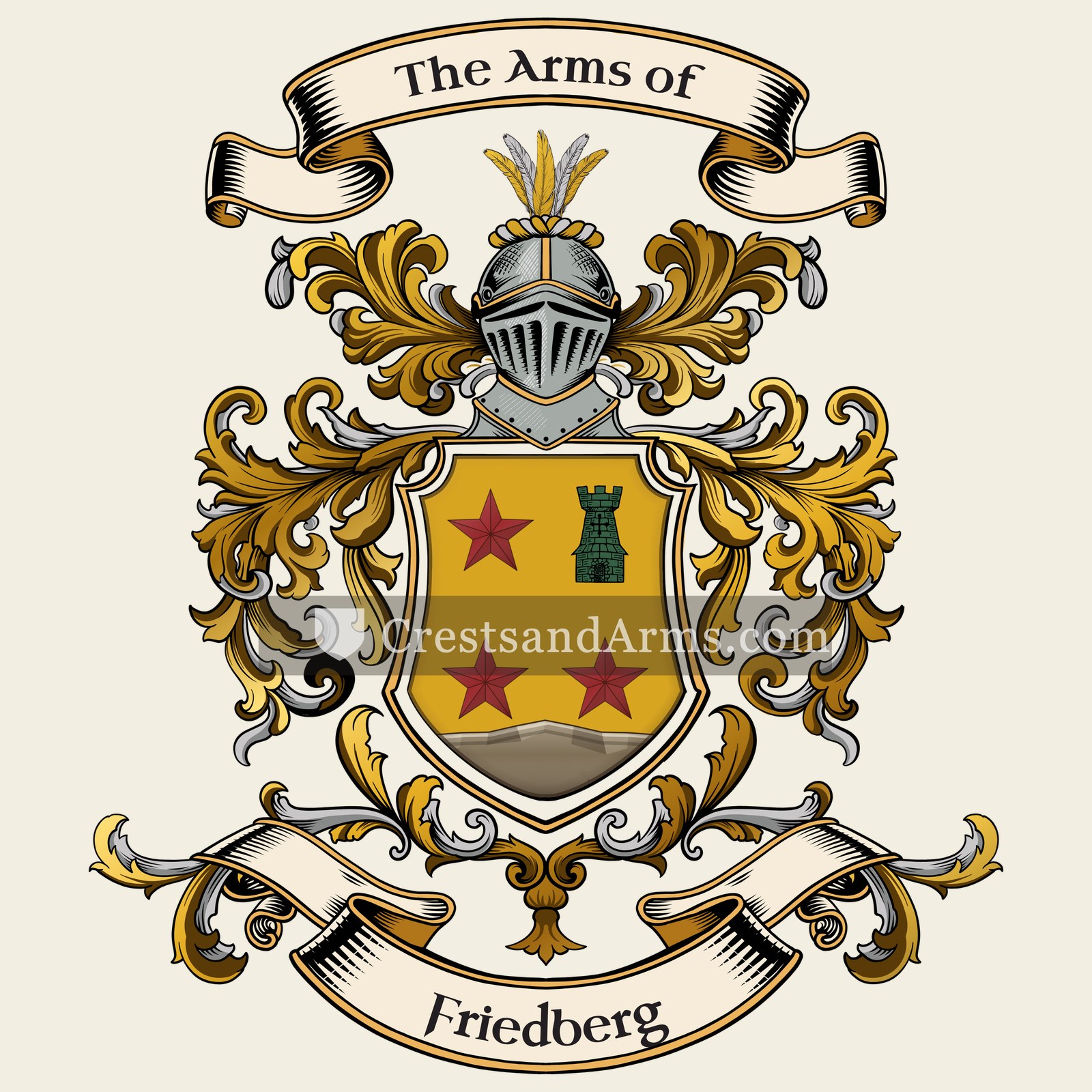

 eagleNobility, strength and a keen mind
 lionCourage, strength and royalty
 knightChivalry and service in arms