Map of Germany showing where the Frieder arms are recorded
The Frieder arms were recorded in Saxony, c. 1765.
Saxony had mines, trade and old landed families all at once. Silver made some fortunes and land held others, and both sorts of family kept arms, which is why Saxon names appear so often in the registers.
This is where the arms were entered in the register. Families often moved to other parts of the country, so the same name can turn up in more than one region.
The body that granted and recorded arms in Germany in this period.
Francis I, Holy Roman Emperor
Sovereign of the period
Francis I, Holy Roman Emperor
1745–1765
Reigning in Germany when the Frieder arms are first recorded.
How Arms Worked in Germany
In the Holy Roman Empire, coats of arms were often granted to individuals by the Emperor or his representatives. These arms were then passed down through the generations to all legitimate descendants of the original holder. Younger branches of a family usually kept the same shield design without needing to change it, as the arms belonged to the entire lineage.
Granting authority
The Holy Roman Emperor held the sole power to grant new coats of arms throughout his vast imperial territories.
How they got arms
Families typically obtained their coats of arms through a formal imperial grant or by proving their noble status to the authorities.
Where arms were recorded
These grants were officially recorded in the Imperial Chancery registers, which began keeping formal records of such honors during the Middle Ages.
The family's standing
Recorded among the armigerous families of Saxony.
Origin & History of the Frieder Family in Germany
The surname Frieder is rooted in the Germanic linguistic tradition, evolving from the Old High German name Friedrich, which combines the elements for "peace" and "ruler." By the mid-18th century, the name had become well-established within the region of Saxony. In 1765, records confirm that members of the family were active participants in the social and economic life of this area, which was then a prominent center for trade and craftsmanship within the Holy Roman Empire. During this period, families in Saxony often lived in small, tight-knit communities where names were passed down through generations to preserve their heritage. As the family settled into their local roles, the name Frieder served as a marker of their identity and their connection to the cultural traditions of the German lands.
Coat of Arms & Family Crest Details
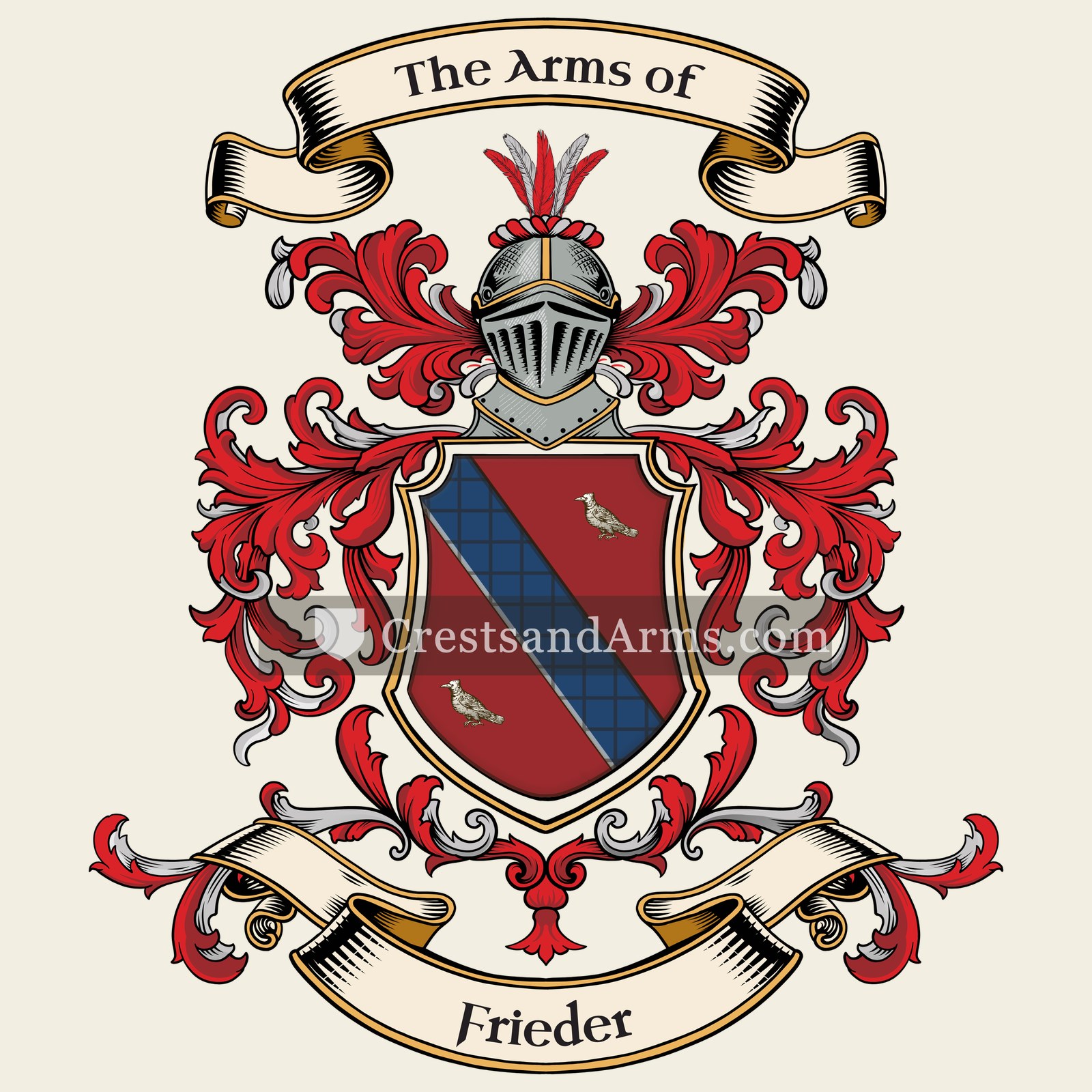
Symbols on this shield
dovePeace, love and the Holy Spirit
Colours
Red (Gules)Means: Military strength
Blue (Azure)Means: Loyalty and truth
Silver (Argent)Means: Peace and sincerity
Historical info
Source
J. B. Rietstap, Armorial Général, Gouda: G. B. van Goor Zonen, 1884–87
Blazon (the actual original written record)
“De gu. à deux colombes affr. d'arg., ramp. contre un bâton de commandement d'azur, en pal, les deux bouts d'or. C.: une couronne civique de sin., supp. une colombe d'arg. L. d'or et de gu. S.: deux aigles reg. de sa., bq. et m. d'or.”
RussiaEsthonie, c. 1784
Digital archive packCoat of arms PNG, gold border print PDF, vector SVG and the certificate of authenticity. Sent to your email in minutes.
Map of Russia showing where the Frieder arms are recorded
The Frieder arms were recorded in Esthonie, c. 1784.
Arms such as these were typically recorded in Moscow.
Moscow held the Russian court, and rank there came from service rather than land. Families who served the Tsar were entered in the registers of nobility, and that entry is where their arms are recorded.
This is where the arms were entered in the register. Families often moved to other parts of the country, so the same name can turn up in more than one region.
The body that granted and recorded arms in Russia in this period.
Catherine II of Russia
Sovereign of the period
Catherine II of Russia
1762–1796
Reigning in Germany when the Frieder arms are first recorded.
How Arms Worked in Russia
Russian heraldry was strictly tied to the nobility and the state service system. Families proved their ancient status or earned new rank to receive an official grant from the Tsar. These symbols were then inherited by all legitimate children of the noble line. If a family lacked proof of their status, they were often excluded from the official records entirely.
Granting authority
The Herald Master's Office acted as the central state body that strictly regulated and verified all noble heraldic symbols.
How they got arms
Families typically received their arms through a formal state grant or by proving their noble status to the government authorities.
Where arms were recorded
All approved coats of arms were officially recorded in the General Armorial of the Noble Families of the Russian Empire starting in 1797.
The family's standing
Recorded among the armigerous families of Russia.
Origin & History of the Frieder Family in Russia
The Frieder family name carries a history deeply rooted in the cultural shifts of late eighteenth-century Russia. By 1784, records confirm that members of the family were already established in Moscow, a city that served as a vibrant hub for European merchants and professionals during the reign of Catherine the Great. At this time, the name Frieder likely arrived in Russia as part of a broader movement of skilled individuals migrating from German-speaking lands to serve the growing needs of the Russian Empire. These early settlers often worked in specialized trades or as tutors and administrators, helping to bridge the gap between Western European intellectual trends and the traditional Russian social structure. Living in Moscow during this period placed the family at the center of a rapidly modernizing society, where they navigated the complex bureaucracy and social hierarchies of the era. Their presence in the city suggests they were part of a distinct community of foreigners who contributed to the urban development and economic life of Moscow long before the political upheavals of the following century.
Related Branches & Arms
Root word
Friedrich
Derived from Germanic elements meaning peaceful ruler.
This name
FriederA patronymic surname originating from the given name meaning peaceful ruler.
also spelled
Friederic
Freederisee
Documented Sources
J. B. Rietstap, Armorial Général, Gouda: G. B. van Goor Zonen, 1884–87
Bahlow, Hans, Deutsches Namenlexikon: Familien- und Vornamen nach Ursprung und Sinn erklärt, 1967
Heintze, Albert, Die deutschen Familien-Namen: geschichtlich, geographisch, sprachlich, 1903
Sächsisches Staatsarchiv, Kirchenbücher der evangelisch-lutherischen Landeskirche Sachsens, 1765
Digital archive packCoat of arms PNG, gold border print PDF, vector SVG and the certificate of authenticity. Sent to your email in minutes.


 roseThe seventh son, and beauty with grace
 roseThe seventh son, and beauty with grace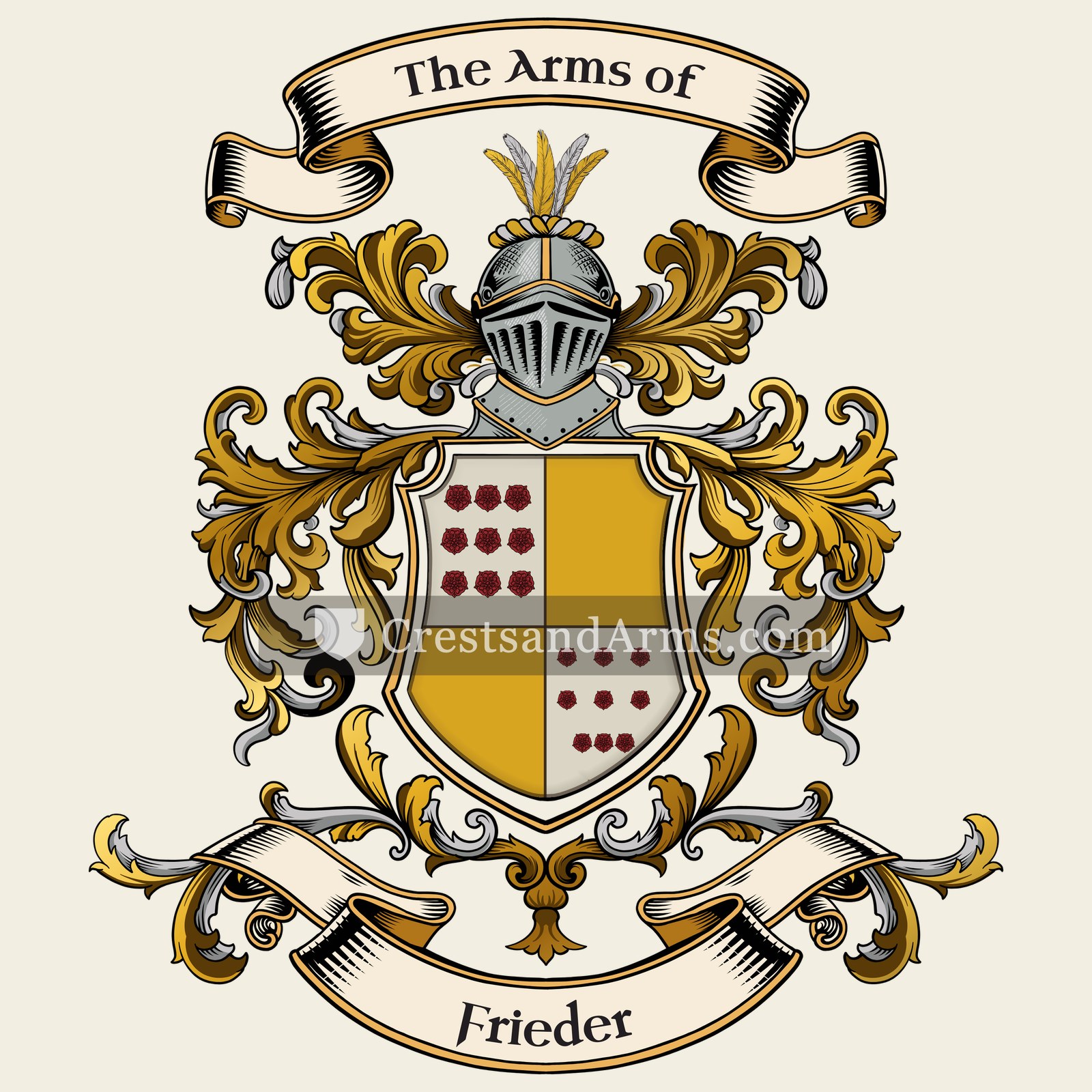


 dovePeace, love and the Holy Spirit