A record of documented arms, meaning and origin, researched for the Friess family lines. Documented in 2 countries.
Reg. 4064 · German, D–F
Coat of Arms & Family Crest Details
Symbols on this shield
horseReadiness to serve king and country
Colours
Gold (Or)Means: Generosity
Red (Gules)Means: Military strength
Black (Sable)Means: Constancy
Historical info
Source
J. B. Rietstap, Armorial Général, Gouda: G. B. van Goor Zonen, 1884–87
Blazon (the actual original written record)
“Coupé d'or sur gu.; à un cheval cabré de sa., bridé d'or, br. sur le tout. C.: le cheval, iss.; entre deux prob., de gu. et de sa. L.: à dextre d'or et de sa., à sen. d'or et de gu.”
GermanyGörlitz, c. 1541
Digital archive packCoat of arms PNG, gold border print PDF, vector SVG and the certificate of authenticity. Sent to your email in minutes.
Map of Germany showing where the Friess arms are recorded
The Friess arms were recorded in Görlitz, c. 1541.
This is where the arms were entered in the register. Families often moved to other parts of the country, so the same name can turn up in more than one region.
The body that granted and recorded arms in Germany in this period.
Charles V
Sovereign of the period
Charles V
1519–1556
Reigning in Germany when the Friess arms are first recorded.
How Arms Worked in Germany
In the Holy Roman Empire, coats of arms were often granted to individuals by the Emperor or his representatives. These arms were then passed down through the generations to all legitimate descendants of the original holder. Younger branches of a family usually kept the same shield design without needing to change it, as the arms belonged to the entire lineage.
Granting authority
The Holy Roman Emperor held the sole power to grant new coats of arms throughout his vast imperial territories.
How they got arms
Families typically obtained their coats of arms through a formal imperial grant or by proving their noble status to the authorities.
Where arms were recorded
These grants were officially recorded in the Imperial Chancery registers, which began keeping formal records of such honors during the Middle Ages.
The family's standing
Recorded among the armigerous families of Germany.
Origin & History of the Friess Family in Germany
The surname Friess finds its roots in the linguistic landscape of medieval Germany, where it likely functioned as a descriptive nickname for a person originating from the region of Friesland. By the middle of the sixteenth century, the family had established a notable presence in the historic city of Görlitz, which was then a prominent center of trade and culture in Upper Lusatia. Records from 1541 confirm that members of the Friess family were active participants in the civic life of this town, which sat at the crossroads of major European merchant routes. During this era, families like the Friess clan often integrated into the local guilds or administrative structures that defined the social order of German city-states. Their settlement in Görlitz suggests they were part of the growing urban middle class that helped shape the economic development of the region during the Renaissance. As the family grew, they became woven into the fabric of the local community, leaving a legacy that reflects the broader patterns of migration and social mobility found throughout German history.
Coat of Arms & Family Crest Details
Symbols on this shield
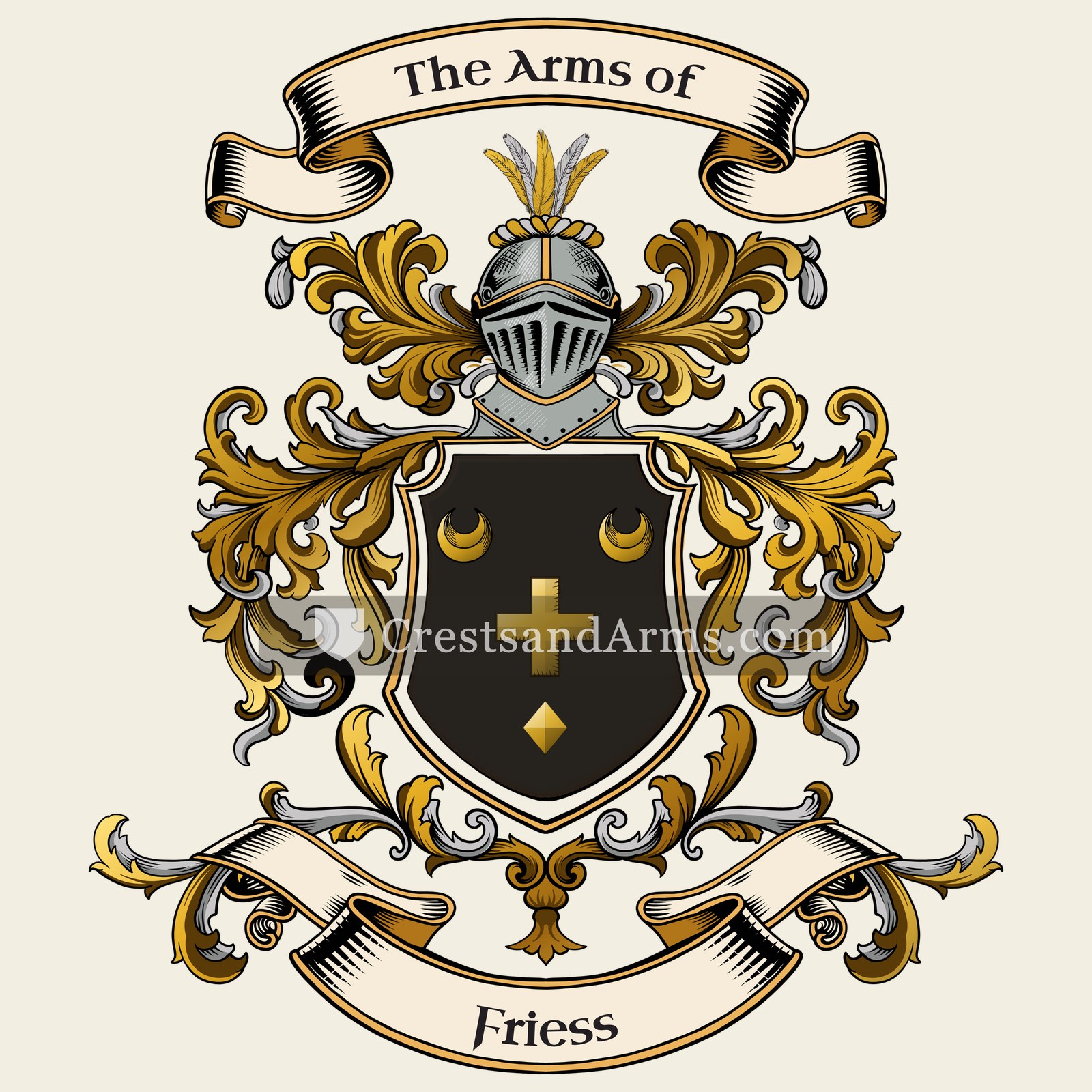
cross symbolChristian faith and service
crescentHonour by the sovereign, and the second son
lozengeHonour and nobility, and the arms of a woman
Colours
Black (Sable)Means: Constancy
Gold (Or)Means: Generosity
Historical info
Source
J. B. Rietstap, Armorial Général, Gouda: G. B. van Goor Zonen, 1884–87
Blazon (the actual original written record)
“De sa. à une croix latine, le pied en forme de chevron; la croix accostée de deux croiss. affr. et acc. en p. d'une losange; le tout d'or.”
SwitzerlandFribourg, c. 1745
Digital archive packCoat of arms PNG, gold border print PDF, vector SVG and the certificate of authenticity. Sent to your email in minutes.
Map of Switzerland showing where the Friess arms are recorded
The Friess arms were recorded in Fribourg, c. 1745.
This is where the arms were entered in the register. Families often moved to other parts of the country, so the same name can turn up in more than one region.
The body that granted and recorded arms in Switzerland in this period.
How Arms Worked in Switzerland
In Switzerland, coats of arms were not restricted to the nobility and were often adopted by common citizens and families. These symbols were passed down through generations to show family identity. When branches of a family grew, they often changed small details of the design to distinguish their own line from the original group.
Granting authority
Cantonal and civic authorities managed the use of coats of arms within their specific regions and local jurisdictions.
How they got arms
Families typically assumed their own coats of arms based on local custom rather than receiving them from a central monarch.
Where arms were recorded
Arms were recorded in various cantonal and civic registers starting from the fourteenth century throughout the Swiss region.
The family's standing
Recorded among the armigerous families of Switzerland.
Origin & History of the Friess Family in Switzerland
The family name Friess has deep roots in the Swiss region, particularly within the canton of Fribourg where records confirm the family’s presence as early as 1745. The name itself is thought to be derived from the Middle High German word "vries," which was historically used to describe someone from the region of Friesland or, in some cases, a person with a particularly bold or spirited personality. During the eighteenth century, families in Fribourg often lived in close-knit agricultural communities where they contributed to the local economy through farming and trade. As the family established itself in this area, they became part of the complex social fabric of the Swiss Confederation, navigating the shifting political landscape of the time. By settling in Fribourg, the Friess family participated in the long tradition of Swiss civic life, where families were deeply tied to their specific town and local customs. Over the generations, the name became a permanent fixture in the region, reflecting the steady growth and integration of families within the Swiss cantons.
Friess Meaning & Related Branches
Root word
Friese
A person originating from the region of Frisia.
This name
FriessAn ethnic or geographic identifier for someone who hailed from the Frisian lands.
also spelled
Friesse
Frees
Documented Sources
J. B. Rietstap, Armorial Général, Gouda: G. B. van Goor Zonen, 1884–87
Jecht, Richard, Geschichte der Stadt Görlitz, 1926
Stadtarchiv Görlitz, Ratsrechnungen der Stadt Görlitz, 1541
Digital archive packCoat of arms PNG, gold border print PDF, vector SVG and the certificate of authenticity. Sent to your email in minutes.


 horseReadiness to serve king and country
 horseReadiness to serve king and country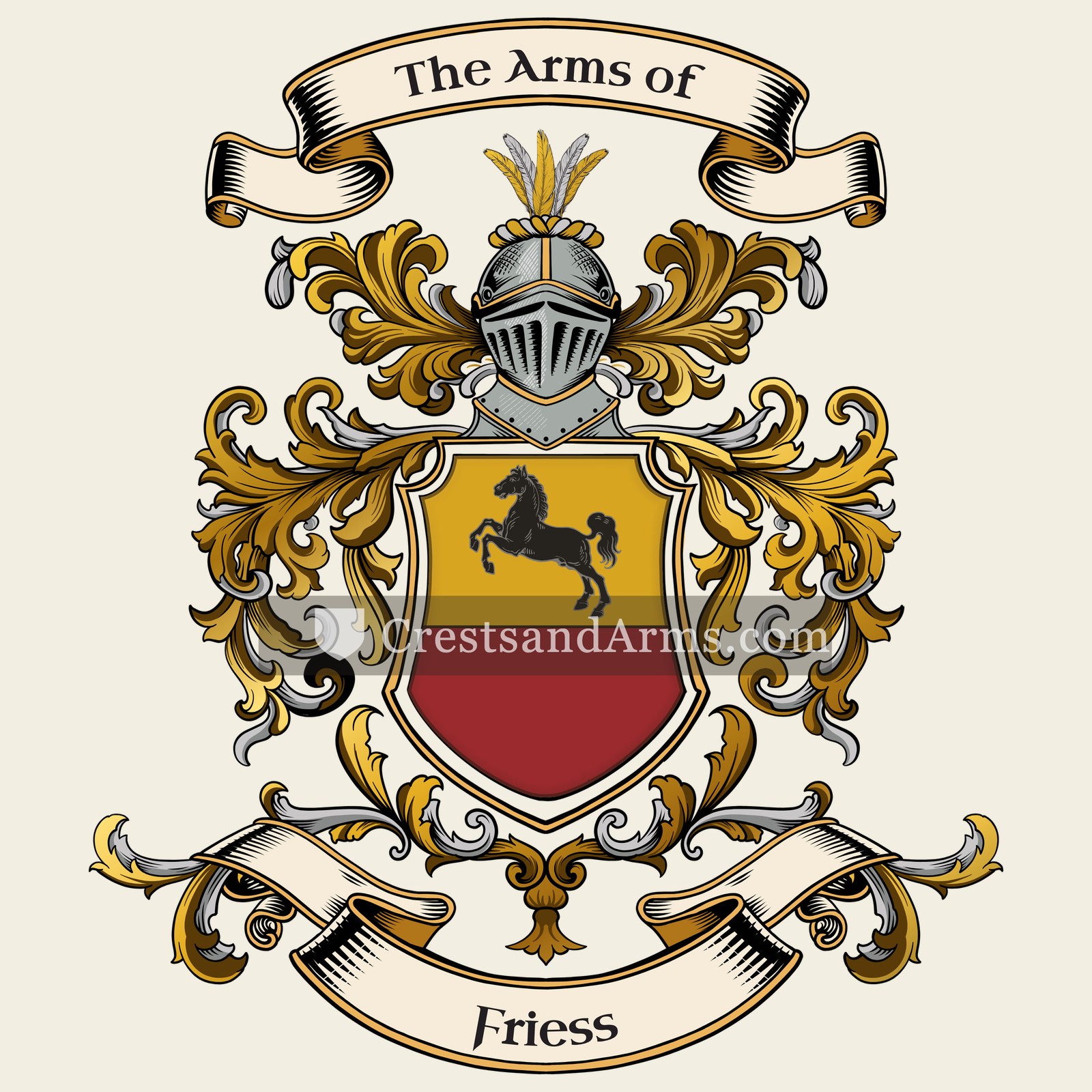


 cross symbolChristian faith and service
 crescentHonour by the sovereign, and the second son
 lozengeHonour and nobility, and the arms of a woman