A record of documented arms, meaning and origin, researched for the Friesz family lines. Documented in 3 countries.
Reg. 7423 · French, D–F
Coat of Arms & Family Crest Details
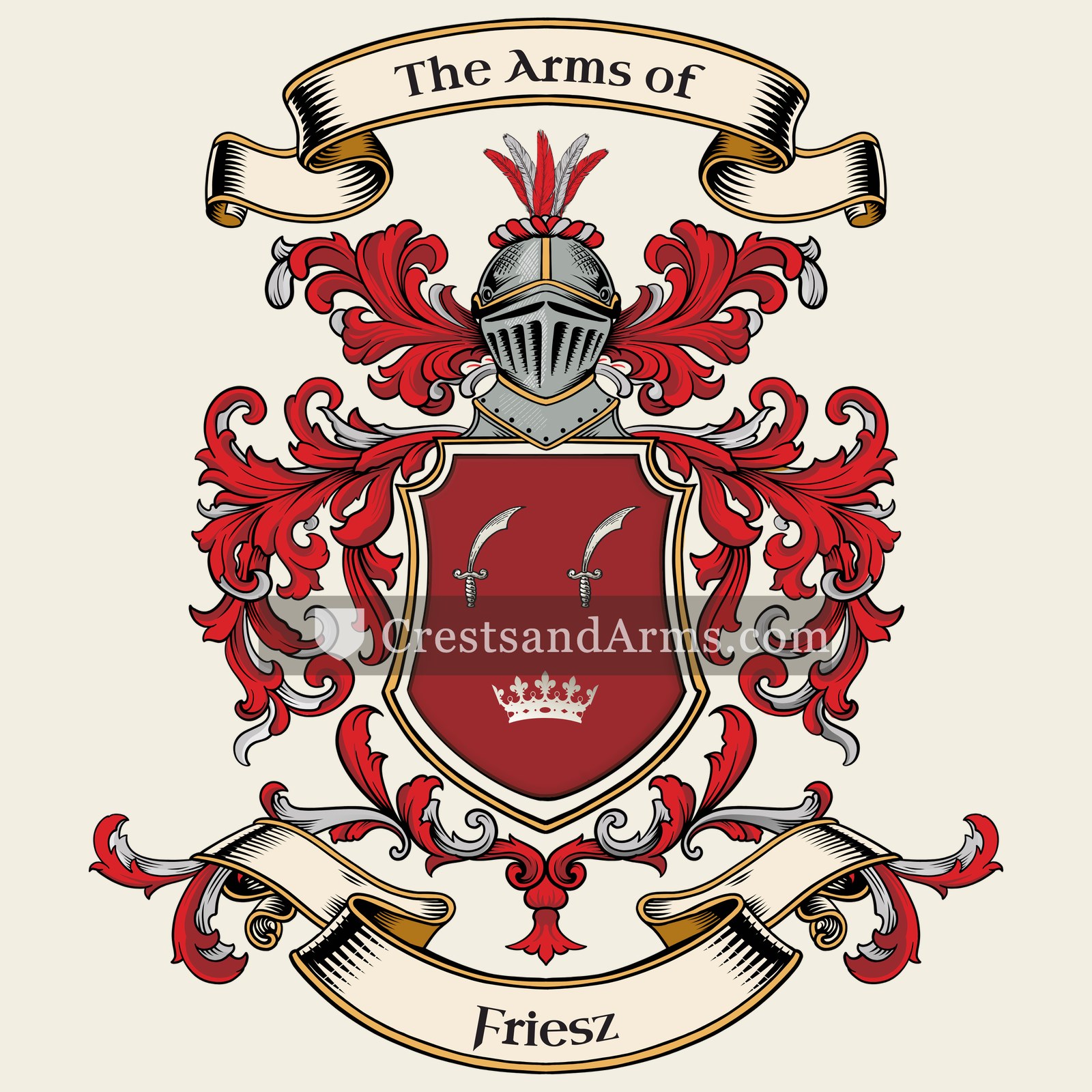
Symbols on this shield
sickleThe harvest, and the reaping of what was sown
mulletThe third son, and a divine quality from above
Colours
Red (Gules)Means: Military strength
Silver (Argent)Means: Peace and sincerity
Gold (Or)Means: Generosity
Historical info
Source
J. B. Rietstap, Armorial Général, Gouda: G. B. van Goor Zonen, 1884–87
Blazon (the actual original written record)
“De gu. à une bêche d'arg., emm. d'or, le fer en bas et terminé en deux pointes; ladite bêche accostée de deux étoiles d'or. Deux cq. cour. C.: 1º un homme iss., hab. d'arg. au rabat de gu., les manches retr. du même, tenant la bêche de l'écu, posée sur son épaule; l. d'arg. et de gu.; 2º un demi-vol coupé d'or sur gu., à deux étoiles de l'un à l'autre; l. d'or et de gu.”
AlsaceAlsace, c. 1757
Digital archive packCoat of arms PNG, gold border print PDF, vector SVG and the certificate of authenticity. Sent to your email in minutes.
Map of France showing where the Friesz arms are recorded
The Friesz arms were recorded in Alsace, c. 1757.
Alsace lay between France and the German lands and belonged to both at different times. Its families held small estates and served whichever side ruled, and men who served in arms carried arms of their own.
This is where the arms were entered in the register. Families often moved to other parts of the country, so the same name can turn up in more than one region.
The body that granted and recorded arms in France in this period.
Louis XV of France
Sovereign of the period
Louis XV of France
1715–1774
Reigning in France when the Friesz arms are first recorded.
How Arms Worked in France
In France, a coat of arms was a mark of honor that passed down through the male line to all legitimate descendants. Families often used the same shield without changes to show their shared heritage. If a branch wanted to stand out, they could add a small mark to their shield to show their specific place in the family tree.
Granting authority
The Juge d'armes de France acted as the official authority that regulated and verified coats of arms across the country.
How they got arms
Families typically inherited their arms from ancestors, though they could also receive them through royal grants or by proving their noble status.
Where arms were recorded
Coats of arms were officially recorded in the Armorial Général de France, which began its main collection in the year 1696.
The family's standing
Recorded among the armigerous families of Alsace.
Origin & History of the Friesz Family in France
The family name Friesz carries a deep connection to the historical region of Alsace, a territory that has long served as a bridge between French and Germanic cultures. By 1757, records confirm that members of the family were firmly established in this area, living through a period where Alsace was under the sovereignty of the French Crown. During the eighteenth century, families in this region often navigated a unique cultural landscape where they spoke local dialects while integrating into the administrative and social structures of France. The name itself likely reflects these regional roots, as it shares linguistic ties to the historic populations of the Rhine valley. As the family grew within the French borders, they participated in the agricultural and artisanal life that defined the Alsatian countryside, contributing to the distinct heritage of the borderland provinces before the major political shifts of the French Revolution.
Coat of Arms & Family Crest Details
Symbols on this shield
lionCourage, strength and royalty
Colours
Black (Sable)Means: Constancy
Gold (Or)Means: Generosity
Historical info
Source
J. B. Rietstap, Armorial Général, Gouda: G. B. van Goor Zonen, 1884–87
Blazon (the actual original written record)
“Coupé de sa. sur or; à un lion, ayant une tête de jeune fille, de l'un en l'autre. C.: le lion, iss. (Branche de la fam. Fries, en Franconie, qui portait: Coupé d'azur sur or, au lion de l'un en l'autre).”
Austriac. 1451
Digital archive packCoat of arms PNG, gold border print PDF, vector SVG and the certificate of authenticity. Sent to your email in minutes.
Map of Austria showing where the Friesz arms are recorded
The Friesz arms were recorded in Austria, c. 1451.
Arms such as these were typically recorded in Tyrol.
Tyrol was mountain country in western Austria, where the valleys were held by families who had been there a very long time. Old tenure counted for more than money, and old families carried arms.
This is where the arms were entered in the register. Families often moved to other parts of the country, so the same name can turn up in more than one region.
Region
Tyrol
First recorded
1451
Granting Authority for the Friesz Arms
Imperial and Royal chancery
Sodacan · CC BY-SA 3.0
The body that granted and recorded arms in Austria in this period.
How Arms Worked in Austria
Austrian coats of arms were often linked directly to noble titles granted by the Emperor. These symbols belonged to the entire family line rather than just one individual. When a family grew, new branches kept the original design without needing to change it. This system allowed all members of a noble house to share the same identity across many generations.
Granting authority
The Imperial and Royal chancery managed all heraldic matters and controlled the official granting of arms throughout the Austrian lands.
How they got arms
Families typically received their arms through a formal imperial decree that often accompanied the elevation of a person to noble status.
Where arms were recorded
Official records of these grants were kept in the Imperial Register of Nobility which began its formal documentation process in 1453.
The family's standing
Recorded among the armigerous families of Austria.
Origin & History of the Friesz Family in Austria
The history of the Friesz family in Austria is deeply rooted in the rugged landscape of the Tyrol region, where records confirm their presence as early as 1451. During this period, the name likely emerged as a descriptive identifier for individuals who either hailed from the northern regions of the Germanic territories or were associated with the Frisian people. Living in the high alpine valleys of Tyrol, early members of the family were often integrated into the local agrarian and administrative systems that defined medieval mountain life. As the family established themselves in these communities, they became part of the social fabric of the Habsburg lands, adapting to the shifting political boundaries of the era. Their persistence in the region suggests a stable existence built upon trade, local craftsmanship, or land management within the secluded mountain passes. By maintaining their identity across generations, the Friesz family helped shape the cultural history of the Austrian Alps long before the rise of modern nation-states.
Coat of Arms & Family Crest Details
Symbols on this shield
saltireResolution, and St Andrew's cross
swordJustice, and military honour
crownSovereignty, authority and just reward
Colours
Red (Gules)Means: Military strength
Silver (Argent)Means: Peace and sincerity
Historical info
Source
J. B. Rietstap, Armorial Général, Gouda: G. B. van Goor Zonen, 1884–87
Blazon (the actual original written record)
“De gu. à deux épées d'arg., passées en saut. dans une couronne d'arg., les pointes en bas. C.: un griffon iss. de gu., tenant de ses pattes une épée d'arg. en pal.”
GermanyFrancfort s, c. 1765
Digital archive packCoat of arms PNG, gold border print PDF, vector SVG and the certificate of authenticity. Sent to your email in minutes.
Map of Germany showing where the Friesz arms are recorded
The Friesz arms were recorded in Francfort s, c. 1765.
This is where the arms were entered in the register. Families often moved to other parts of the country, so the same name can turn up in more than one region.
The body that granted and recorded arms in Germany in this period.
Francis I, Holy Roman Emperor
Sovereign of the period
Francis I, Holy Roman Emperor
1745–1765
Reigning in France when the Friesz arms are first recorded.
How Arms Worked in Germany
In the Holy Roman Empire, coats of arms were often granted to individuals by the Emperor or his representatives. These arms were then passed down through the generations to all legitimate descendants of the original holder. Younger branches of a family usually kept the same shield design without needing to change it, as the arms belonged to the entire lineage.
Granting authority
The Holy Roman Emperor held the sole power to grant new coats of arms throughout his vast imperial territories.
How they got arms
Families typically obtained their coats of arms through a formal imperial grant or by proving their noble status to the authorities.
Where arms were recorded
These grants were officially recorded in the Imperial Chancery registers, which began keeping formal records of such honors during the Middle Ages.
The family's standing
Recorded among the armigerous families of Germany.
Origin & History of the Friesz Family in Germany
The surname Friesz is deeply rooted in the German-speaking regions of Europe, where it historically identified individuals who either originated from the coastal region of Friesland or maintained strong cultural and trade connections to that area. By the mid-eighteenth century, the family had established a notable presence in the bustling trade hub of Frankfurt am Main. Records confirm that members of the Friesz family were active residents in this city by 1765, likely drawn to the region by the thriving mercantile economy and the city's status as a center for international commerce. During this era, families with this name often integrated into the urban middle class, working as skilled craftsmen or merchants who helped shape the social and economic fabric of German city life. The migration of the Friesz name from northern coastal territories into central German cities reflects the broader patterns of movement and professional growth that defined many families during the Enlightenment period.
Related Branches & Arms
Root word
Frisius
Latinized form referring to a person from the region of Frisia.
This name
FrieszA locative surname denoting an individual who originated from the Frisian lands.
also spelled
Fryes
Frees
Freeze
Documented Sources
J. B. Rietstap, Armorial Général, Gouda: G. B. van Goor Zonen, 1884–87
Archives Départementales du Bas-Rhin, Registres paroissiaux et d'état civil
Boehler, Jean-Michel, Une société rurale en milieu rhénan: la paysannerie de la plaine d'Alsace (1648-1789), 1994
Livet, Georges, L'Alsace et le Rhin: de la paix de Westphalie à la Révolution française, 1981
Digital archive packCoat of arms PNG, gold border print PDF, vector SVG and the certificate of authenticity. Sent to your email in minutes.


 sickleThe harvest, and the reaping of what was sown
 mulletThe third son, and a divine quality from above
 sickleThe harvest, and the reaping of what was sown
 mulletThe third son, and a divine quality from above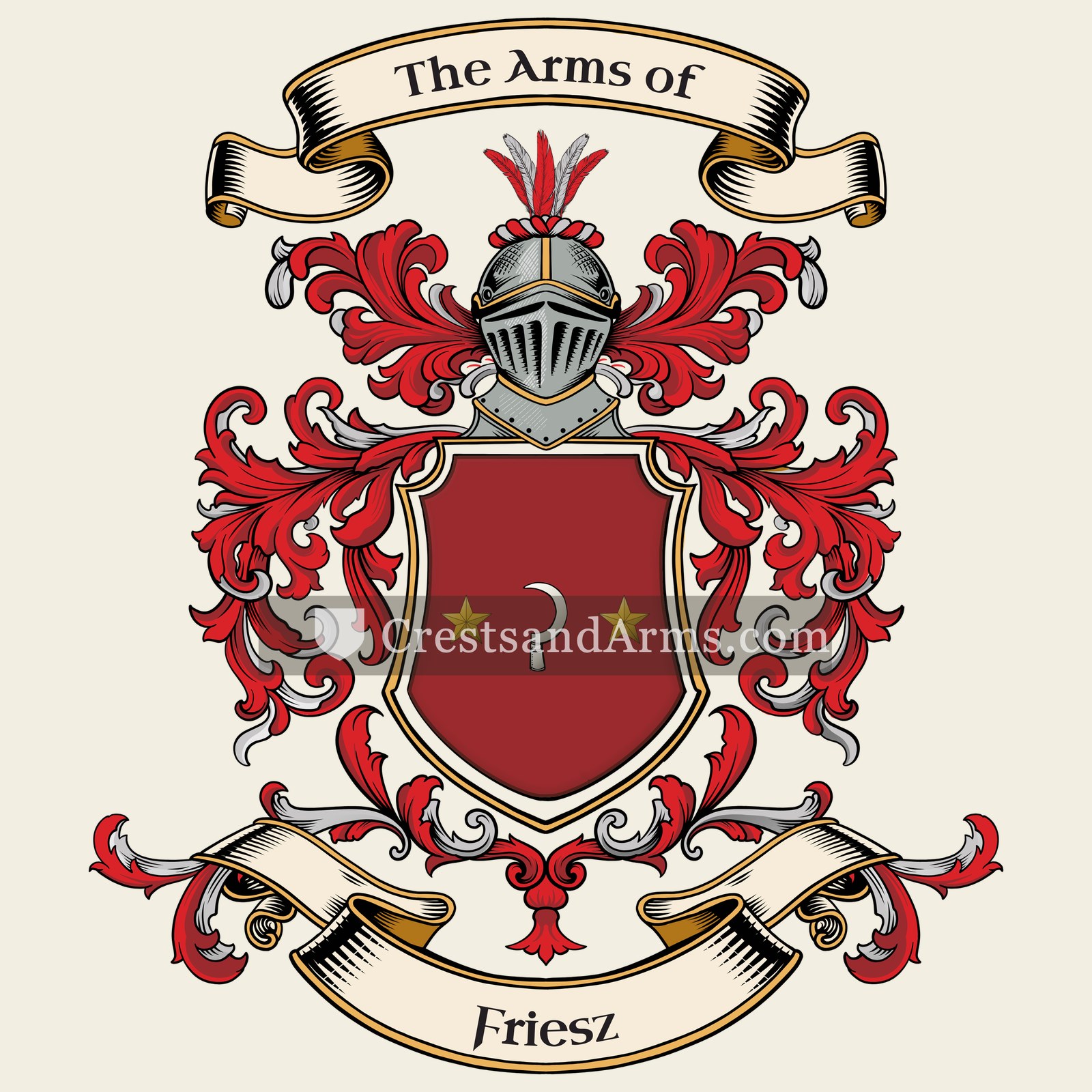


 lionCourage, strength and royalty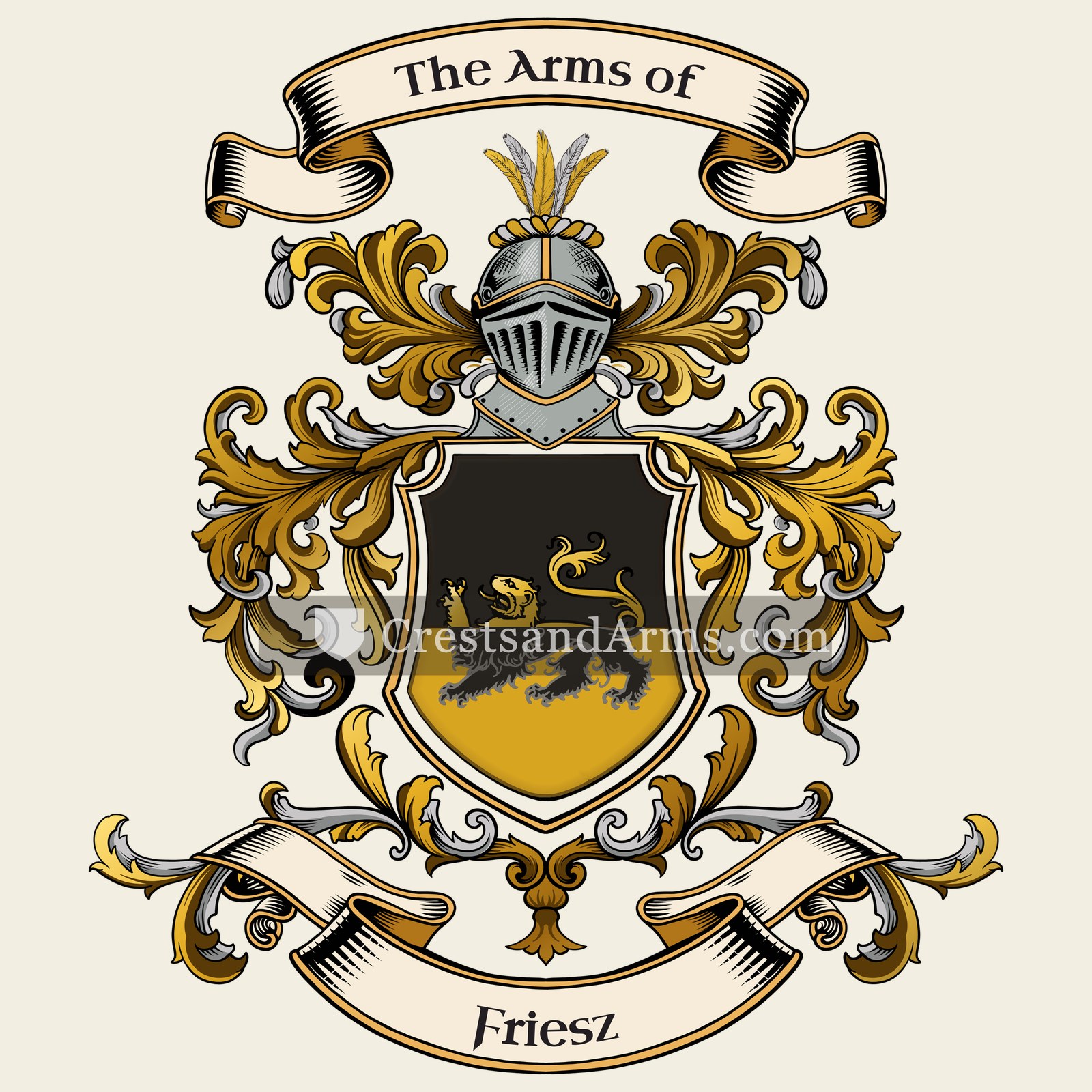

 saltireResolution, and St Andrew's cross
 swordJustice, and military honour
 crownSovereignty, authority and just reward