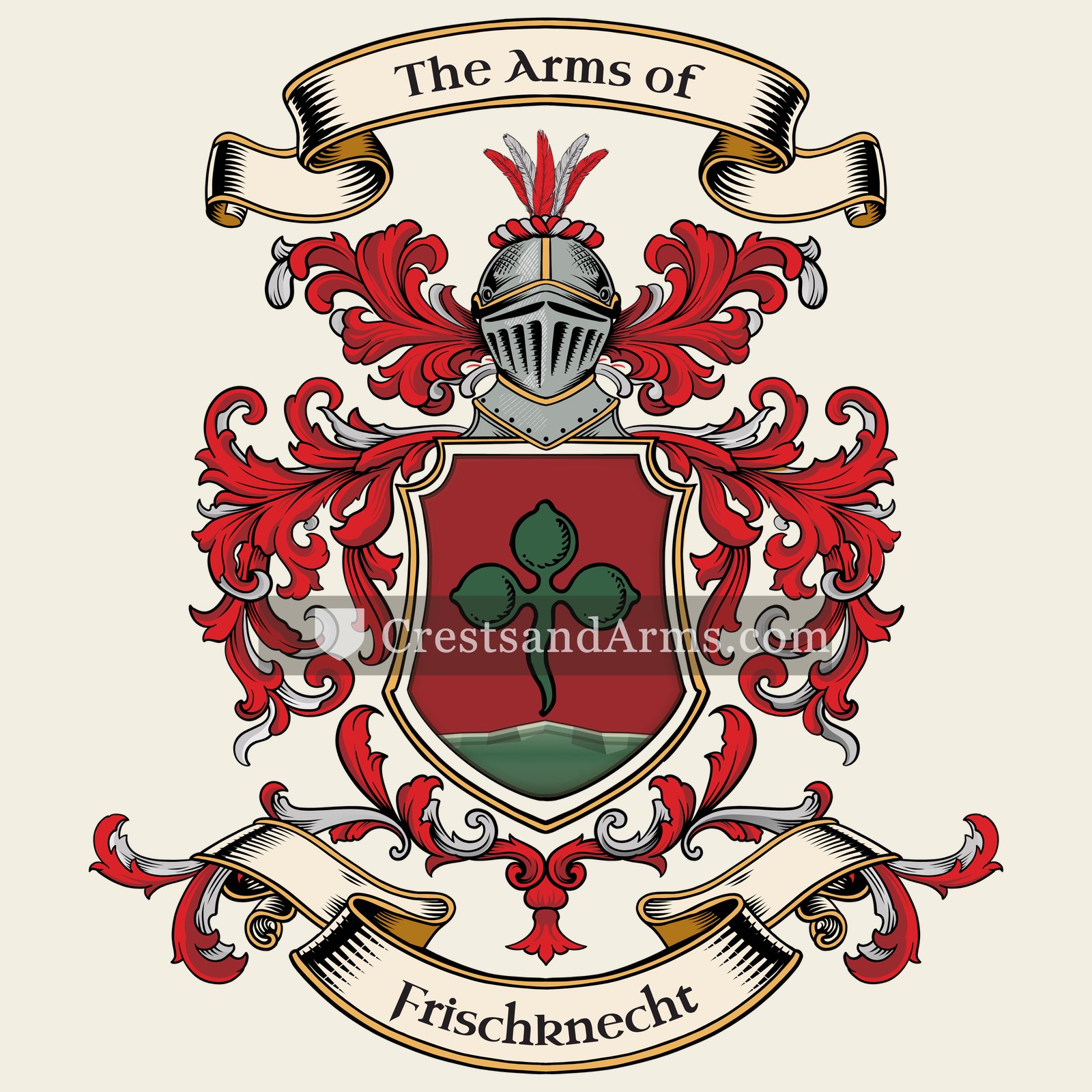
A record of documented arms, meaning and origin, researched for the Frischknecht family of Switzerland.
Reg. 3319 · Swiss, D–F
Coat of Arms & Family Crest Details
Symbols on this shield
mountThe ground held, and steadfastness upon it
trefoilPerpetuity, and the Trinity
Colours
Red (Gules)Means: Military strength
Green (Vert)Means: Hope
Historical info
Source
J. B. Rietstap, Armorial Général, Gouda: G. B. van Goor Zonen, 1884–87
Blazon (the actual original written record)
“De gu. à un trèfle de sin. mouv. d'un tertre du même. C.: un homme barbu iss., hab. de gu., rebr. d'arg., au rabat du meme, coiffé d'un bonnet conique de gu. retr. d'arg., tenant un trèfle de sin. L. d'or et de sa.”
SwitzerlandBâle, c. 1745
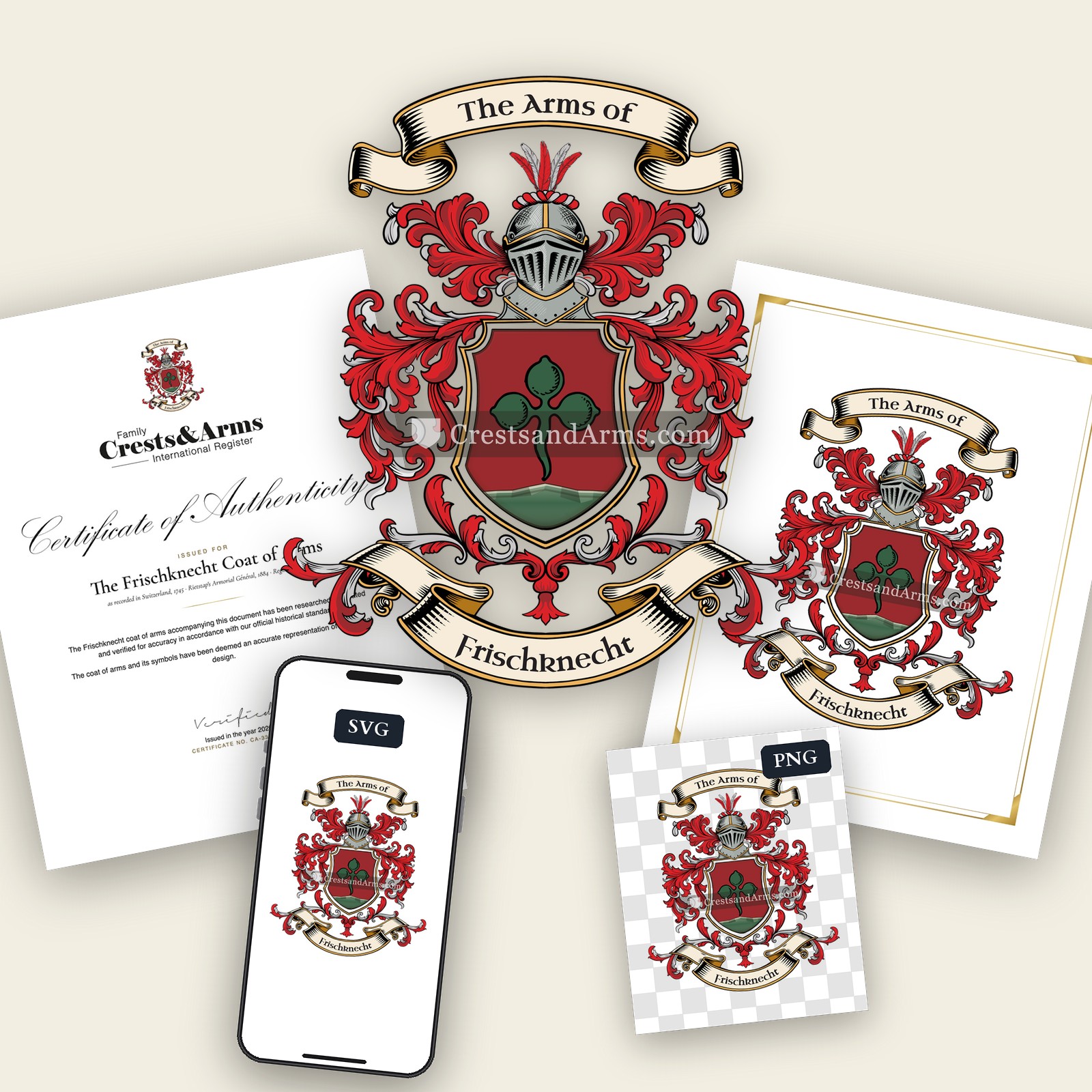
Digital archive packCoat of arms PNG, gold border print PDF, vector SVG and the certificate of authenticity. Sent to your email in minutes.
Map of Switzerland showing where the Frischknecht arms are recorded
The Frischknecht arms were recorded in Bâle, c. 1745.
This is where the arms were entered in the register. Families often moved to other parts of the country, so the same name can turn up in more than one region.
The body that granted and recorded arms in Switzerland in this period.
How Arms Worked in Switzerland
In Switzerland, coats of arms were not restricted to the nobility and were often adopted by common citizens and families. These symbols were passed down through generations to show family identity. When branches of a family grew, they often changed small details of the design to distinguish their own line from the original group.
Granting authority
Cantonal and civic authorities managed the use of coats of arms within their specific regions and local jurisdictions.
How they got arms
Families typically assumed their own coats of arms based on local custom rather than receiving them from a central monarch.
Where arms were recorded
Arms were recorded in various cantonal and civic registers starting from the fourteenth century throughout the Swiss region.
The family's standing
Recorded among the armigerous families of Switzerland.
Origin & History of the Frischknecht Family in Switzerland
The surname Frischknecht is a classic example of a descriptive occupational name originating from the German-speaking regions of Switzerland. The name is composed of two parts: "frisch," meaning fresh or energetic, and "knecht," which historically referred to a servant, farmhand, or a young man in training. Together, the name likely identified a vigorous or newly arrived worker within a rural community. By the mid-18th century, the family had established a notable presence in the city of Bâle, where records confirm their residence by 1745. During this era, families with this name were often integrated into the local guild systems or agricultural sectors, contributing to the steady growth of the region’s urban and suburban populations. Over time, the family spread from these early hubs, maintaining their identity through a name that reflects the industrious spirit of their ancestors.
Frischknecht Meaning & Related Branches
Root word
frisch and knecht
Fresh or new and a servant, farmhand, or young man.
This name
FrischknechtA surname historically denoting a new or recent servant working on a farm or estate.
also spelled
Frishknecht
Fryschknecht
Frischknet
Frishknek
Documented Sources
J. B. Rietstap, Armorial Général, Gouda: G. B. van Goor Zonen, 1884–87
Brechenmacher, Josef Karlmann. Etymologisches Wörterbuch der deutschen Familiennamen. 1957
Staatsarchiv Basel-Stadt. Bürgerverzeichnisse und Einwohnerregister. 1745
Bahlow, Hans. Deutsches Namenlexikon: Familien- und Vornamen nach Ursprung und Sinn erklärt. 1967
Digital archive packCoat of arms PNG, gold border print PDF, vector SVG and the certificate of authenticity. Sent to your email in minutes.


 mountThe ground held, and steadfastness upon it
 trefoilPerpetuity, and the Trinity
 mountThe ground held, and steadfastness upon it
 trefoilPerpetuity, and the Trinity