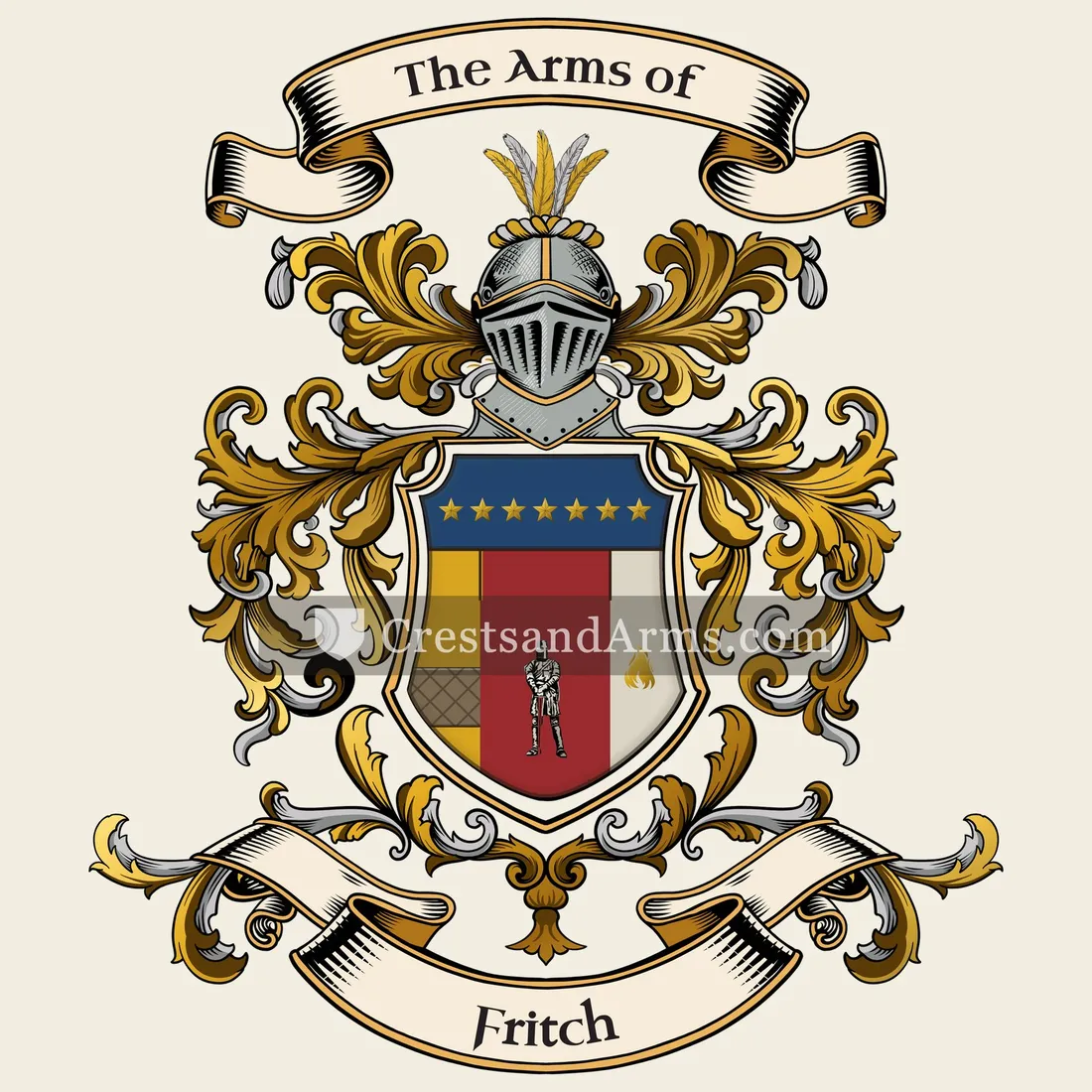
A record of documented arms, meaning and origin, researched for the Fritch family lines. Documented in 2 countries.
Reg. 4210 · German, D–F
Meaning of the Fritch family crest colors & symbols
Symbols on this shield
chevronProtection, and faithful service completed
mulletThe third son, and a divine quality from above
Colours
Blue (Azure)Means: Loyalty and truth
Silver (Argent)Means: Peace and sincerity
Historical info
Source
J. B. Rietstap, Armorial Général, Gouda: G. B. van Goor Zonen, 1884–87
Blazon (the actual original written record)
“D'azur au chev. d'arg., acc. de trois étoiles du même. Cq. cour. C.: une étoile d'or, entre un vol d'azur, chaque aile ch. d'une étoile d'or. L.: à dextre d'arg. et d'azur, à sen. d'or et d'azur.”
SaxonySaxony, c. 1730
Digital archive packCoat of arms PNG, gold border print PDF, vector SVG and the certificate of authenticity. Sent to your email in minutes.
Map of Germany showing where the Fritch arms are recorded
The Fritch arms were recorded in Saxony, c. 1730.
Saxony had mines, trade and old landed families all at once. Silver made some fortunes and land held others, and both sorts of family kept arms, which is why Saxon names appear so often in the registers.
This is where the arms were entered in the register. Families often moved to other parts of the country, so the same name can turn up in more than one region.
The body that granted and recorded arms in Germany in this period.
Charles VI, Holy Roman Emperor
Sovereign of the period
Charles VI, Holy Roman Emperor
1711–1740
Reigning in Germany when the Fritch arms are first recorded.
How Arms Worked in Germany
In the Holy Roman Empire, coats of arms were often granted to individuals by the Emperor or his representatives. These arms were then passed down through the generations to all legitimate descendants of the original holder. Younger branches of a family usually kept the same shield design without needing to change it, as the arms belonged to the entire lineage.
Granting authority
The Holy Roman Emperor held the sole power to grant new coats of arms throughout his vast imperial territories.
How they got arms
Families typically obtained their coats of arms through a formal imperial grant or by proving their noble status to the authorities.
Where arms were recorded
These grants were officially recorded in the Imperial Chancery registers, which began keeping formal records of such honors during the Middle Ages.
The family's standing
Recorded among the armigerous families of Saxony.
Origin & History of the Fritch Family in Germany
The surname Fritch finds its roots in the German-speaking lands, where it evolved as a variation of the name Friedrich. This name is derived from the Old High German words for peace and ruler, suggesting that early ancestors were often seen as leaders or peacemakers within their local communities. By the year 1730, records confirm that families bearing this name were well-established in the region of Saxony. During this period, Saxony was a center of trade and intellectual growth, and families like the Fritches were typically involved in the agrarian or craft-based economies that defined village life. As the name spread across German territories, it adapted to local dialects, eventually settling into the spelling recognized today. These early generations lived through a time of significant social change, as the influence of the Holy Roman Empire began to shift and local governance became more central to daily life.
Meaning of the Fritch family crest colors & symbols
Symbols on this shield
fessThe military belt, and readiness to serve
chiefAuthority, wisdom and dominion
mulletThe third son, and a divine quality from above
womanGrace, and the founding of a house
knightChivalry and service in arms
fireZeal and purification
Colours
Gold (Or)Means: Generosity
Red (Gules)Means: Military strength
Silver (Argent)Means: Peace and sincerity
Blue (Azure)Means: Loyalty and truth
Historical info
Source
J. B. Rietstap, Armorial Général, Gouda: G. B. van Goor Zonen, 1884–87
Blazon (the actual original written record)
“Parti: au 1 d'or à une représentation de l'Autriche (Austria) sous les traits d'une femme drapée d'une longue tunique blanche, revêtue d'un manteau de gu. bordé d'or, sommée d'une couronne murale au nat., appuyant la main dextre sur un bouclier triangulaire de fer (représentant un champ ch. d'une fasce, sans émaux); ladite femme soutenue de quatre degrés de marbre; au 2 de gu. à un homme revètu d'une longue tunique blanche, posant la main sen. sur son coeur, dirigeant la dextre vers ladite Austria et soutenu de quatre degrés de marbre. Enté en p. d'arg. à un autel carré au nat., haussé sur des degrés et portant un feu d'or. Au chef de l'écu d'azur, ch. de la constellation de l'Ourse d'or, l'étoile polaire à dextre. Deux cq. cour. C.: 1° deux prob., coupées alt. d'azur et d'or; l. d'or et d'azur; 2° deux prob., coupées alt. de gu. et d'or; l. d'or et de gu. D.: IMPERATORI ET PATRIÆ.”
Austriac. 1854
Digital archive packCoat of arms PNG, gold border print PDF, vector SVG and the certificate of authenticity. Sent to your email in minutes.
Map of Austria showing where the Fritch arms are recorded
The Fritch arms were recorded in Austria, c. 1854.
Arms such as these were typically recorded in Tyrol.
Tyrol was mountain country in western Austria, where the valleys were held by families who had been there a very long time. Old tenure counted for more than money, and old families carried arms.
This is where the arms were entered in the register. Families often moved to other parts of the country, so the same name can turn up in more than one region.
Region
Tyrol
First recorded
1854
Granting Authority for the Fritch Arms
Imperial and Royal chancery
Sodacan · CC BY-SA 3.0
The body that granted and recorded arms in Austria in this period.
Franz Joseph I of Austria
Sovereign of the period
Franz Joseph I of Austria
1848–1916
Reigning in Germany when the Fritch arms are first recorded.
How Arms Worked in Austria
Austrian coats of arms were often linked directly to noble titles granted by the Emperor. These symbols belonged to the entire family line rather than just one individual. When a family grew, new branches kept the original design without needing to change it. This system allowed all members of a noble house to share the same identity across many generations.
Granting authority
The Imperial and Royal chancery managed all heraldic matters and controlled the official granting of arms throughout the Austrian lands.
How they got arms
Families typically received their arms through a formal imperial decree that often accompanied the elevation of a person to noble status.
Where arms were recorded
Official records of these grants were kept in the Imperial Register of Nobility which began its formal documentation process in 1453.
The family's standing
Recorded among the armigerous families of Austria.
Origin & History of the Fritch Family in Austria
The family name Fritch, often spelled Fritsch in its native German, finds its deep roots in the rugged landscape of the Austrian Alps. By the mid-19th century, the family was well-established in the Tyrol region, a mountainous area known for its strong traditions and isolated valley communities. The name itself is a diminutive form of the name Friedrich, which means peaceful ruler. In the context of Tyrol, families like the Fritches were often tied to the land, working as skilled farmers, craftsmen, or local officials who helped maintain the social order of their mountain villages. Life in 1854 Tyrol was defined by the harsh climate and a close connection to the Catholic Church, which served as the primary record-keeper for births, marriages, and deaths. As the family moved through these alpine settlements, they contributed to the unique cultural identity of the region, blending Germanic naming customs with the distinct local heritage of the Austrian highlands.
Fritch Meaning & Related Branches
Root word
Friedrich
Derived from Germanic elements meaning peaceful ruler.
This name
FritchA diminutive or patronymic form indicating a descendant of someone named Frederick.
also spelled
Frich
Frytsch
Fritsche
Documented Sources
J. B. Rietstap, Armorial Général, Gouda: G. B. van Goor Zonen, 1884–87
Bahlow, Hans, Deutsches Namenlexikon: Familien- und Vornamen nach Ursprung und Sinn erklärt, 1967
Heintze, Albert, Die deutschen Familien-Namen: geschichtlich, geographisch, sprachlich, 1903
Sächsisches Staatsarchiv, Kirchenbücher der evangelisch-lutherischen Landeskirche Sachsens, 1730
Digital archive packCoat of arms PNG, gold border print PDF, vector SVG and the certificate of authenticity. Sent to your email in minutes.


 chevronProtection, and faithful service completed
 mulletThe third son, and a divine quality from above
 chevronProtection, and faithful service completed
 mulletThe third son, and a divine quality from above



 fessThe military belt, and readiness to serve
 chiefAuthority, wisdom and dominion
 womanGrace, and the founding of a house
 knightChivalry and service in arms
 fireZeal and purification