Map of Switzerland showing where the Frolick arms are recorded
The Frolick arms were recorded in Aarau, c. 1745.
This is where the arms were entered in the register. Families often moved to other parts of the country, so the same name can turn up in more than one region.
The body that granted and recorded arms in Switzerland in this period.
How Arms Worked in Switzerland
In Switzerland, coats of arms were not restricted to the nobility and were often adopted by common citizens and families. These symbols were passed down through generations to show family identity. When branches of a family grew, they often changed small details of the design to distinguish their own line from the original group.
Granting authority
Cantonal and civic authorities managed the use of coats of arms within their specific regions and local jurisdictions.
How they got arms
Families typically assumed their own coats of arms based on local custom rather than receiving them from a central monarch.
Where arms were recorded
Arms were recorded in various cantonal and civic registers starting from the fourteenth century throughout the Swiss region.
The family's standing
Recorded among the armigerous families of Switzerland.
Origin & History of the Frolick Family in Switzerland
The family name Frolick, often recorded in historical documents as Fröhlich, has deep roots in the Swiss canton of Aargau. By the year 1745, members of the family were well-established residents of the town of Aarau. During this period, Aarau was a growing center of trade and political activity, and families like the Frolicks were typically integrated into the local guild systems or agricultural life of the region. The name itself is derived from the Middle High German word for joyful or happy, suggesting that it may have originally been a nickname for a person with a cheerful disposition. As residents of a Swiss town in the eighteenth century, the family would have navigated the complex social structures of the Old Swiss Confederacy, likely participating in the local governance and religious life that defined daily existence in the Aare River valley.
Coat of Arms & Family Crest Details
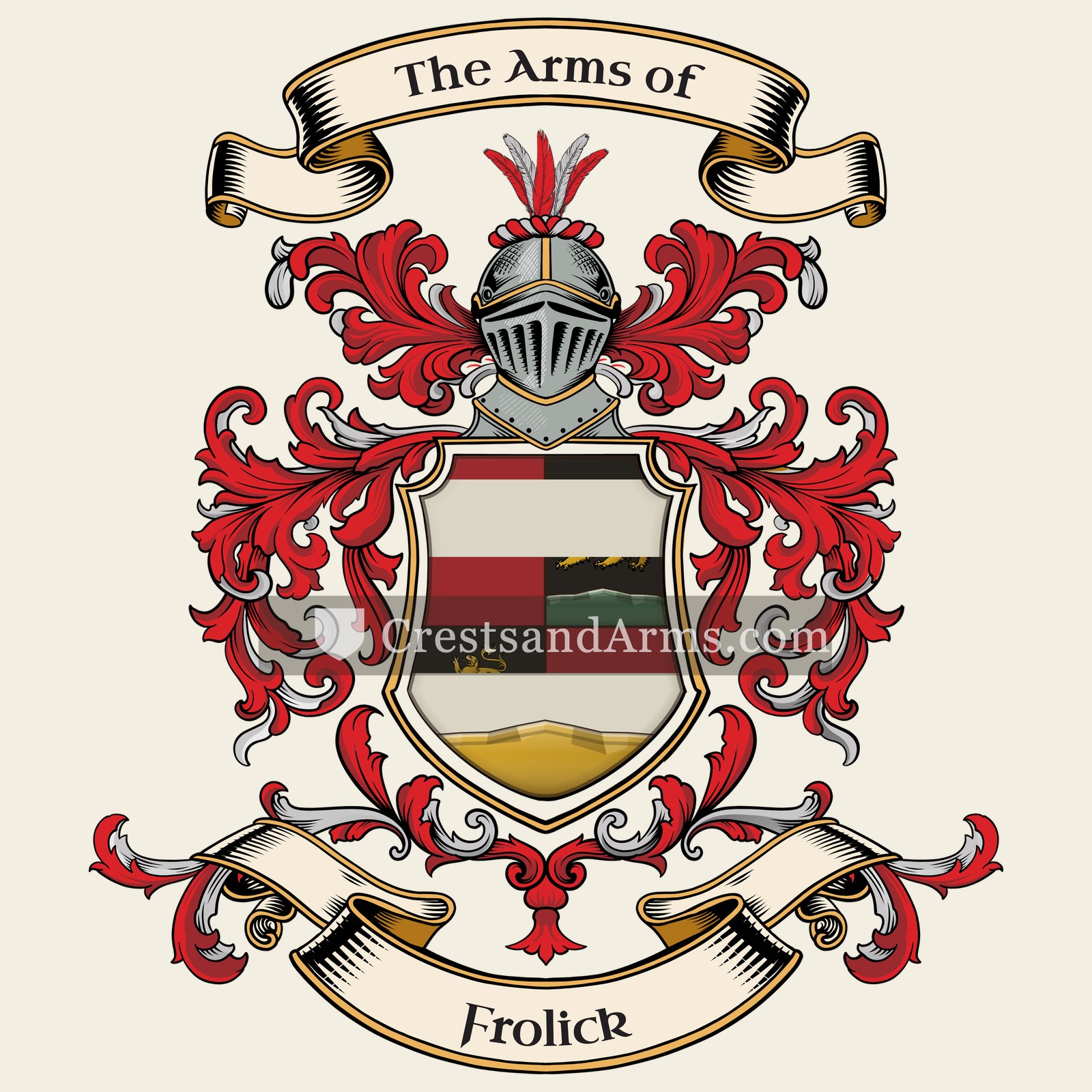
Symbols on this shield
fessThe military belt, and readiness to serve
mountThe ground held, and steadfastness upon it
lionCourage, strength and royalty
Colours
Red (Gules)Means: Military strength
Black (Sable)Means: Constancy
Silver (Argent)Means: Peace and sincerity
Gold (Or)Means: Generosity
Green (Vert)Means: Hope
Historical info
Source
J. B. Rietstap, Armorial Général, Gouda: G. B. van Goor Zonen, 1884–87
Blazon (the actual original written record)
“Ec.: aux 1 et 4 de gu. à deux fasces d'arg.; aux 2 et 3 de sa. au lion d'or, soutenu d'un tertre du même. Cq. cour. C.: le lion, iss. L.: à dextre d'arg. et de gu., à sen. d'arg. et de sa.”
FranconiaFranconia, c. 1765
Digital archive packCoat of arms PNG, gold border print PDF, vector SVG and the certificate of authenticity. Sent to your email in minutes.
Map of Germany showing where the Frolick arms are recorded
The Frolick arms were recorded in Franconia, c. 1765.
Franconia was a patchwork of small territories in central Germany, full of minor landowners and prosperous market towns. So many separate households held land there that the region produced a great many coats of arms.
This is where the arms were entered in the register. Families often moved to other parts of the country, so the same name can turn up in more than one region.
The body that granted and recorded arms in Germany in this period.
Francis I, Holy Roman Emperor
Sovereign of the period
Francis I, Holy Roman Emperor
1745–1765
Reigning in Switzerland when the Frolick arms are first recorded.
How Arms Worked in Germany
In the Holy Roman Empire, coats of arms were often granted to individuals by the Emperor or his representatives. These arms were then passed down through the generations to all legitimate descendants of the original holder. Younger branches of a family usually kept the same shield design without needing to change it, as the arms belonged to the entire lineage.
Granting authority
The Holy Roman Emperor held the sole power to grant new coats of arms throughout his vast imperial territories.
How they got arms
Families typically obtained their coats of arms through a formal imperial grant or by proving their noble status to the authorities.
Where arms were recorded
These grants were officially recorded in the Imperial Chancery registers, which began keeping formal records of such honors during the Middle Ages.
The family's standing
Recorded among the armigerous families of Franconia.
Origin & History of the Frolick Family in Germany
The family name Frolick finds its roots in the historic region of Franconia, a territory known for its deep cultural traditions within the Holy Roman Empire. By the year 1765, records confirm that families bearing this name were well-established in this area, which was characterized by a mix of independent cities and rural farming communities. The name itself is derived from the Middle High German word *vrolich*, which translates to cheerful or joyful. Historically, such names often began as descriptive nicknames given to individuals who possessed a particularly sunny disposition or a lively personality. As these families lived through the eighteenth century, they likely participated in the local agrarian economy or skilled trades that defined the Franconian landscape. Over time, the name became a permanent identifier that passed from parents to children, anchoring the family identity to the social fabric of the German states long before the modern era of national unification.
Frolick Meaning & Related Branches
Root word
froelich
Germanic term meaning happy, joyful, or cheerful.
This name
FrolickA descriptive surname for a person with a merry or lighthearted disposition.
also spelled
Frohlick
Frolik
Frolick
Documented Sources
J. B. Rietstap, Armorial Général, Gouda: G. B. van Goor Zonen, 1884–87
Kulturstiftung Aarau, Aarau: Eine Stadtgeschichte, 2014
Bahnmüller, Wilfried, Die Familiennamen der Schweiz, 2008
Staatsarchiv Aargau, Bürgerregister der Stadt Aarau, 1745
Digital archive packCoat of arms PNG, gold border print PDF, vector SVG and the certificate of authenticity. Sent to your email in minutes.


 lionCourage, strength and royalty
 lionCourage, strength and royalty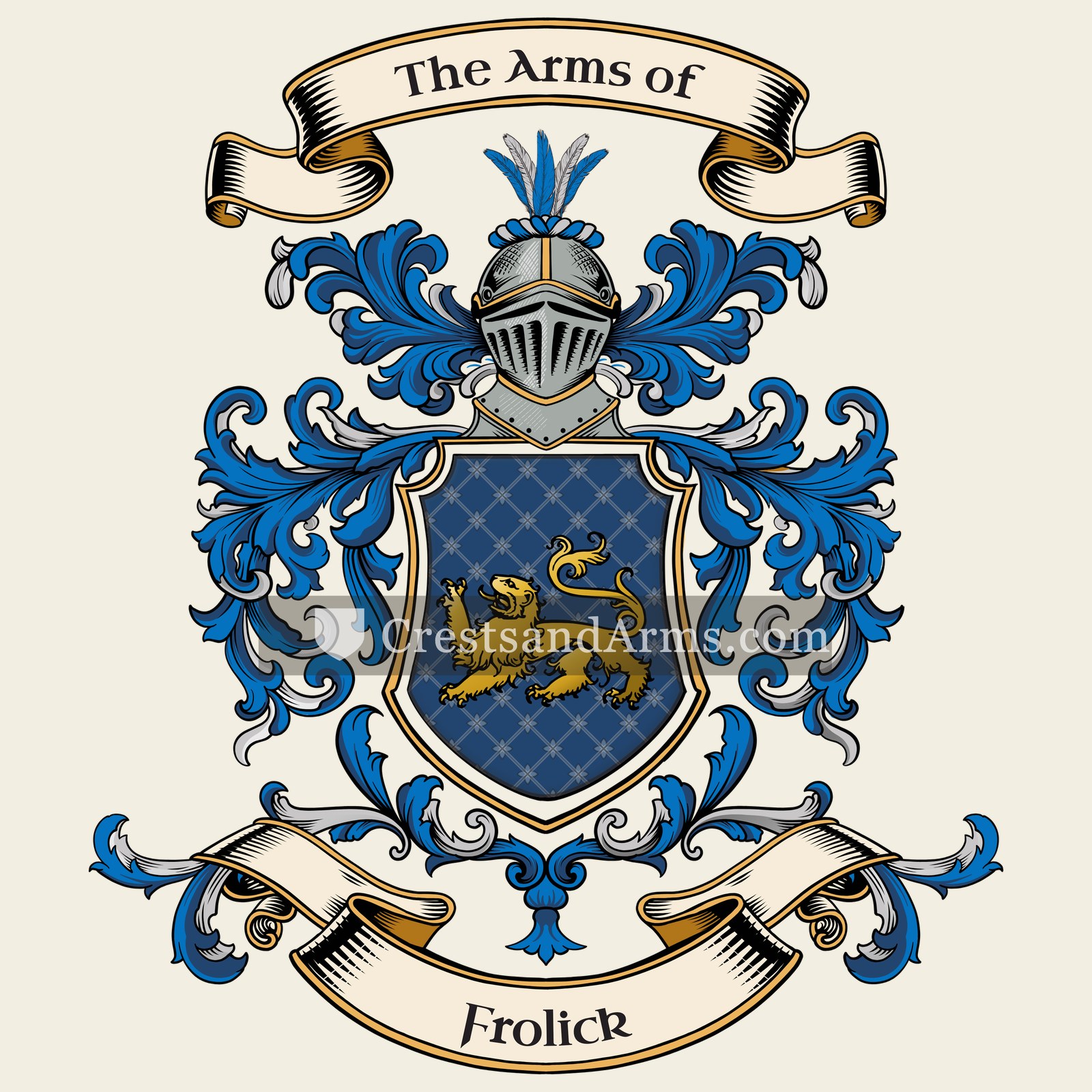

 fessThe military belt, and readiness to serve
 mountThe ground held, and steadfastness upon it