Map of Belgium showing where the Fronto arms are recorded
The Fronto arms were recorded in Belgium, c. 1737.
Arms such as these were typically recorded in Brabant.
Brabant lay at the heart of the Low Countries, where the trade routes met. Its towns were wealthy and its landowners many, and both kinds of family kept arms, which is why the region is so heavily represented.
This is where the arms were entered in the register. Families often moved to other parts of the country, so the same name can turn up in more than one region.
The body that granted and recorded arms in Belgium in this period.
Charles VI, Holy Roman Emperor
Sovereign of the period
Charles VI, Holy Roman Emperor
1711–1740
Reigning in Belgium when the Fronto arms are first recorded.
How Arms Worked in Belgium
In Belgium, a coat of arms is considered personal property that is passed down through the male line to legitimate descendants. Families often use the same shield design across generations to show their shared heritage. If a branch of the family wants to change the design, they must apply for an official update to their specific version of the arms.
Granting authority
The Conseil héraldique is the official body that regulates and approves all coats of arms in Belgium.
How they got arms
Families obtain their coats of arms through formal royal grants or by confirming their historical right to use existing designs.
Where arms were recorded
All approved coats of arms are officially recorded in the public registers of the Conseil héraldique since 1844.
The family's standing
Recorded among the armigerous families of Belgium.
Origin & History of the Fronto Family in Belgium
The family name Fronto carries deep historical roots that likely trace back to the Latin word *fronto*, which was a common Roman cognomen meaning someone with a prominent forehead. While the name has ancient origins, the specific branch of the family documented in the Brabant region by 1737 likely emerged as part of the shifting populations of the Low Countries during the eighteenth century. At this time, Brabant was a bustling center of trade and agriculture, and families often moved between local parishes to find work or settle on new land. The presence of the Fronto name in these official records suggests that the family was well-integrated into the local community, participating in the religious and civil life of the region. By maintaining their identity through generations in this area, the family became a small but permanent part of the local historical record.
Fronto Meaning & Related Branches
Root word
Frons
Latin term referring to the forehead or brow.
This name
FrontoDerived from a Roman cognomen indicating a person with a prominent or distinctive forehead.
also spelled
Fronto
Documented Sources
J. B. Rietstap, Armorial Général, Gouda: G. B. van Goor Zonen, 1884–87
State Archives in Belgium (Rijksarchief te België), Parochieregisters van Brabant
State Archives in Belgium (Rijksarchief te België), Burgerlijke Stand van de provincie Brabant
Debrabandere, Frans. Woordenboek van de familienamen in België en Noord-Frankrijk. 2003
Fruin, Robert. Geschiedenis der Staatsinstellingen in Nederland. 1901
Digital archive packCoat of arms PNG, gold border print PDF, vector SVG and the certificate of authenticity. Sent to your email in minutes.


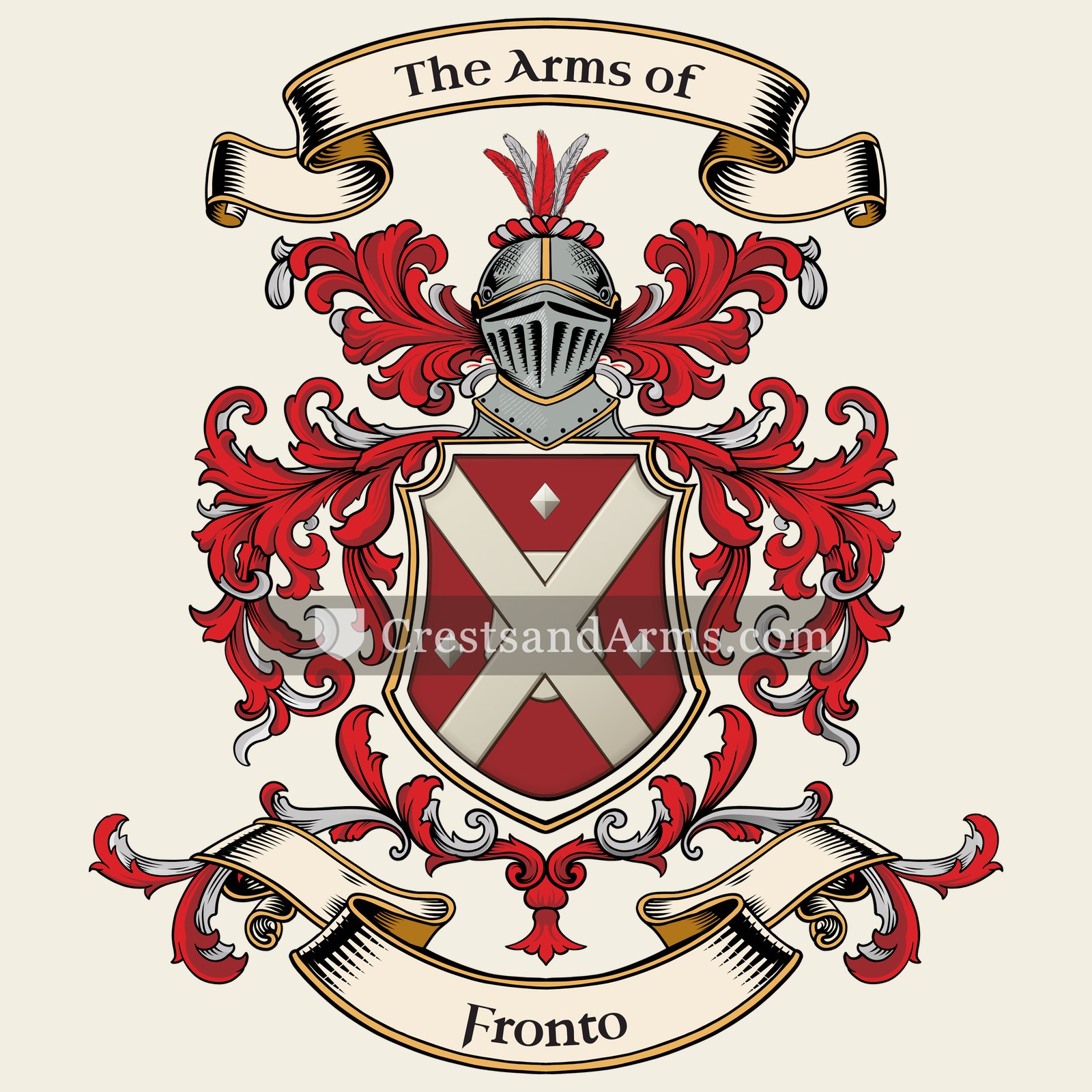
 saltireResolution, and St Andrew's cross
 lozengeHonour and nobility, and the arms of a woman
 saltireResolution, and St Andrew's cross
 lozengeHonour and nobility, and the arms of a woman