Map of Denmark showing where the Frost arms are recorded
The Frost arms were recorded in Denmark, c. 1722.
Arms such as these were typically recorded in Sjaælland.
Zealand held the Danish court, the crown's offices and Copenhagen itself. Families who served the king kept estates within reach of it, and royal service was the ordinary route to a coat of arms.
This is where the arms were entered in the register. Families often moved to other parts of the country, so the same name can turn up in more than one region.
The body that granted and recorded arms in Denmark in this period.
Frederik IV of Denmark
Sovereign of the period
Frederik IV of Denmark
1699–1730
Reigning in Denmark when the Frost arms are first recorded.
How Arms Worked in Denmark
Danish heraldry during this period was closely tied to noble status and royal favor rather than being open to all citizens. Arms were typically granted by the monarch to individuals, and these symbols were then shared by all members of the noble house. If a family line died out, the right to use those specific arms ended with them.
Granting authority
The Danish royal chancery held the power to issue and regulate official coats of arms for the kingdom.
How they got arms
Families usually received their arms through a formal royal grant that confirmed their noble status and rights.
Where arms were recorded
These grants were officially recorded in the Danish Royal Chancery records starting in the sixteenth century.
The family's standing
Recorded among the armigerous families of Denmark.
Origin & History of the Frost Family in Denmark
The name Frost has deep roots in the Danish landscape, functioning originally as a descriptive nickname rather than a formal surname. In the early eighteenth century, the name was already well-established among the rural populations of Sjælland. Records from 1722 confirm that families bearing this name were living in the region, likely as farmers or laborers who were deeply connected to the local soil. Because the word frost refers to the cold winter climate of Scandinavia, it is probable that the name was first given to individuals who were known for a stern personality or perhaps those who were born during a particularly harsh winter season. Over generations, this nickname transitioned into a permanent family name as it was passed down from parents to children. By the time of the 1722 records, the name had become a stable identifier for families working within the parish systems of eastern Denmark.
Coat of Arms & Family Crest Details
Symbols on this shield
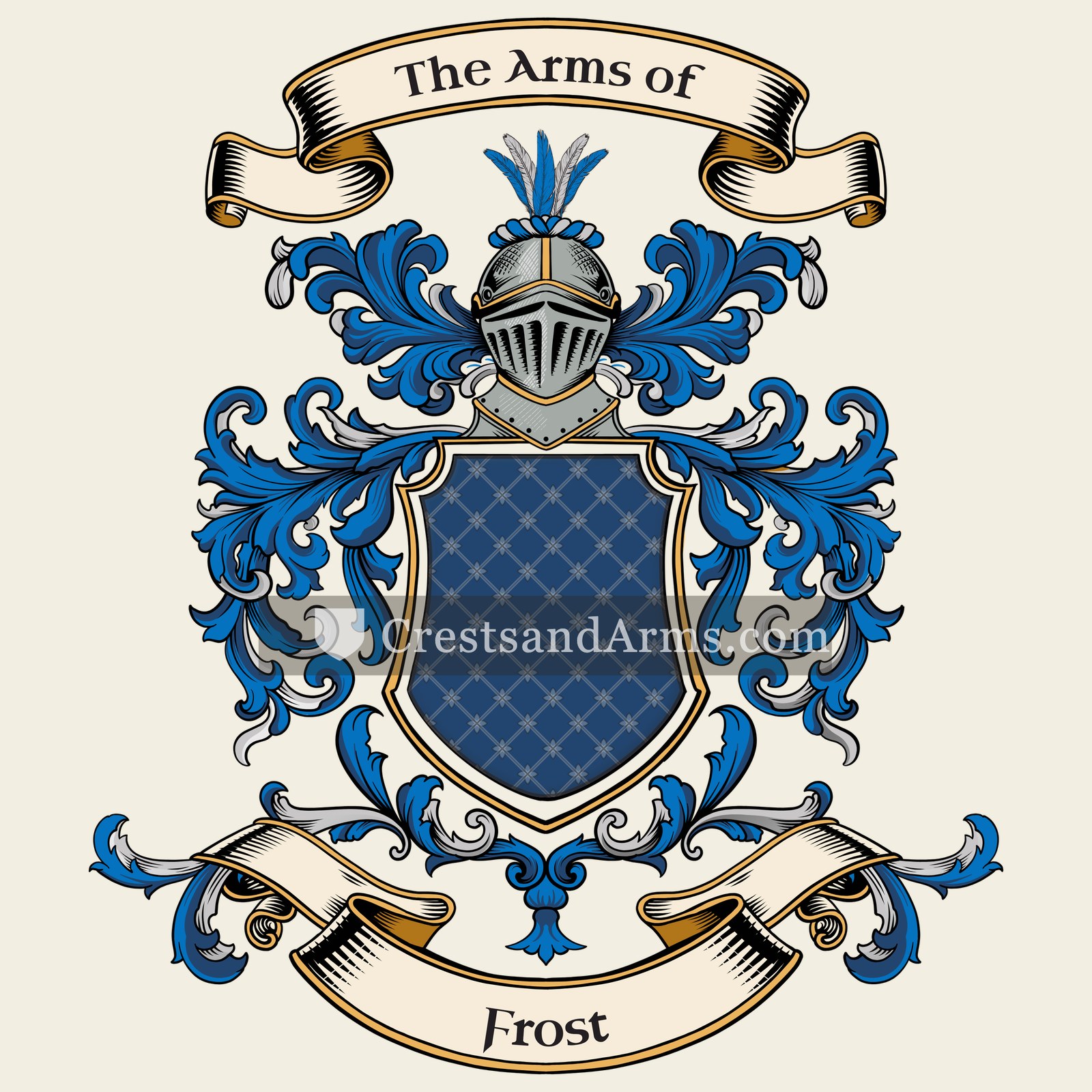
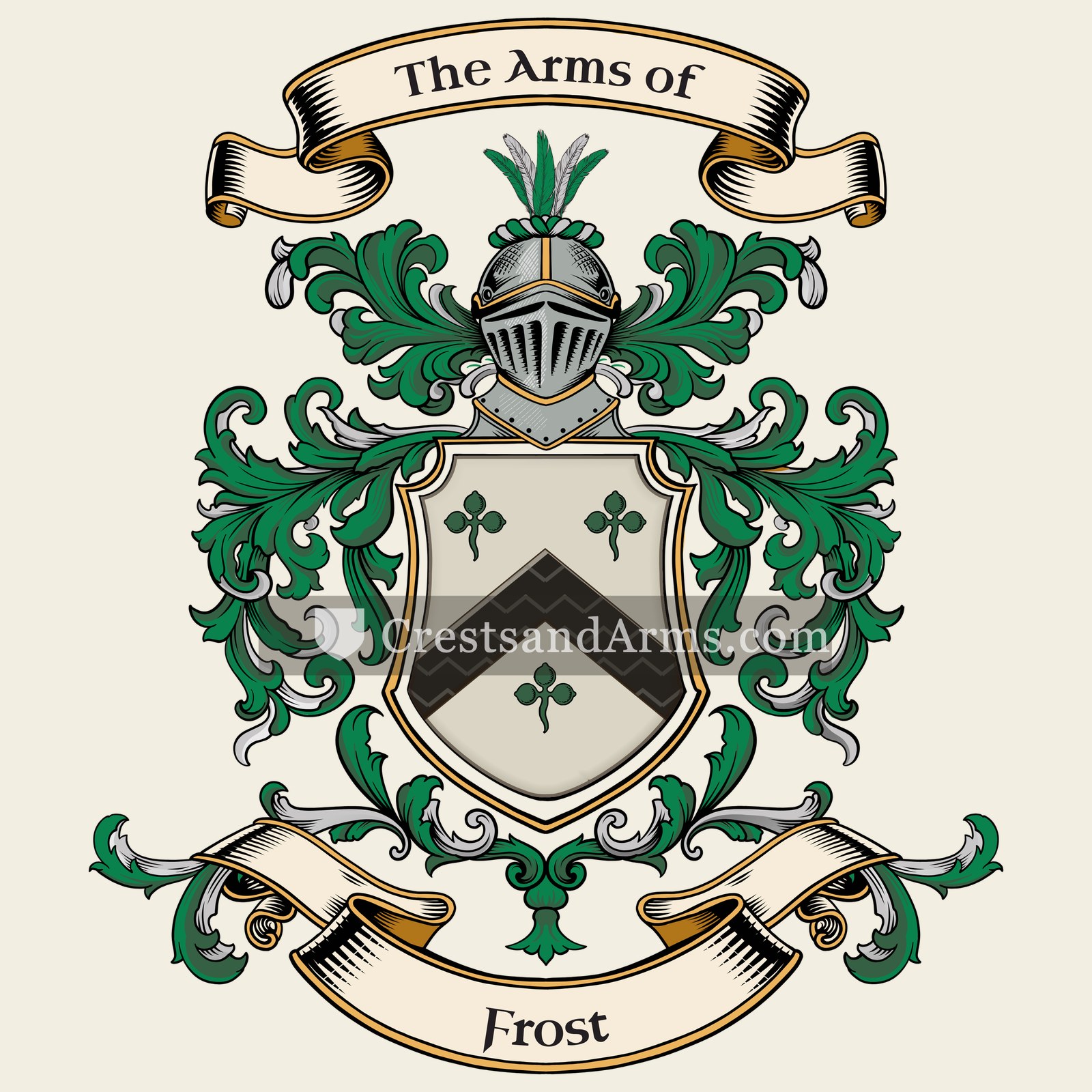
chevronProtection, and faithful service completed
trefoilPerpetuity, and the Trinity
Colours
Silver (Argent)Means: Peace and sincerity
Black (Sable)Means: Constancy
Green (Vert)Means: Hope
Historical info
Source
Sir Bernard Burke, The General Armory of England, Scotland, Ireland and Wales, London: Harrison & Sons, 1884
Blazon (the actual original written record)
“Ar. a chev. sa. betw. three trefoils slipped vert”
YorkYork, c. 1620
Digital archive packCoat of arms PNG, gold border print PDF, vector SVG and the certificate of authenticity. Sent to your email in minutes.
Map of England showing where the Frost arms are recorded
The Frost arms were recorded in York, c. 1620.
Yorkshire is the largest of the English counties, and it held more gentry families than any other. Land there was split among a great many households rather than a few, so a great many of them carried arms.
This is where the arms were entered in the register. Families often moved to other parts of the country, so the same name can turn up in more than one region.
The body that granted and recorded arms in England in this period.
James VI and I
Sovereign of the period
James VI and I
1603–1625
Reigning in Denmark when the Frost arms are first recorded.
How Arms Worked in England
English heraldry allowed arms to be shared by all legitimate descendants of the original owner. These symbols were treated as personal property that moved through the generations to all children. While the eldest son kept the original design, other family members could use the same shield without needing to change it or register their own unique versions.
Granting authority
The College of Arms in London has regulated the use of coats of arms throughout England and Wales since 1484.
How they got arms
Families typically obtained their coats of arms through a formal grant from the Crown or by proving their ancient right to them.
Where arms were recorded
All official coats of arms are recorded in the registers kept at the College of Arms, which date back to the fifteenth century.
The family's standing
Recorded among the armigerous families of York.
Origin & History of the Frost Family in England
The surname Frost originated in England as a descriptive nickname, likely given to someone with a cold or stern personality, or perhaps to a person who lived in a particularly chilly location. During the Middle Ages, surnames often emerged from personal traits or occupations to help distinguish individuals in growing communities. By the early seventeenth century, the name was well-established across various English regions, including the historic city of York. Records confirm that members of the Frost family were present in York by 1620, where they lived as part of the local urban population during a time of significant social and economic change. These early ancestors were likely tradespeople or laborers who contributed to the daily life and commerce of the city, helping to anchor the family name in the northern English landscape long before later generations began to migrate further afield.
Coat of Arms & Family Crest Details
Symbols on this shield
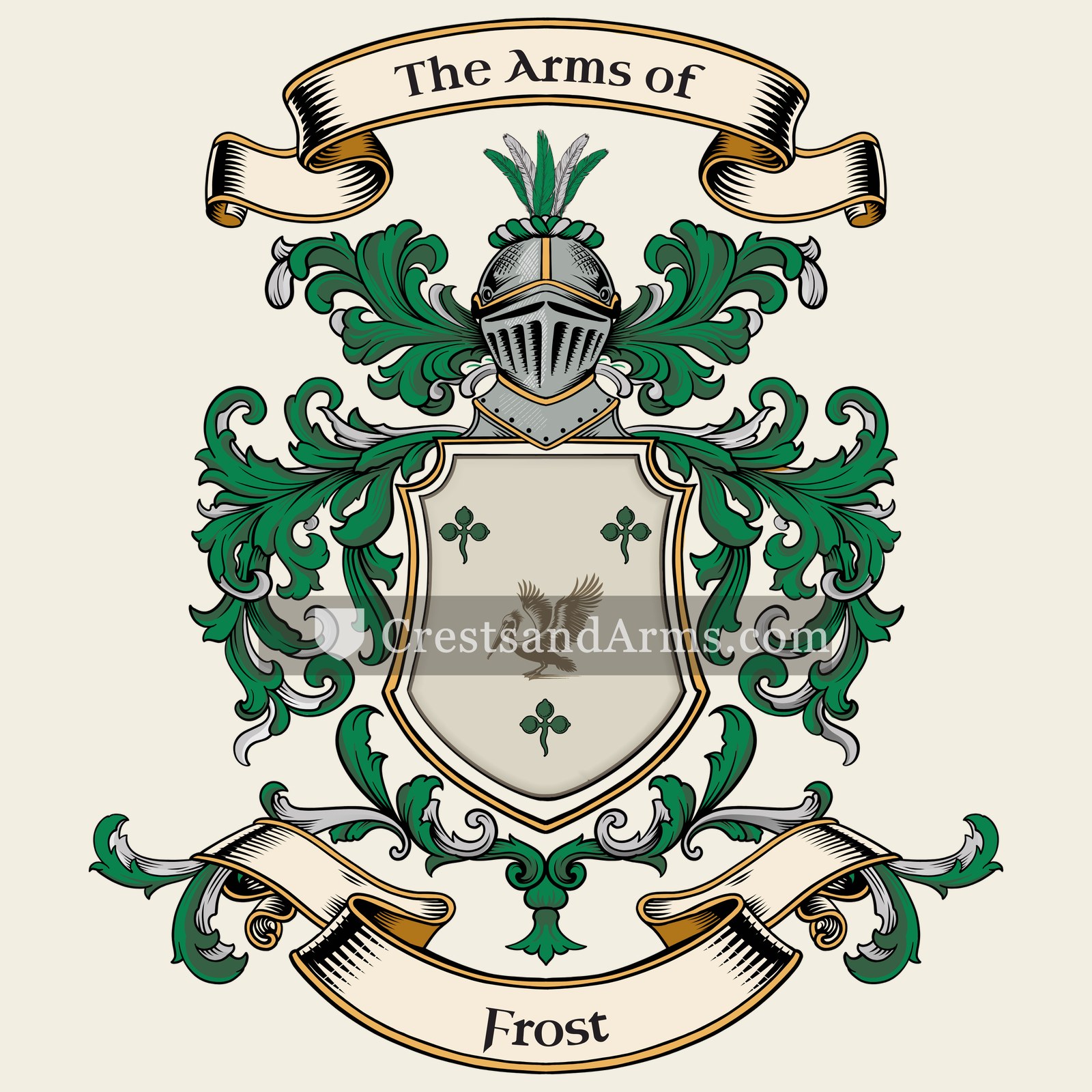
pelicanSelf-sacrifice and devotion to one's children
trefoilPerpetuity, and the Trinity
Colours
Silver (Argent)Means: Peace and sincerity
Green (Vert)Means: Hope
Historical info
Source
Sir Bernard Burke, The General Armory of England, Scotland, Ireland and Wales, London: Harrison & Sons, 1884
Blazon (the actual original written record)
“Ar. a pelican vulning betw. three trefoils slipped vert”
MontgomeryMontgomery, c. 1647
Digital archive packCoat of arms PNG, gold border print PDF, vector SVG and the certificate of authenticity. Sent to your email in minutes.
Map of Wales showing where the Frost arms are recorded
The Frost arms were recorded in Montgomery, c. 1647.
Montgomeryshire was mid-Welsh border country where land was held in return for keeping it quiet. Families were expected to arm, and an armed household carried a shield.
This is where the arms were entered in the register. Families often moved to other parts of the country, so the same name can turn up in more than one region.
The body that granted and recorded arms in Wales in this period.
Charles I of England
Sovereign of the period
Charles I of England
1625–1649
Reigning in Denmark when the Frost arms are first recorded.
How Arms Worked in Wales
English heraldry allowed arms to be shared by all legitimate descendants of the original owner. These symbols were treated as personal property that moved through the generations to all children. While the eldest son kept the original design, other family members could use the same shield without needing to change it or register their own unique versions.
Granting authority
The College of Arms in London has regulated the use of coats of arms throughout England and Wales since 1484.
How they got arms
Families typically obtained their coats of arms through a formal grant from the Crown or by proving their ancient right to them.
Where arms were recorded
All official coats of arms are recorded in the registers kept at the College of Arms, which date back to the fifteenth century.
The family's standing
Recorded among the armigerous families of Montgomery.
Origin & History of the Frost Family in Wales
The surname Frost likely arrived in Wales as a descriptive nickname, often used to identify individuals with a cold temperament or those who lived in particularly harsh, wintry climates. While the name has deep roots in England, its presence in the Welsh borderlands became well-documented by the mid-seventeenth century. By 1647, records confirm that members of the Frost family were established in the town of Montgomery. During this period, Montgomery served as a vital administrative and military center, and families residing there were often involved in the local trade or the governance of the Welsh Marches. These early settlers were part of a growing movement of families who integrated into the local Welsh community while maintaining the traditions and naming conventions brought from across the border. Their presence in the town suggests they were likely landowners or skilled tradespeople who played a functional role in the daily life of the region during a time of significant political upheaval in Britain.
Frost Meaning & Related Branches
Root word
Frosti
Old Norse term referring to cold, ice, or freezing weather.
This name
FrostA descriptive nickname for a person with a cold temperament or pale hair.
Documented Sources
J. B. Rietstap, Armorial Général, Gouda: G. B. van Goor Zonen, 1884–87
Rigsarkivet, Kirkebøger for Sjællands Stift (Parish registers for the Diocese of Sjælland)
Rigsarkivet, Folketællinger og lægdsruller (Census records and military levy rolls)
Kousgård Sørensen, John, Danske Surnavne, 1999
Nielsen, Oluf, Olddanske Personnavne, 1883
Digital archive packCoat of arms PNG, gold border print PDF, vector SVG and the certificate of authenticity. Sent to your email in minutes.




 chevronProtection, and faithful service completed
 trefoilPerpetuity, and the Trinity


 pelicanSelf-sacrifice and devotion to one's children