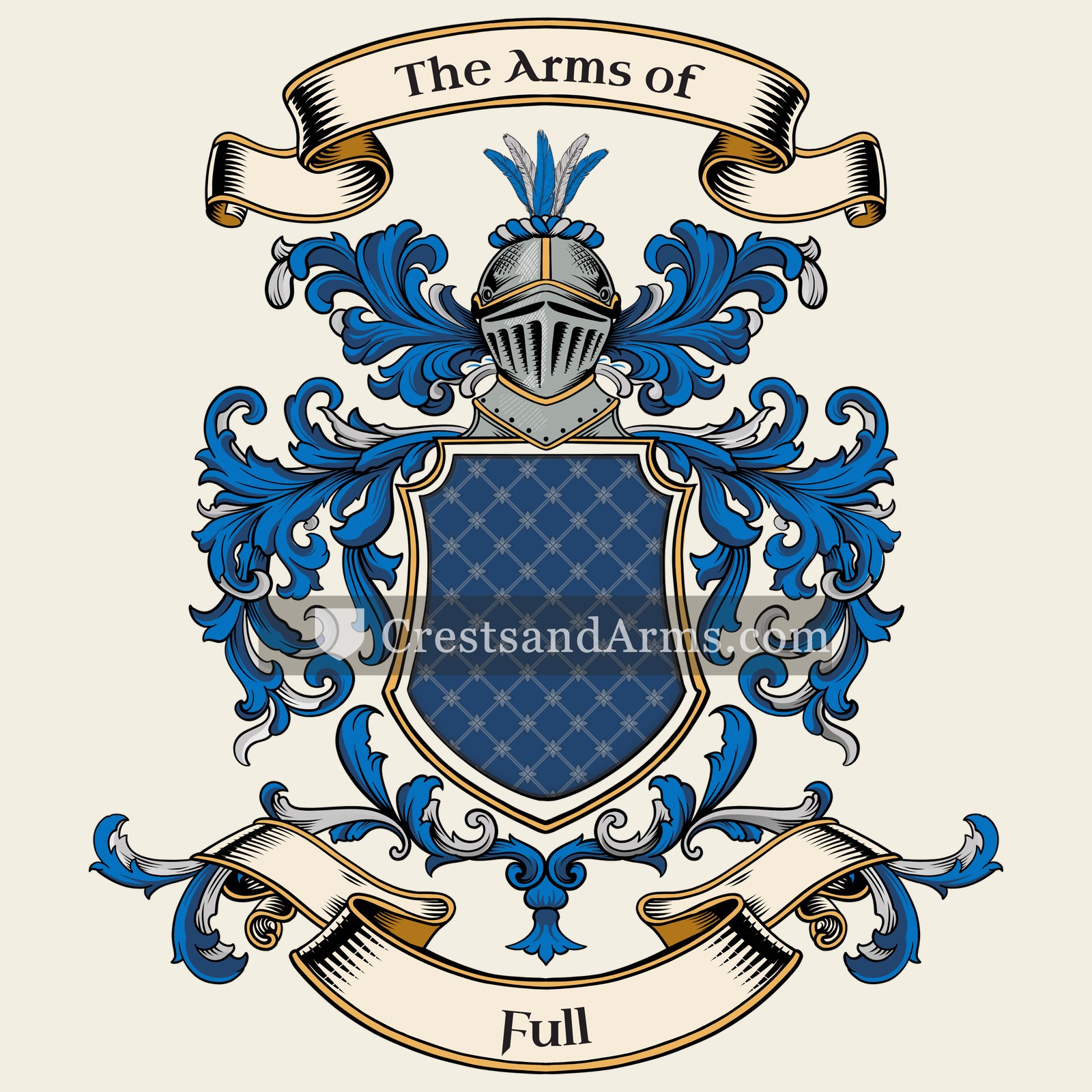
A record of documented arms, meaning and origin, researched for the Full family of Germany.
Reg. 9249 · German, D–F
Coat of Arms & Family Crest Details
Colours
Blue (Azure)Means: Loyalty and truth
Historical info
Source
J. B. Rietstap, Armorial Général, Gouda: G. B. van Goor Zonen, 1884–87
Blazon (the actual original written record)
“D'azur à trois arcs-en-ciel au nat., posés l'un sur l'autre. Cq. cour. C.: un palmier de sin., surm. d'un arc-en-ciel de l'écu, le tout acc. de trois étoiles mal-ordonnées d'or. L. d'arg. et d'azur. D.: MUTH UND HOFFNUNG.”
WurttembergWurttemberg, c. 1686
Digital archive packCoat of arms PNG, gold border print PDF, vector SVG and the certificate of authenticity. Sent to your email in minutes.
Map of Germany showing where the Full arms are recorded
The Full arms were recorded in Wurttemberg, c. 1686.
Wurttemberg was southern German country of small estates and well-off market towns. Both landowners and leading townsmen kept arms there, so the region carries far more names than its size suggests.
This is where the arms were entered in the register. Families often moved to other parts of the country, so the same name can turn up in more than one region.
The body that granted and recorded arms in Germany in this period.
Leopold I, Holy Roman Emperor
Sovereign of the period
Leopold I, Holy Roman Emperor
1658–1705
Reigning in Germany when the Full arms are first recorded.
How Arms Worked in Germany
In the Holy Roman Empire, coats of arms were often granted to individuals by the Emperor or his representatives. These arms were then passed down through the generations to all legitimate descendants of the original holder. Younger branches of a family usually kept the same shield design without needing to change it, as the arms belonged to the entire lineage.
Granting authority
The Holy Roman Emperor held the sole power to grant new coats of arms throughout his vast imperial territories.
How they got arms
Families typically obtained their coats of arms through a formal imperial grant or by proving their noble status to the authorities.
Where arms were recorded
These grants were officially recorded in the Imperial Chancery registers, which began keeping formal records of such honors during the Middle Ages.
The family's standing
Recorded among the armigerous families of Wurttemberg.
Origin & History of the Full Family in Germany
The surname Full traces its roots to the southwestern region of Germany, with documented evidence placing members of the family in the state of Württemberg as early as 1686. During the late seventeenth century, this area was recovering from the immense social and economic upheaval caused by the Thirty Years' War. Families like the Fulls were typically part of the rural peasantry or skilled artisan classes who lived in small, tightly knit village communities. The name itself likely originated as a descriptive nickname or a reference to a specific physical trait or personal quality held by an early ancestor. As these individuals moved through the local parish systems, their name was recorded in church registers that tracked baptisms, marriages, and burials. These records serve as the primary link to understanding how the family established its presence in the region during a time of significant reconstruction and growth in German history.
Full Meaning & Related Branches
Root word
Full
Derived from the Middle High German word full meaning complete or filled.
This name
FullA descriptive nickname for a person who was stout, plump, or prosperous.
also spelled
Phull
Pfuel
Phul
Full
Documented Sources
J. B. Rietstap, Armorial Général, Gouda: G. B. van Goor Zonen, 1884–87
Brechenmacher, Josef Karlmann. Etymologisches Wörterbuch der deutschen Familiennamen. 1957
Hauptstaatsarchiv Stuttgart. Kirchenbücher der evangelischen Landeskirche in Württemberg. 1686
Heintze, Albert. Die deutschen Familiennamen: geschichtlich, geographisch, sprachlich. 1903
Digital archive packCoat of arms PNG, gold border print PDF, vector SVG and the certificate of authenticity. Sent to your email in minutes.