Map of Austria showing where the Füller arms are recorded
The Füller arms were recorded in Carinthia, c. 1772.
Carinthia was Alpine country in southern Austria with iron and lead in its mountains. Mining and landholding both made money, and families who held either kind of property took arms.
This is where the arms were entered in the register. Families often moved to other parts of the country, so the same name can turn up in more than one region.
Region
Carinthia
First recorded
1772
Granting Authority for the Füller Arms
Imperial and Royal chancery
Sodacan · CC BY-SA 3.0
The body that granted and recorded arms in Austria in this period.
Joseph II, Holy Roman Emperor
Sovereign of the period
Joseph II, Holy Roman Emperor
1765–1790
Reigning in Austria when the Füller arms are first recorded.
How Arms Worked in Austria
Austrian coats of arms were often linked directly to noble titles granted by the Emperor. These symbols belonged to the entire family line rather than just one individual. When a family grew, new branches kept the original design without needing to change it. This system allowed all members of a noble house to share the same identity across many generations.
Granting authority
The Imperial and Royal chancery managed all heraldic matters and controlled the official granting of arms throughout the Austrian lands.
How they got arms
Families typically received their arms through a formal imperial decree that often accompanied the elevation of a person to noble status.
Where arms were recorded
Official records of these grants were kept in the Imperial Register of Nobility which began its formal documentation process in 1453.
The family's standing
Recorded among the armigerous families of Carinthia.
Origin & History of the Füller Family in Austria
The family name Füller traces its roots to the skilled trades of medieval Europe, where it originated as an occupational surname for a fuller. A fuller was a worker who cleaned and thickened raw wool cloth by pounding it in water, a vital step in the textile industry before the age of mass production. By the late 18th century, the family had established a firm presence in the mountainous region of Carinthia, Austria. Records confirm that members of the family were living in this area by 1772, likely integrated into the local agricultural or craft-based economy that defined the province at the time. Life in Carinthia during this period was shaped by the rugged landscape and the influence of the Habsburg monarchy, which governed the region and kept detailed administrative records of its inhabitants. As the family settled into their community, they became part of the long history of Austrian provincial life, contributing to the local workforce and the social fabric of the southern Alpine valleys.
Coat of Arms & Family Crest Details
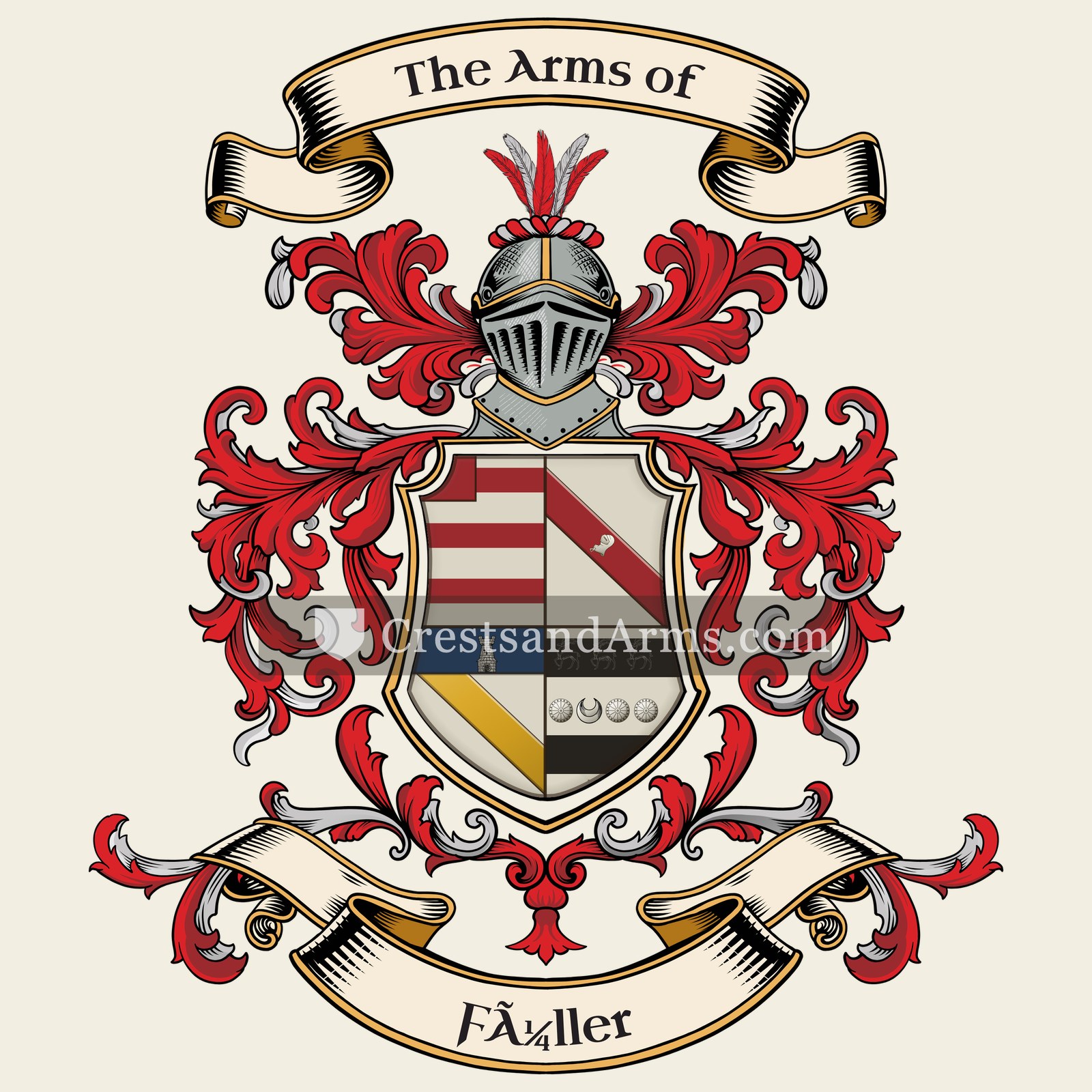
Symbols on this shield
cantonA mark of honour granted by the sovereign
bendDefence, and the scarf of a commander
chiefAuthority, wisdom and dominion
fessThe military belt, and readiness to serve
helmetWisdom and security in defence
towerGrandeur and solidity, and a stronghold defended
crescentHonour by the sovereign, and the second son
roundelA coin, and one who has been to the crusades
lionCourage, strength and royalty
stagPeace and harmony, and one who will not fight unprovoked
Colours
Silver (Argent)Means: Peace and sincerity
Red (Gules)Means: Military strength
Gold (Or)Means: Generosity
Blue (Azure)Means: Loyalty and truth
Black (Sable)Means: Constancy
Historical info
Source
Sir Bernard Burke, The General Armory of England, Scotland, Ireland and Wales, London: Harrison & Sons, 1884
Blazon (the actual original written record)
“Quarterly, 1st, ar. three bars and a canton gu., for FULLER; 2nd, ar. on a bend gu. a close helmet ppr.; 3rd, gu. on a bend or, a baton of the first on a chief az. the fortress of Gibraltar ar. under it "Plus ultra"; 4th, ar. betw. two bars sa. the upper charged with a crescent betw. two plates, the lower with another plate, a lion pass. of the second, in chief three stags' heads cabossed, also of the second; 5th, az. fretty or, over all a fesse of the second, for PARKER, of Ratton”
SussexAshdown House · Sussex, c. 1620
Digital archive packCoat of arms PNG, gold border print PDF, vector SVG and the certificate of authenticity. Sent to your email in minutes.
Map of England showing where the Füller arms are recorded
The Füller arms were recorded in Sussex, c. 1620.
Sussex had ironworks in its woods and good farmland on its downs. Both made money, and families who made it bought manors, which is what put their names in the heraldic records.
This is where the arms were entered in the register. Families often moved to other parts of the country, so the same name can turn up in more than one region.
The body that granted and recorded arms in England in this period.
James VI and I
Sovereign of the period
James VI and I
1603–1625
Reigning in Austria when the Füller arms are first recorded.
How Arms Worked in England
English heraldry allowed arms to be shared by all legitimate descendants of the original owner. These symbols were treated as personal property that moved through the generations to all children. While the eldest son kept the original design, other family members could use the same shield without needing to change it or register their own unique versions.
Granting authority
The College of Arms in London has regulated the use of coats of arms throughout England and Wales since 1484.
How they got arms
Families typically obtained their coats of arms through a formal grant from the Crown or by proving their ancient right to them.
Where arms were recorded
All official coats of arms are recorded in the registers kept at the College of Arms, which date back to the fifteenth century.
The family's standing
Recorded among the armigerous families of Sussex.
Origin & History of the Füller Family in England
The surname Füller is occupational in origin, derived from the Middle High German word "fullen," which refers to the process of cleaning and thickening raw wool cloth. While the name has deep roots in Germanic regions, individuals bearing this name began appearing in English records during the early seventeenth century. By 1620, there is documented evidence of the family residing in the county of Sussex. During this period, the textile industry was a vital part of the English economy, and many families with trade-based surnames were often involved in the production or finishing of wool. As these families settled into local communities, they became part of the growing social fabric of southern England. The presence of the Füller name in Sussex suggests that these early members were likely integrated into the regional agricultural or craft-based workforce that defined the area at the time.
Füller Meaning & Related Branches
Root word
Full
Germanic term referring to someone who is plump or stout.
This name
FüllerAn occupational surname for a fuller, a person who cleans and thickens cloth.
also spelled
Fueller
Fullar
Documented Sources
J. B. Rietstap, Armorial Général, Gouda: G. B. van Goor Zonen, 1884–87


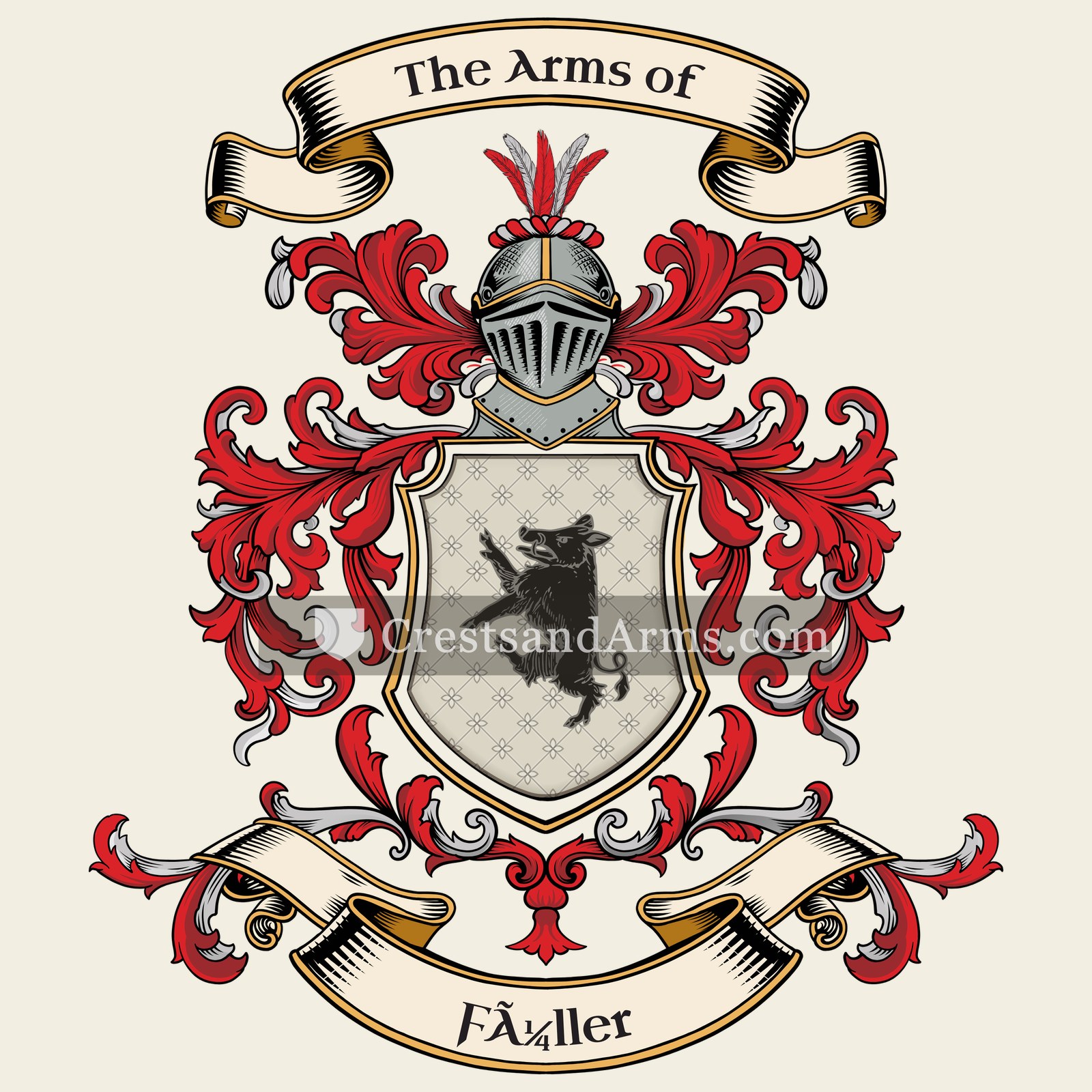
 boarA fierce fighter who battles to the end
 boarA fierce fighter who battles to the end


 cantonA mark of honour granted by the sovereign
 bendDefence, and the scarf of a commander
 chiefAuthority, wisdom and dominion
 fessThe military belt, and readiness to serve
 helmetWisdom and security in defence
 towerGrandeur and solidity, and a stronghold defended
 crescentHonour by the sovereign, and the second son
 roundelA coin, and one who has been to the crusades
 lionCourage, strength and royalty
 stagPeace and harmony, and one who will not fight unprovoked