A record of documented arms, meaning and origin, researched for the Funes family lines. Documented in 2 countries.
Reg. 8212 · French, D–F
Coat of Arms & Family Crest Details
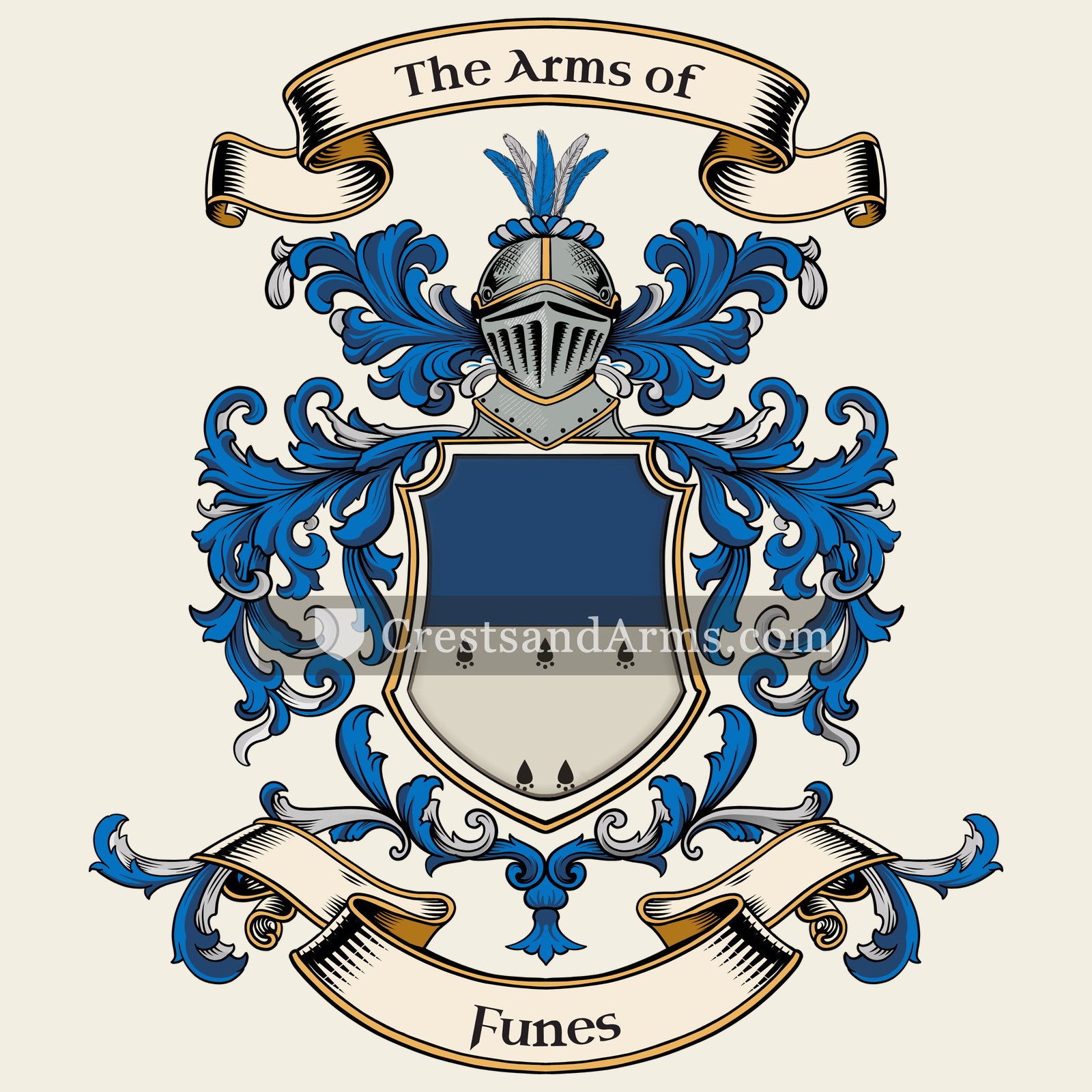
Symbols on this shield
ermineDignity and rank
Colours
Blue (Azure)Means: Loyalty and truth
Silver (Argent)Means: Peace and sincerity
Black (Sable)Means: Constancy
Historical info
Source
J. B. Rietstap, Armorial Général, Gouda: G. B. van Goor Zonen, 1884–87
Blazon (the actual original written record)
“Coupé d'azur sur arg., l'arg. ch. de cinq mouch. d'herm. de sa., 3 et 2.”
NavarreNavarre, c. 1663
Where the Funes Arms Were Recorded
Navarre
Map of France showing where the Funes arms are recorded
The Funes arms were recorded in Navarre, c. 1663.
Navarre was mountain country straddling the Pyrenees, with a strong class of small independent landholders. A great many households counted as gentry there, and each needed a shield to be told apart.
This is where the arms were entered in the register. Families often moved to other parts of the country, so the same name can turn up in more than one region.
The body that granted and recorded arms in France in this period.
Louis XIV of France
Sovereign of the period
Louis XIV of France
1643–1715
Reigning in France when the Funes arms are first recorded.
How Arms Worked in France
In France, a coat of arms was a mark of honor that passed down through the male line to all legitimate descendants. Families often used the same shield without changes to show their shared heritage. If a branch wanted to stand out, they could add a small mark to their shield to show their specific place in the family tree.
Granting authority
The Juge d'armes de France acted as the official authority that regulated and verified coats of arms across the country.
How they got arms
Families typically inherited their arms from ancestors, though they could also receive them through royal grants or by proving their noble status.
Where arms were recorded
Coats of arms were officially recorded in the Armorial Général de France, which began its main collection in the year 1696.
The family's standing
Recorded among the armigerous families of Navarre.
Origin & History of the Funes Family in France
The surname Funes traces its roots to the rugged landscape of the Navarre region, a territory that historically straddled the border between present-day France and Spain. By the mid-seventeenth century, families bearing this name were well-established in the area, living at the intersection of the Pyrenees Mountains and the shifting political boundaries of the Basque country. The name is often linked to the town of Funes in Navarre, which served as a focal point for the family’s early development. During the 1600s, individuals with this name were deeply integrated into the local social fabric, often working as landowners or participants in the regional administration of the kingdom. As the borders between the French and Spanish crowns fluctuated, the Funes family maintained a presence in these borderlands, navigating the complex cultural exchanges that defined life in the Pyrenees. Their history reflects the broader movement of families who lived in these mountain corridors, where local identity was shaped more by the geography of the valleys than by the distant decrees of kings.
Coat of Arms & Family Crest Details
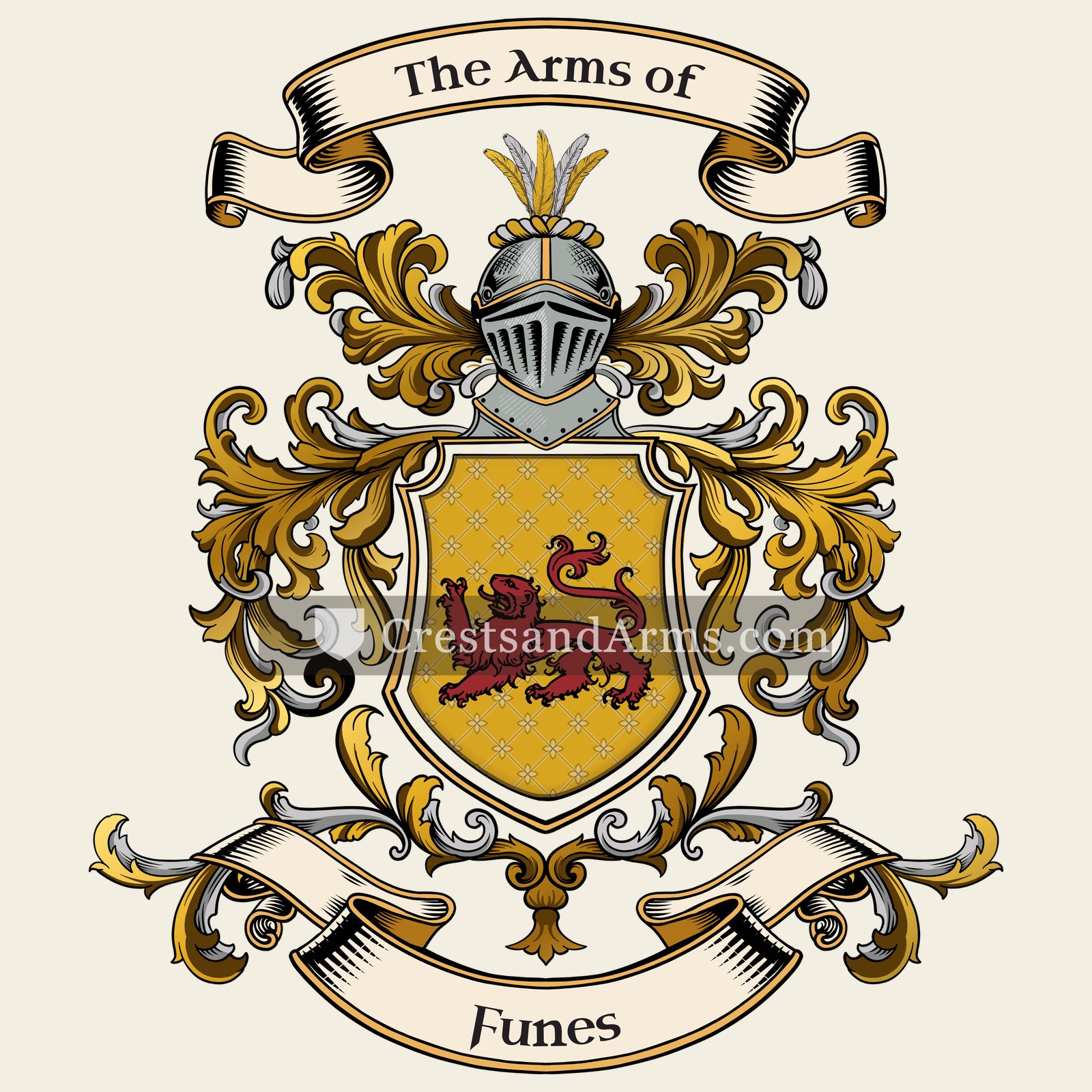
Symbols on this shield
saltireResolution, and St Andrew's cross
cantonA mark of honour granted by the sovereign
lionCourage, strength and royalty
Colours
Gold (Or)Means: Generosity
Red (Gules)Means: Military strength
Historical info
Source
J. B. Rietstap, Armorial Général, Gouda: G. B. van Goor Zonen, 1884–87
Blazon (the actual original written record)
“D'or au lion de gu., enlacé dans une corde en saut. d'azur, acc. de la D.: FUNES PECCATORUM APPREHENDERUNT ME, en lettres de sa., posée en orle, ladite corde passée dans quatre demi-annelets d'azur, mouv. des cantons de l'écu.”
AragonAragon, c. 1722
Where the Funes Arms Were Recorded
Aragon
Map of Spain showing where the Funes arms are recorded
The Funes arms were recorded in Aragon, c. 1722.
Aragon was mountain and river country in north-eastern Spain, with a strong tradition of small independent landholders. A great many families counted as gentry there, and each one needed a shield to be told apart.
This is where the arms were entered in the register. Families often moved to other parts of the country, so the same name can turn up in more than one region.
The body that granted and recorded arms in Spain in this period.
Philip V of Spain
Sovereign of the period
Philip V of Spain
1714–1724
Reigning in France when the Funes arms are first recorded.
How Arms Worked in Spain
In Spain, a coat of arms was considered a form of property that belonged to the entire family line. These arms were passed down from a father to all his children equally. Younger branches of the family usually kept the original design without needing to add any special marks to distinguish their specific line.
Granting authority
The Cronista Rey de Armas was the official body that regulated and granted coats of arms throughout Spain.
How they got arms
Families often obtained their arms through royal grants or by proving their noble status to the official heraldic authority.
Where arms were recorded
Coats of arms were officially recorded in the registers of the Cronista Rey de Armas starting in 1496.
The family's standing
Recorded among the armigerous families of Aragon.
Origin & History of the Funes Family in Spain
The surname Funes originates from the northern regions of Spain, specifically gaining prominence in the medieval Kingdom of Aragon and the surrounding areas of Navarre. The name is topographic in nature, meaning it was likely adopted by families who lived near or held land in the town of Funes, located in the modern-day province of Navarre. By the early 18th century, the family had firmly established roots within the social and administrative structures of Aragon. During this period, members of the Funes family were active participants in the local economy and community life, often appearing in regional census records and parish registers. Their presence in Aragon by 1722 reflects a history of settlement in the Ebro River valley, where families of this name played a role in the agricultural and civic development of the Spanish frontier.
Related Branches & Arms
Root word
funis
Latin word meaning a rope, cord, or cable.
This name
FunesA topographic or occupational name for a rope maker or someone living near a ropewalk.
also spelled
Fune
Funess
Funese
Documented Sources
J. B. Rietstap, Armorial Général, Gouda: G. B. van Goor Zonen, 1884–87
Archivo General de Navarra, Sección de Protocolos Notariales
Archives Départementales des Pyrénées-Atlantiques, Série E: Familles et seigneuries
Caro Baroja, Julio, Los vascos, 1971
Jimeno Jurío, José María, Toponimia navarra: Merindad de Olite, 1990
Digital archive packCoat of arms PNG, gold border print PDF, vector SVG and the certificate of authenticity. Sent to your email in minutes.


 ermineDignity and rank
 ermineDignity and rank

 saltireResolution, and St Andrew's cross
 cantonA mark of honour granted by the sovereign
 lionCourage, strength and royalty