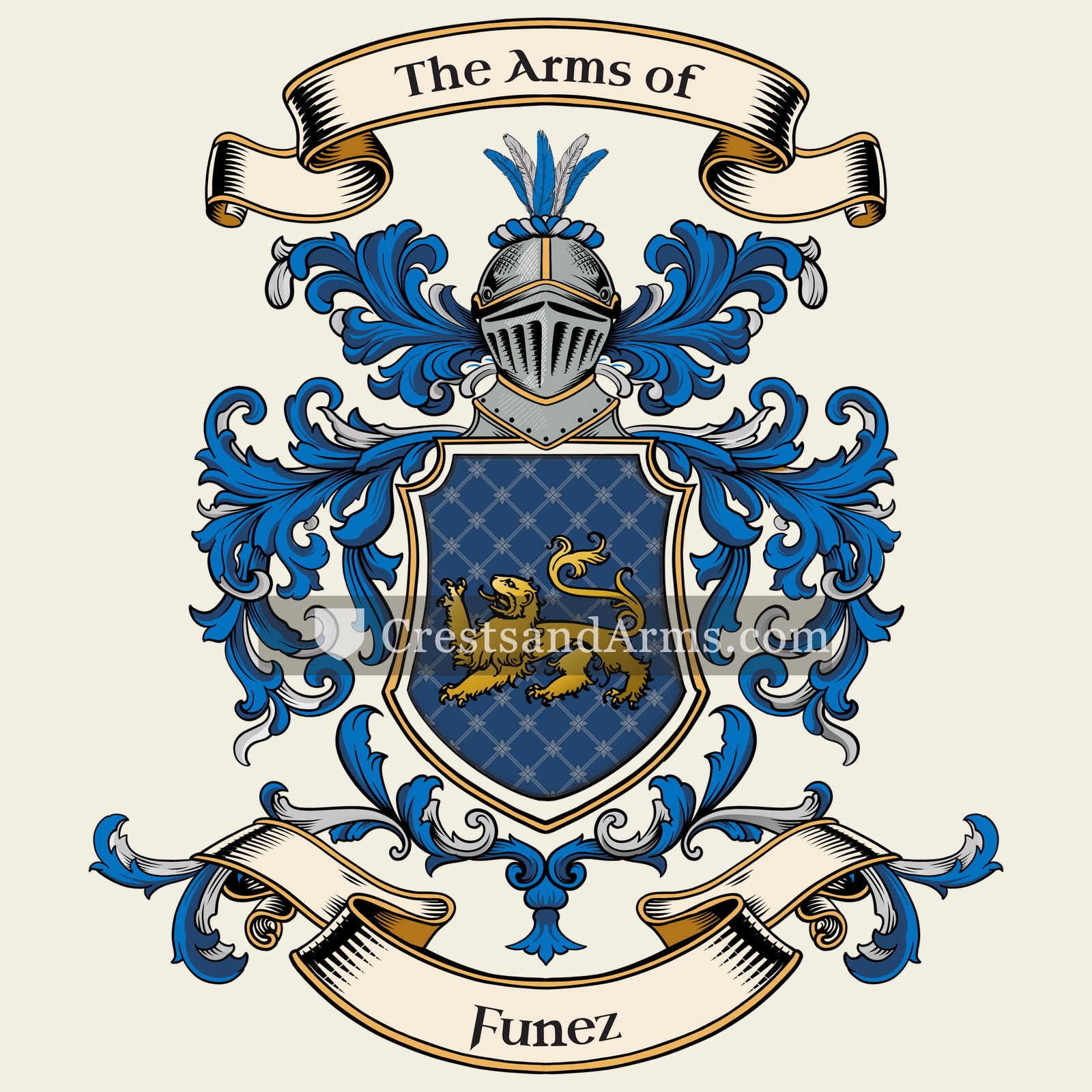
A record of documented arms, meaning and origin, researched for the Funez family of Germany.
Reg. 9517 · German, D–F
Coat of Arms & Family Crest Details
Symbols on this shield
lionCourage, strength and royalty
Colours
Blue (Azure)Means: Loyalty and truth
Gold (Or)Means: Generosity
Historical info
Source
J. B. Rietstap, Armorial Général, Gouda: G. B. van Goor Zonen, 1884–87
Blazon (the actual original written record)
“D'azur au lion d'or, tenant une épée flamboyante d'arg., garnie d'or. Cq. cour. C.: une étoile d'arg., posée au centre d'une couronne de myrthe; entre un vol, coupé alt. d'or et d'azur. L. d'or et d'azur. D.: SUSTINERE.”
SaxonySaxony, c. 1872
Digital archive packCoat of arms PNG, gold border print PDF, vector SVG and the certificate of authenticity. Sent to your email in minutes.
Map of Germany showing where the Funez arms are recorded
The Funez arms were recorded in Saxony, c. 1872.
Saxony had mines, trade and old landed families all at once. Silver made some fortunes and land held others, and both sorts of family kept arms, which is why Saxon names appear so often in the registers.
This is where the arms were entered in the register. Families often moved to other parts of the country, so the same name can turn up in more than one region.
The body that granted and recorded arms in Germany in this period.
Wilhelm I
Sovereign of the period
Wilhelm I
1861–1888
Reigning in Germany when the Funez arms are first recorded.
How Arms Worked in Germany
Prussian heraldry was strictly tied to social rank and noble status rather than being a free choice for every citizen. These symbols were treated as permanent family property that moved through the generations to all legitimate heirs. If a family branch wanted to change their design to stand out, they had to apply for official permission to alter their specific version of the shield.
Granting authority
The Prussian Heroldsamt acted as the central state office that managed and strictly controlled all noble titles and coats of arms.
How they got arms
Families usually obtained their arms through formal royal grants or by proving their long-standing noble status to the state authorities.
Where arms were recorded
All official coats of arms were kept in the rolls of the Prussian Heroldsamt, which functioned from 1706 until 1918.
The family's standing
Recorded among the armigerous families of Saxony.
Origin & History of the Funez Family in Germany
The family name Funez carries a history that reflects the movement and cultural shifts of nineteenth-century Europe. By 1872, records confirm that members of the family were established in the region of Saxony, which was then a kingdom within the newly formed German Empire. During this era, Saxony was a major industrial and intellectual hub, attracting many families who sought new opportunities in its growing cities and manufacturing centers. While the name itself has roots that often trace back to Spanish or Mediterranean origins, its presence in German records suggests a story of migration and integration. Families like the Funez line likely moved across borders to find work or stability, eventually embedding themselves into the local social fabric of the German states. This transition highlights how surnames often traveled alongside people as they sought better lives in changing political landscapes.
Related Branches & Arms
Root word
Funes
Derived from the Latin word funis meaning rope or cord.
This name
FunezA topographic or occupational surname referring to a rope maker or someone living near a ropewalk.
also spelled
Funk
Funkee
Funkes
Funka
Documented Sources
J. B. Rietstap, Armorial Général, Gouda: G. B. van Goor Zonen, 1884–87
Königliches Statistisches Bureau, Zeitschrift des Königlich Sächsischen Statistischen Bureaus, 1872
Sächsisches Staatsarchiv, Bestand 10001: Statistische Landesämter, 1872
Digital archive packCoat of arms PNG, gold border print PDF, vector SVG and the certificate of authenticity. Sent to your email in minutes.


 lionCourage, strength and royalty
 lionCourage, strength and royalty