A record of documented arms, meaning and origin, researched for the Fure family lines. Documented in 2 countries.
Reg. 4311 · Swiss, D–F
Coat of Arms & Family Crest Details
Symbols on this shield
crescentHonour by the sovereign, and the second son
mulletThe third son, and a divine quality from above
Colours
Blue (Azure)Means: Loyalty and truth
Gold (Or)Means: Generosity
Historical info
Source
J. B. Rietstap, Armorial Général, Gouda: G. B. van Goor Zonen, 1884–87
Blazon (the actual original written record)
“D'azur à un croiss. versé d'or, acc. de trois étoiles mal-ordonnées du même; en p. un tertre de sin. C.: un homme iss., hab. d'azur, coiffé d'un chapeau du même, tenant de sa main dextre une étoile d'or et de sa sen. un croiss. montant du même.”
SwitzerlandBerne, c. 1745
Digital archive packCoat of arms PNG, gold border print PDF, vector SVG and the certificate of authenticity. Sent to your email in minutes.
Map of Switzerland showing where the Fure arms are recorded
The Fure arms were recorded in Berne, c. 1745.
This is where the arms were entered in the register. Families often moved to other parts of the country, so the same name can turn up in more than one region.
The body that granted and recorded arms in Switzerland in this period.
How Arms Worked in Switzerland
In Switzerland, coats of arms were not restricted to the nobility and were often adopted by common citizens and families. These symbols were passed down through generations to show family identity. When branches of a family grew, they often changed small details of the design to distinguish their own line from the original group.
Granting authority
Cantonal and civic authorities managed the use of coats of arms within their specific regions and local jurisdictions.
How they got arms
Families typically assumed their own coats of arms based on local custom rather than receiving them from a central monarch.
Where arms were recorded
Arms were recorded in various cantonal and civic registers starting from the fourteenth century throughout the Swiss region.
The family's standing
Recorded among the armigerous families of Switzerland.
Origin & History of the Fure Family in Switzerland
The family name Fure has deep roots in the Swiss canton of Berne, where records confirm members of the family were established by 1745. During this period, the region was governed by a strict social structure where families were often tied to specific parishes and local trade guilds. The name likely originated as a descriptive term or a geographic identifier linked to the rugged landscape of the Swiss plateau. Families in this area were often involved in agriculture or skilled craftsmanship, contributing to the local economy of the Old Swiss Confederacy. As the family grew, they became part of the long-standing tradition of Swiss citizenship, which was historically tied to a person’s home commune. By maintaining their presence in Berne, the Fure family helped shape the local community through generations of steady work and civic participation within the Swiss cantonal system.
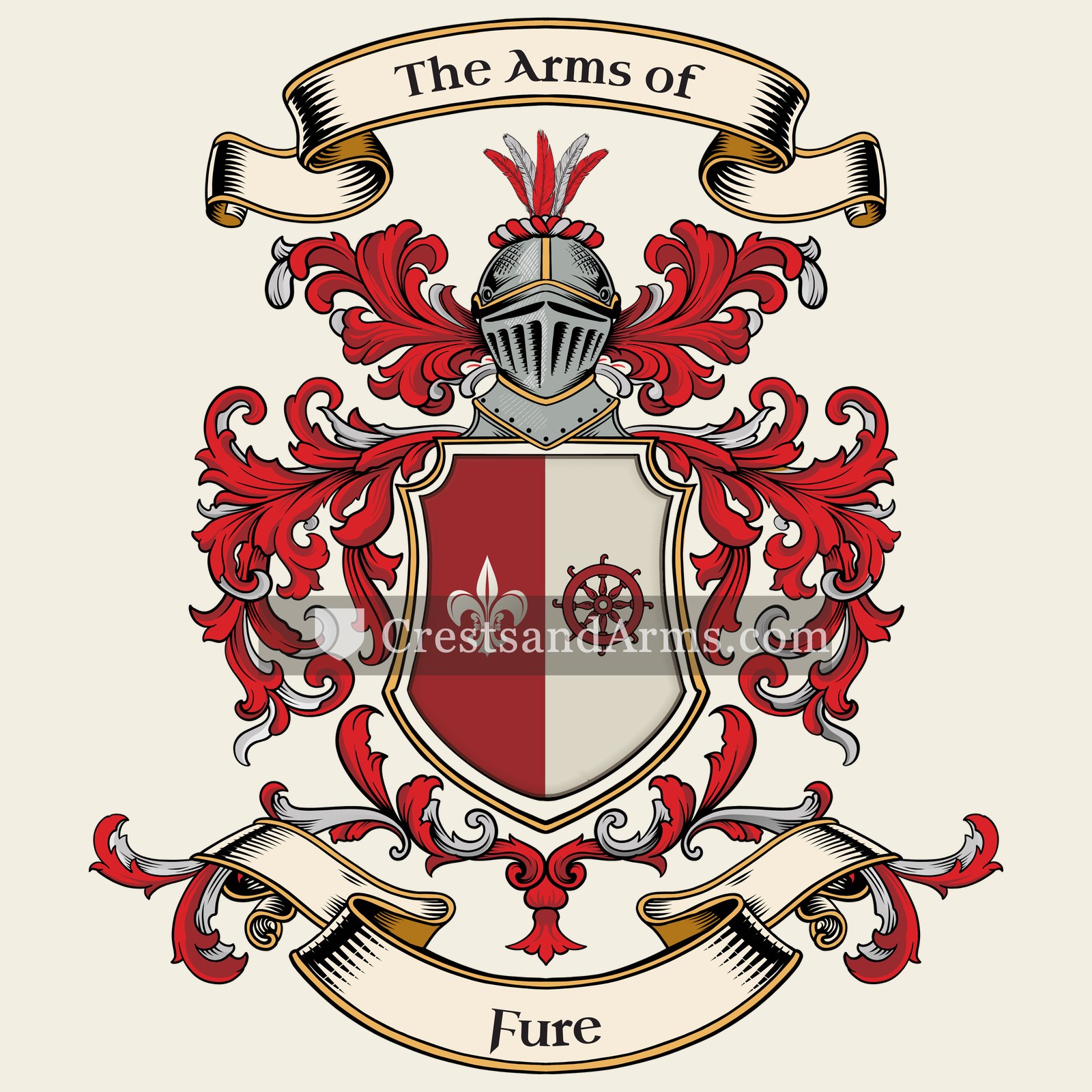
Coat of Arms & Family Crest Details
Symbols on this shield
fleur de lisPurity, light, and the sixth son
wheelFortune's turning, and the carter's trade
Colours
Red (Gules)Means: Military strength
Silver (Argent)Means: Peace and sincerity
Historical info
Source
J. B. Rietstap, Armorial Général, Gouda: G. B. van Goor Zonen, 1884–87
Blazon (the actual original written record)
“Parti: au 1 de gu. à une demi-fleur-de-lis d'arg., mouv. du parti: au 2 d'arg. à une demi-roue de gu., mouv. du parti. Cq. cour. C.: une tête et col d'aigle de sa., entre un vol aux armes de l'écu, les meubles sur l'aile dextre rangés en ordre inverse.”
Germanyc. 1599
Digital archive packCoat of arms PNG, gold border print PDF, vector SVG and the certificate of authenticity. Sent to your email in minutes.
Map of Germany showing where the Fure arms are recorded
The Fure arms were recorded in Germany, c. 1599.
Arms such as these were typically recorded in Bavaria.
Bavaria was a country of old landed families and walled market towns. Estates passed down the same line for centuries, and both the landowners and the leading townsmen kept arms, which is why so many Bavarian names sit in the registers.
This is where the arms were entered in the register. Families often moved to other parts of the country, so the same name can turn up in more than one region.
The body that granted and recorded arms in Germany in this period.
Emperor Rudolf II
Sovereign of the period
Emperor Rudolf II
1576–1612
Reigning in Switzerland when the Fure arms are first recorded.
How Arms Worked in Germany
In the Holy Roman Empire, coats of arms were often granted to individuals by the Emperor or his representatives. These arms were then passed down through the generations to all legitimate descendants of the original holder. Younger branches of a family usually kept the same shield design without needing to change it, as the arms belonged to the entire lineage.
Granting authority
The Holy Roman Emperor held the sole power to grant new coats of arms throughout his vast imperial territories.
How they got arms
Families typically obtained their coats of arms through a formal imperial grant or by proving their noble status to the authorities.
Where arms were recorded
These grants were officially recorded in the Imperial Chancery registers, which began keeping formal records of such honors during the Middle Ages.
The family's standing
Recorded among the armigerous families of Germany.
Origin & History of the Fure Family in Germany
The family name Fure traces its roots to the southern German region of Bavaria, where records confirm members of the family were established by the year 1599. During this period, Bavaria was a center of significant religious and political change, heavily influenced by the Counter-Reformation and the transition toward the Thirty Years' War. Families living in this area were often tied to the land or specialized trades, as the social structure of the late sixteenth century relied on local guilds and agricultural production. The name likely evolved from regional dialects common to the Alpine foothills, reflecting the distinct linguistic patterns of the Bavarian people. As the family settled into their community, they participated in the daily life of a region defined by its deep Catholic traditions and its role as a major crossroads for trade between northern Europe and Italy. By maintaining a presence in Bavaria at the turn of the seventeenth century, the Fure family became part of a long-standing history of rural and urban development in one of Germany’s most influential states.
Fure Meaning & Related Branches
Root word
Fur
Old High German term referring to a furrow or a ploughed field.
This name
FureA topographic name for someone who lived near a furrow or a cultivated strip of land.
also spelled
Furere
Furerr
Fure
Documented Sources
J. B. Rietstap, Armorial Général, Gouda: G. B. van Goor Zonen, 1884–87
Historisches Lexikon der Schweiz, Historisches Lexikon der Schweiz, 2002
Staatsarchiv des Kantons Bern, Kirchenbücher der Stadt Bern, 1745
Digital archive packCoat of arms PNG, gold border print PDF, vector SVG and the certificate of authenticity. Sent to your email in minutes.


 crescentHonour by the sovereign, and the second son
 mulletThe third son, and a divine quality from above
 crescentHonour by the sovereign, and the second son
 mulletThe third son, and a divine quality from above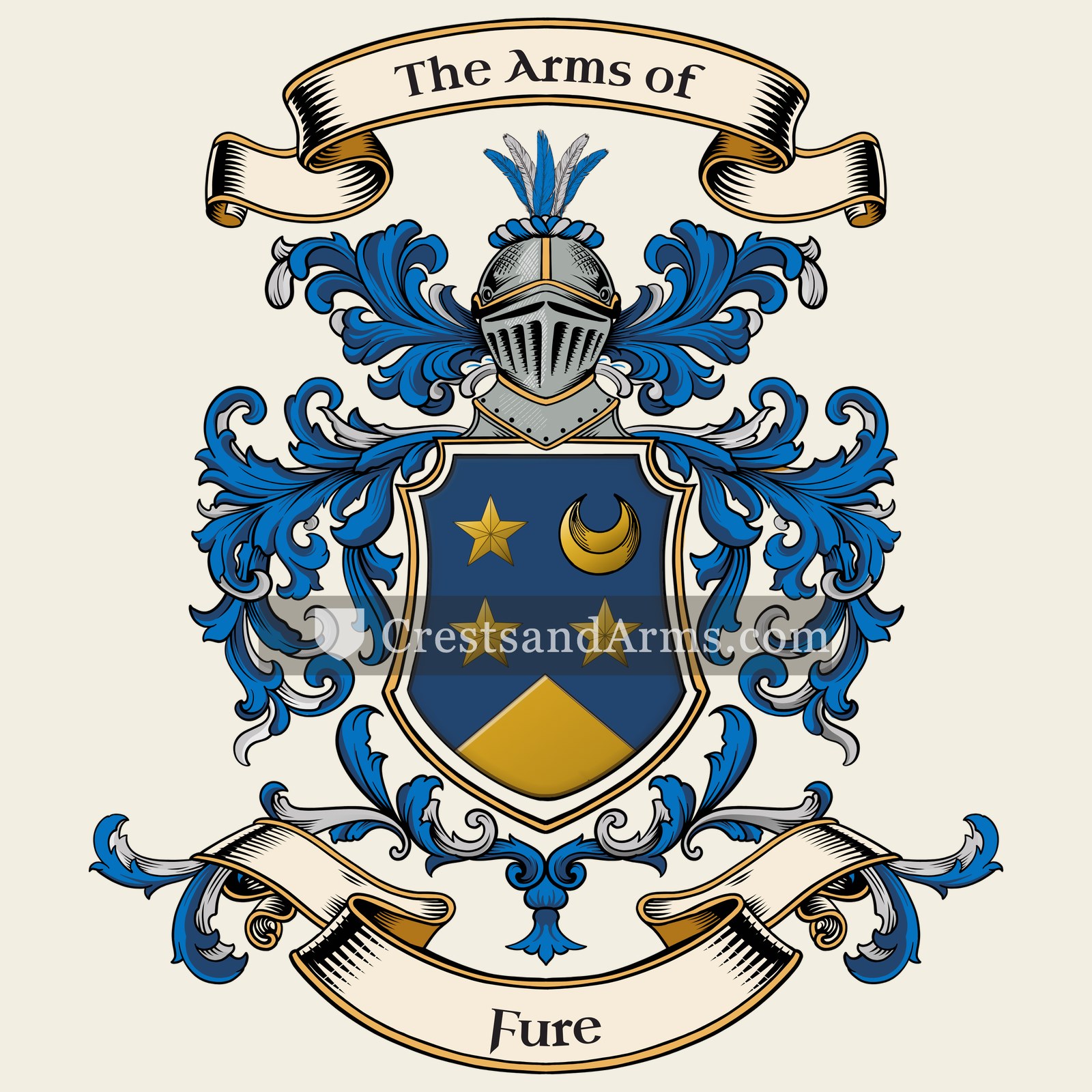

 fleur de lisPurity, light, and the sixth son
 wheelFortune's turning, and the carter's trade