A record of documented arms, meaning and origin, researched for the Fürstenberg family lines. Documented in 2 countries.
Reg. 2364 · Austrian, D–F
Coat of Arms & Family Crest Details
Symbols on this shield
bordureA difference between branches of one family
eagleNobility, strength and a keen mind
flag / pennantA command held, and a following kept
Colours
Gold (Or)Means: Generosity
Silver (Argent)Means: Peace and sincerity
Red (Gules)Means: Military strength
Historical info
Source
J. B. Rietstap, Armorial Général, Gouda: G. B. van Goor Zonen, 1884–87
Blazon (the actual original written record)
“D'or, à la bordure nébulée d'arg. sur azur; le champ ch. d'une aigle de gu., bq. et m. d'azur, ch. sur l'estomac d'un écusson éc.: aux 1 et 4 de gu. au gonfanon d'arg. (Werdenberg); aux 2 et 3 d'arg. à la bande vivrée de sa. (Heiligenberg). Cinq cq. d'or, cour. du même, excepté le troisième. C.: 1° un buste d'homme, hab. d'azur, au rabat d'arg., coiffé d'un bonnet albanais d'azur, retr. d'arg. (Stühlingen); 1. d'arg. et d'azur; 2° un mitre épiscopal de gu., bordé d'arg., orné d'or et de perles (Werdenberg); l. d'arg. et de gu.; 3° une boule d'arg., posée sur un coussin de gu., houppé d'or (Fürstenberg); l. d'arg. et de gu.; 4° une tête et col de chien braque d'arg., l'oreille ch. d'une bande vivrée de sa. (Heiligenberg); l. d'arg. et de sa.; 5° un cygne d'arg., cour. d'or, accosté de deux bâtons d'or, sommés chacun d'une plume de paon au nat. (Lupfen); l. d'arg. et d'azur. T.: deux anges. Manteau de gu., doublé d'herm. [Les landgraves de F. portent les mêmes armes, sans casques ni cimiers. Manteau de pourpre, frangé d'or, doublé d'herm., sommé de la couronne princière].”
WurttembergWurttemberg, c. 1772
Digital archive packCoat of arms PNG, gold border print PDF, vector SVG and the certificate of authenticity. Sent to your email in minutes.
Map of Austria showing where the Fürstenberg arms are recorded
The Fürstenberg arms were recorded in Wurttemberg, c. 1772.
Wurttemberg was southern German country of small estates and well-off market towns. Both landowners and leading townsmen kept arms there, so the region carries far more names than its size suggests.
This is where the arms were entered in the register. Families often moved to other parts of the country, so the same name can turn up in more than one region.
Region
Wurttemberg
First recorded
1772
Granting Authority for the Fürstenberg Arms
Imperial and Royal chancery
Sodacan · CC BY-SA 3.0
The body that granted and recorded arms in Austria in this period.
Joseph II, Holy Roman Emperor
Sovereign of the period
Joseph II, Holy Roman Emperor
1765–1790
Reigning in Austria when the Fürstenberg arms are first recorded.
How Arms Worked in Austria
Austrian coats of arms were often linked directly to noble titles granted by the Emperor. These symbols belonged to the entire family line rather than just one individual. When a family grew, new branches kept the original design without needing to change it. This system allowed all members of a noble house to share the same identity across many generations.
Granting authority
The Imperial and Royal chancery managed all heraldic matters and controlled the official granting of arms throughout the Austrian lands.
How they got arms
Families typically received their arms through a formal imperial decree that often accompanied the elevation of a person to noble status.
Where arms were recorded
Official records of these grants were kept in the Imperial Register of Nobility which began its formal documentation process in 1453.
The family's standing
Recorded among the armigerous families of Wurttemberg.
Origin & History of the Fürstenberg Family in Austria
The family name Fürstenberg traces its roots to the region of Swabia, where early members were established in Württemberg by 1772. The name itself is derived from the German words for prince and mountain, suggesting that the family likely originated near a prominent hill or a fortified site associated with local nobility. As the family moved across German-speaking lands, they became part of the administrative and social fabric of the Holy Roman Empire. By the time branches of the family settled in Austria, they were often involved in the professional and bureaucratic life of the Habsburg territories. These early generations focused on building influence through land management and service to the crown, which allowed them to integrate into the Austrian social hierarchy during a period of significant political change.
Coat of Arms & Family Crest Details
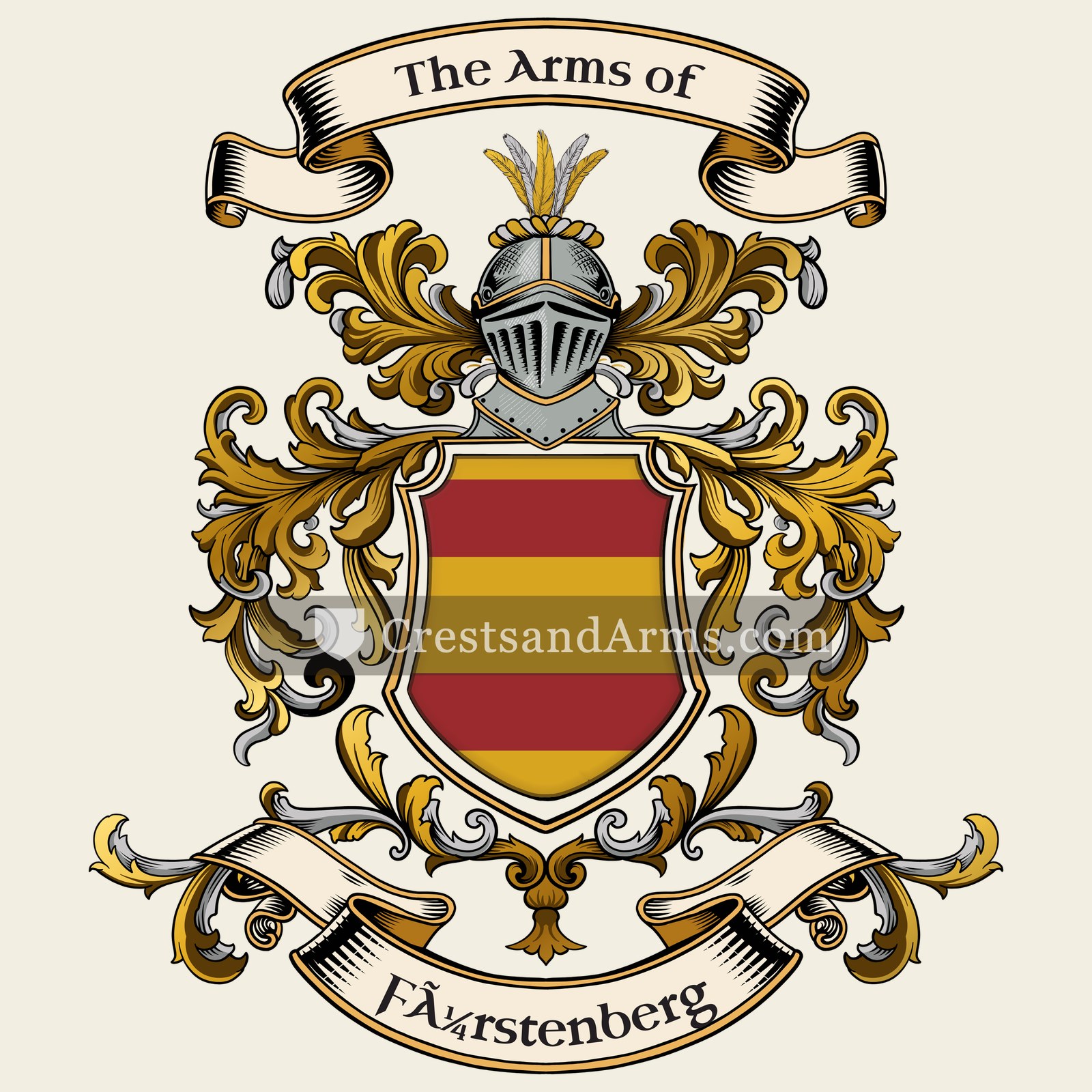
Symbols on this shield
fessThe military belt, and readiness to serve
Colours
Gold (Or)Means: Generosity
Red (Gules)Means: Military strength
Historical info
Source
J. B. Rietstap, Armorial Général, Gouda: G. B. van Goor Zonen, 1884–87
Blazon (the actual original written record)
“D'or à deux fasces de gu. Cq. cour. C.: deux plumes de faisan aux armes de l'écu.”
CourlandCourland, c. 1663
Digital archive packCoat of arms PNG, gold border print PDF, vector SVG and the certificate of authenticity. Sent to your email in minutes.
Map of France showing where the Fürstenberg arms are recorded
The Fürstenberg arms were recorded in Courland, c. 1663.
Courland was Baltic coast country held in large estates by a small number of families. They kept their land for generations and served as officers abroad, and both landholding and service brought arms with them.
This is where the arms were entered in the register. Families often moved to other parts of the country, so the same name can turn up in more than one region.
The body that granted and recorded arms in France in this period.
Louis XIV of France
Sovereign of the period
Louis XIV of France
1643–1715
Reigning in Austria when the Fürstenberg arms are first recorded.
How Arms Worked in France
In France, a coat of arms was a mark of honor that passed down through the male line to all legitimate descendants. Families often used the same shield without changes to show their shared heritage. If a branch wanted to stand out, they could add a small mark to their shield to show their specific place in the family tree.
Granting authority
The Juge d'armes de France acted as the official authority that regulated and verified coats of arms across the country.
How they got arms
Families typically inherited their arms from ancestors, though they could also receive them through royal grants or by proving their noble status.
Where arms were recorded
Coats of arms were officially recorded in the Armorial Général de France, which began its main collection in the year 1696.
The family's standing
Recorded among the armigerous families of Courland.
Origin & History of the Fürstenberg Family in France
The family name Fürstenberg carries a history that stretches across European borders, connecting the Baltic region to the political landscape of France. While the family established a notable presence in Courland by 1663, their influence eventually reached French territories through military service and diplomatic ties. During the seventeenth and eighteenth centuries, members of the family often sought positions within the French royal court or served as officers in the king’s armies. This movement was common for noble families of the era who looked to France as the center of European power and culture. By integrating into French society, these individuals helped bridge the gap between their ancestral lands in the east and the sophisticated political circles of Versailles. Their transition into France highlights how families of that time navigated shifting borders to maintain their status and influence across the continent.
Fürstenberg Meaning & Related Branches
Root word
Fürst and Berg
Prince or ruler and mountain or hill.
This name
FürstenbergRefers to a person living on or near a mountain associated with a prince.
also spelled
Furstenberk
Fuerstenberg
Furstenburg
Related arms
van Wittenhorstsimilar arms
Documented Sources
J. B. Rietstap, Armorial Général, Gouda: G. B. van Goor Zonen, 1884–87
Bader, Karl S., Der deutsche Südwesten in seiner territorialstaatlichen Entwicklung, 1950
Müller, Helmut, Die Fürstenberger in Schwaben und Österreich, 1985
Hauptstaatsarchiv Stuttgart, Bestand A 602 (Fürstenbergisches Archiv)
Österreichisches Staatsarchiv, Adelsarchiv
Digital archive packCoat of arms PNG, gold border print PDF, vector SVG and the certificate of authenticity. Sent to your email in minutes.


 bordureA difference between branches of one family
 eagleNobility, strength and a keen mind
 flag / pennantA command held, and a following kept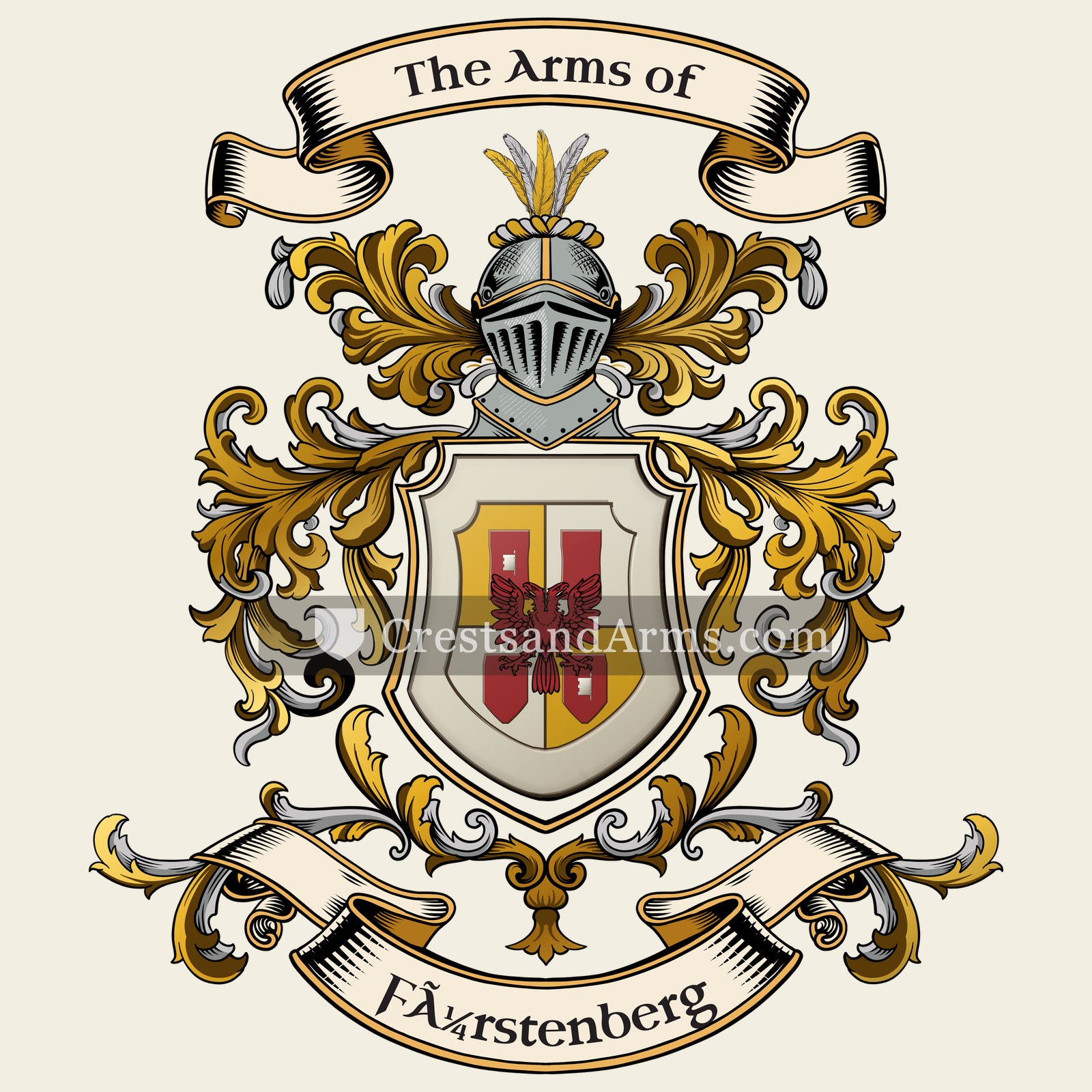


 fessThe military belt, and readiness to serve