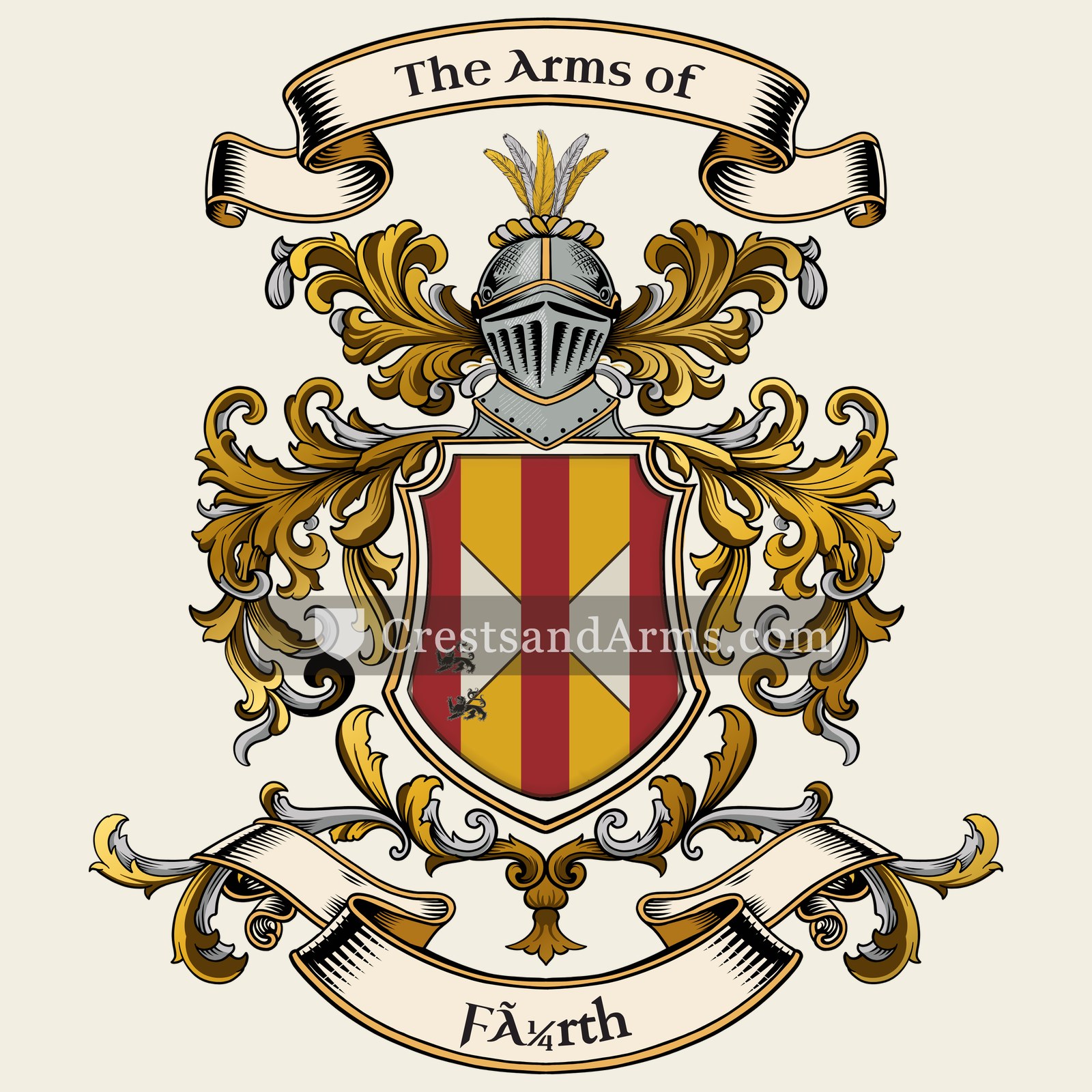
A record of documented arms, meaning and origin, researched for the Fürth family of France.
Reg. 9224 · French, D–F
Coat of Arms & Family Crest Details
Symbols on this shield
saltireResolution, and St Andrew's cross
paleMilitary strength, and a fortified defence
lionCourage, strength and royalty
Colours
Silver (Argent)Means: Peace and sincerity
Gold (Or)Means: Generosity
Red (Gules)Means: Military strength
Black (Sable)Means: Constancy
Historical info
Source
J. B. Rietstap, Armorial Général, Gouda: G. B. van Goor Zonen, 1884–87
Blazon (the actual original written record)
“Ec. en saut.: aux 1 et 4 d'arg. à trois pals de gu.; aux 2 et 3 d'or à une tête de léopard de sa., lamp. de gu. Cq. cour. C.: un lion iss. de sa., lamp. de gu., cour. d'or, posé de front; entre un vol coupé, à dextre de sa. sur or, à sen. de gu. sur arg. L.: à dextre d'or et de sa., à sen. d'arg. et de gu. [V. Brewer dit Fürth.]”
FranceAix-la-Chapelle, c. 1593
Where the Fürth Arms Were Recorded
Aix-la-Chapelle
Map of France showing where the Fürth arms are recorded
The Fürth arms were recorded in Aix-la-Chapelle, c. 1593.
This is where the arms were entered in the register. Families often moved to other parts of the country, so the same name can turn up in more than one region.
The body that granted and recorded arms in France in this period.
Henry IV of France
Sovereign of the period
Henry IV of France
1589–1610
Reigning in France when the Fürth arms are first recorded.
How Arms Worked in France
In France, a coat of arms was a mark of honor that passed down through the male line to all legitimate descendants. Families often used the same shield without changes to show their shared heritage. If a branch wanted to stand out, they could add a small mark to their shield to show their specific place in the family tree.
Granting authority
The Juge d'armes de France acted as the official authority that regulated and verified coats of arms across the country.
How they got arms
Families typically inherited their arms from ancestors, though they could also receive them through royal grants or by proving their noble status.
Where arms were recorded
Coats of arms were officially recorded in the Armorial Général de France, which began its main collection in the year 1696.
The family's standing
Recorded among the armigerous families of France.
Origin & History of the Fürth Family in France
The family name Fürth is a locative surname, meaning it was originally derived from the geographic location where the family resided. Historical records confirm that members of the family were established in the city of Aix-la-Chapelle, known in German as Aachen, by the year 1593. During this period, the name served as a way to identify individuals who had either traveled from or lived near a ford, which is the literal meaning of the word Fürth in the German language. Because Aachen was a major center for trade and politics in the Holy Roman Empire, families living there often held positions in local guilds or civic administration. As the family grew, their presence in this influential city helped solidify the name as a distinct identifier that traveled with them as they moved to other regions of Europe over the following centuries.
Related Branches & Arms
Root word
Furt
A shallow place in a river that can be crossed by wading.
This name
FürthRefers to a person who lived near or worked at a river crossing.
also spelled
Furt
Fuert
Related arms
Deutgenrecorded with Fürth, same area
Indenrecorded with Fürth, same area
Olivarecorded with Fürth, same area
Schincksrecorded with Fürth, same area
Documented Sources
J. B. Rietstap, Armorial Général, Gouda: G. B. van Goor Zonen, 1884–87
Stadtarchiv Aachen, Bürgeraufnahmen und Zunftrollen (1550–1650)
Bahlow, Hans, Deutsches Namenlexikon: Familien- und Vornamen nach Ursprung und Sinn erklärt, 1967
Brepohl, Wilhelm, Aachener Geschichtsquellen: Die Einwohner der Stadt Aachen im 16. und 17. Jahrhundert, 1954
Digital archive packCoat of arms PNG, gold border print PDF, vector SVG and the certificate of authenticity. Sent to your email in minutes.


 saltireResolution, and St Andrew's cross
 paleMilitary strength, and a fortified defence
 lionCourage, strength and royalty
 saltireResolution, and St Andrew's cross
 paleMilitary strength, and a fortified defence
 lionCourage, strength and royalty